
REVIEW: Guilt sends Diane Flacks on an odyssey of culpability
If you could sum up your life in a feeling, which would you choose?
For me (and my tendency towards sentimentalism), it would probably be nostalgia. Others might pick love, or ambition, or despair.
For actor and theatre creator Diane Flacks, that feeling is guilt. Thorny, inescapable, shape-shifting guilt.
Flacks attributes this thread of her life to a few sources — to her status as a relatively well-off white woman in Toronto, perhaps, or to her Jewish heritage. Guilt isn’t just a feeling to her: it’s both a companion and adversary as she navigates her life, making choices that in the end will either amplify or quell the relentless culpability sitting on her shoulders at all times.
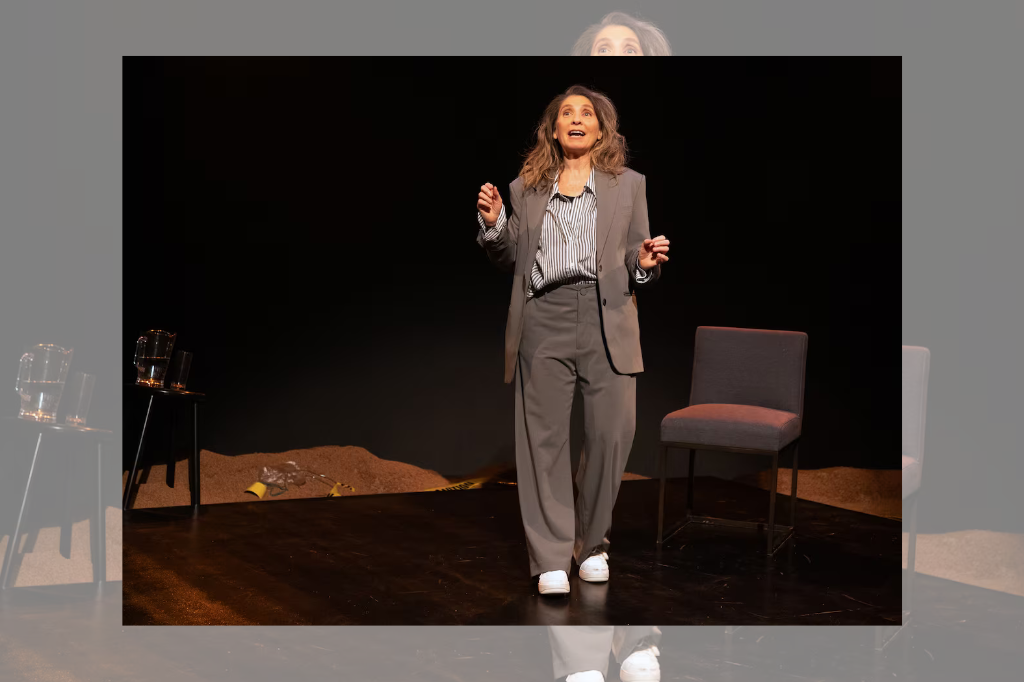
In Guilt, Flacks’ solo show in its Toronto premiere at Tarragon Theatre, we follow Flacks on a series of becomings, watching her evolve into a mother, and eventually, a divorcée. That second one in particular seems to stir up the strongest feelings of regret and heaviness — her divorce is the painful ending to a story of falling out of love, a breakup tangled with infidelity and parenthood. Flacks doesn’t cut herself any slack in her recounting of what happened — while, no, it’s not all her fault, she tells us, it’s not not her fault either — and the result is a 70-minute play drenched in honesty, pain, and even humour.
There’s lots of great stuff going on in Guilt: director Alisa Palmer has injected smart movement sequences into the text, keeping the play from becoming too physically stagnant in its more narrative segments. As well, there’s an interesting, sandy set by designer Junge-Hye Kim, making literal the all-inclusive beach vacations of Flacks’ memories. Embedded in the sand are talismans of Flacks’ guilt, including airplane oxygen masks and a gelatinous brain, as well as a simple chair that provides Flacks with a small jungle gym as she excavates her adult life for sediments of guilt.
Ultimately, the play could likely be cut to an hour — there are occasional swathes of writing that dip into Freudian psychology and surface-level role-playing, and these segments left me yearning for Flacks’ more personal, accessible writing, rooted in her life as a Toronto mom. Much of the play is lovely and evocative (I’m thinking specifically of a moment in which Flacks recalls her son’s earliest days in the NICU).
As well, Flacks has an odd tendency to lean into TikTok humour — already-dated viral songs and dances make frequent appearances as she paints the complex picture of her guilt — and I found these sequences ultimately distracting, and more in the realm of non-sequitur than artistic choice. The kernel of Guilt is a strong enough solo show that these additions feel extraneous, without contributing much to the play’s dramaturgical thesis or aesthetic.
All in, I quite enjoyed Guilt, and I imagine the story Flacks has to tell will resonate with anyone who’s experienced divorce, as either a spouse or a child. With further honing, Flacks will have a gem of a solo show on her hands, but for now, that perfect iteration of the play lies just beneath the sand, ready to be dug out if afforded additional polishing.
Guilt runs at Tarragon Theatre until March 3. Tickets are available here.
Intermission reviews are independent and unrelated to Intermission’s partnered content. Learn more about Intermission’s partnership model here.

Aisling Murphy
Aisling is Intermission's former senior editor and the theatre reporter for the Globe and Mail. She likes British playwright Sarah Kane, most songs by Taylor Swift, and her cats, Fig and June. She was a 2024 fellow at the National Critics Institute in Waterford, CT.
LEARN MORE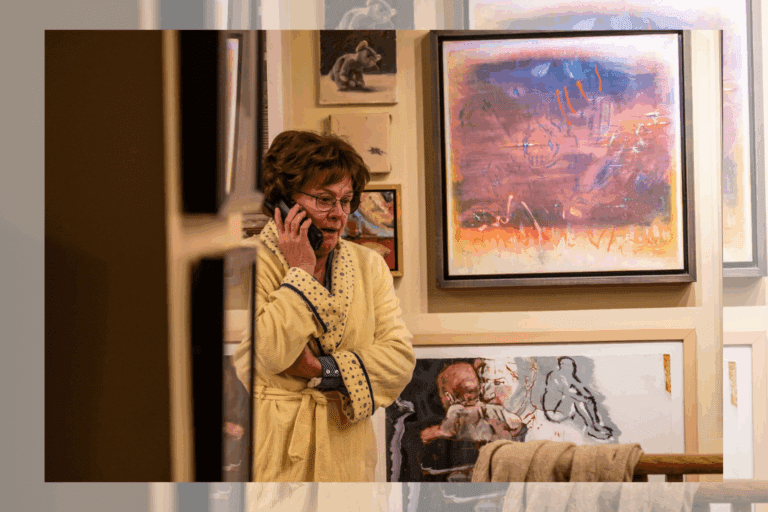 iPhoto caption: Jane Spidell in 'Twelve Dinners.' Photo by Dahlia Katz.
REVIEW: Family tensions run high in TIFT’s intimate Twelve Dinners
In the now-closed Twelve Dinners, an autobiographical play written and directed by Steve Ross, audiences received intimate access to an unvarnished version of a younger Ross through 12 evening meals with his parents.
 iPhoto caption: Members of the company of 'Narnia.' Photo by Dahlia Katz.
REVIEW: Bad Hats’ Narnia is a joyful, heartwarming escape
The spirit of openness and the joy of discovery rule over this Narnia. Open the wardrobe and see.
 iPhoto caption: Members of the company of 'Robin Hood.' Photo by Dahlia Katz.
REVIEW: Canadian Stage’s Robin Hood panto is anti-capitalist fun for the whole family
Following Ross Petty’s legacy of scene-stealing, Damien Atkins as the evil Prince John is easily the greatest delight of the show.
 iPhoto caption: Lauren Gillis and Alaine Hutton in 'Public Consumption.' Photo by Eden Graham.
REVIEW: Lester Trips’ stylish Public Consumption captures the internet’s profound emptiness
Rather than directly representing online life, Public Consumption speculates — with virtuosity — about how the digital world affects our bodies. And the show's findings are by no means comfortable.
 iPhoto caption: Tony Ofori and Daren A. Herbert in 'Moonlight Schooner.' Photo by Dahlia Katz.
Kanika Ambrose’s Moonlight Schooner is animated and visually stunning, but its individual pieces don’t come together as neatly as I would've expected.
 iPhoto caption: Fiona Mongillo in 'Reproduktion.' Photo by Ann Baggley.
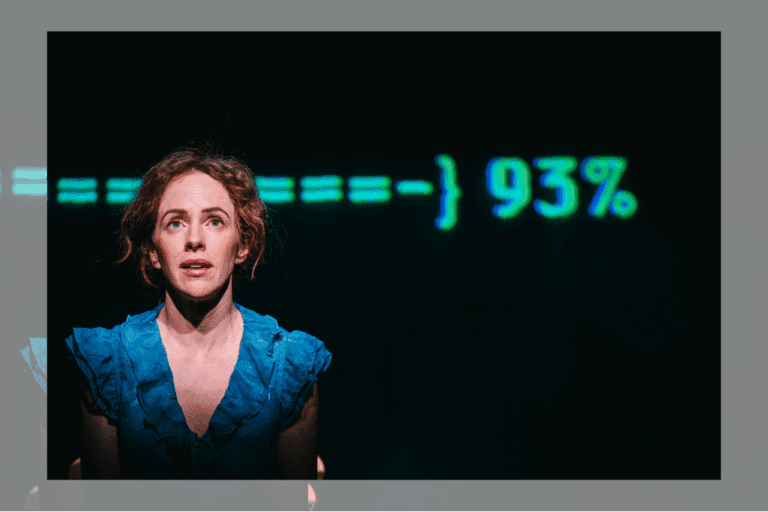
REVIEW: Here For Now’s well-acted Reproduktion attempts to tackle too much
Amy Rutherford’s world premiere script is ambitious and the material it covers is complex — but the narrative feels disjointed.
 iPhoto caption: Photo by Aisling Murphy.
In the darkest months of Yukon winter, it’s all about the Sun Room
I’m here for a week in January as a guest of Nakai Theatre, a hub for theatrical experimentation and outside-the-box programming in Canada’s westernmost territory.

Armchairs, tattoos, and an online theatre magazine
When I started at Intermission, my world was limited to the confines of an armchair. Arts journalism was a high it felt dangerously fruitless to chase. The life stretched ahead of me was amorphous and frightening, a chasm filled with hand sanitizer and immigration concerns. It was worth crying over a spilled kombucha and scrubbing at the stain.
 iPhoto caption: Liz Appel headshot courtesy of Liz Appel.
Five questions with Wights playwright Liz Appel
Intermission spoke with Appel over email for a brief Q&A about Wights, now playing at Crow’s Theatre until February 9.

Call for applications: Publishing and editorial assistant
Intermission Magazine is seeking a dynamic and collaborative individual to join our team.
 iPhoto caption: What Writing Can Do: The 2025 Musical Theatre Critics Lab
Announcing What Writing Can Do: The 2025 Musical Theatre Critics Lab
What Writing Can Do is timed to coincide with the Grand and Theatre Aquarius’ co-production of Waitress, which will serve as a jumping-off point for discussions throughout the Lab.
 iPhoto caption: A Christmas Story production still by Dahlia Katz.
REVIEW: A Christmas Story feels fresh at Theatre Aquarius
If you want to catch A Christmas Story before it closes, good luck — the show is close to sold out, and with the talent on that stage, it’s not hard to see why.
Comments