
Supporting Actors Need Love Too
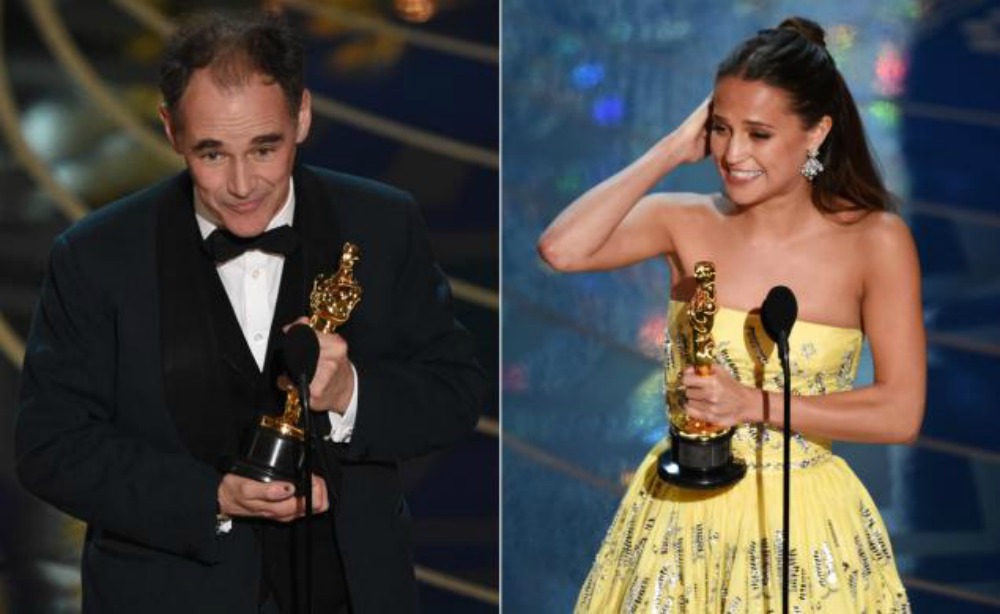 iPhoto caption: Academy Award-winning supporting actors Mark Rylance and Alicia Vikander
The Dora Awards provoke all kinds of arguments within the theatre community. I’ve been involved in many. Aside from agents, unemployment, arts councils, casting decisions, politics, housing prices, and the TTC, the Doras are probably the thing Toronto theatre artists complain about the most. (We love complaining.) Some people even believe that theatre awards shouldn’t exist at all, like playwright Daniel MacIvor, who argued the case recently for the SpiderWebShow. At the very least, everyone has their own opinion on how the Awards could be improved.
For the record, I’m a big fan of the Awards. I think it’s important to have an evening to celebrate the incredible theatre that happens in Toronto. And I think TAPA does a wonderful job executing the show every year.
But… and it’s a big BUT… for the love of the God I don’t believe in, can we please bring back the supporting acting awards!!!!!
Is this not something we can all agree on?
As far as I know (and I did semi-extensive research), the Doras are the only major theatre or film awards that do not give out supporting acting awards. In Canada alone, the Jessies, Sterlings, Bettys, Merritts, and METAs all have them. Hell, even the Toronto critics give out supporting acting awards at the TTCAs, and we know they usually never get anything right.
How did it even come to this?
As far as I can tell—and someone can correct me if I’m wrong—the story goes something like this: Once upon a time the Dora Awards gave out both a male and female supporting actor award. They called them “featured” performances and not supporting, but they were essentially the same thing. As the awards grew and more categories were added, they decided to condense the featured category into one. It was for only one performance, open to both men and women, in both general and musical theatre. Things were going along in this manner for a while until it was decided that ensembles could also be nominated in this category. This Frankenstein category of Outstanding Performance in a Featured Role/Ensemble produced some very odd competitions, like this one in 2010:
- The Ensemble of Oh What a Lovely War (Soulpepper)
- The Ensemble of Second City for Mayor (The Second City)
- Maurice Dean Wint, Courageous (Tarragon Theatre, in co-production with Citadel Theatre)
- Eric Peterson, Hamlet (Necessary Angel, presented by Harbourfront Centre’s World Stage)
- Eric Peterson, Of the Fields, Lately (Soulpepper)
There are so many strange things to point out about this. (The obvious being the travesty that Eric Peterson was nominated for these performances and not the ones he gave in Festen or The Test, but I digress.) I admit choosing one performance over another is the most subjective of things in any scenario, but honestly, how the jury could begin to compare Maurice’s individual work to a whole sketch comedy troupe is beyond me. Thankfully, it became obvious that this category wasn’t the greatest idea in theatre-award history, and the organizers went about remedying it.
But this is where I think the decision-makers got it very wrong. Instead of reverting back to two featured performance categories and removing the ensembles from the equation, they did the reverse. They removed any feature performance from being celebrated and instead opted to create an ensemble-only category.
In theory, I’m all for the idea that an ensemble of actors rely so heavily on each other that it’s impossible to celebrate one without the rest. I don’t think any great acting happens in a vacuum. But for the sake of an awards show, I think individual performances should be celebrated. It’s nice that a select few performers get some time in the spotlight. The ensemble award doesn’t allow for this in the same way. I’m fairly certain I was once nominated as part of an ensemble. I couldn’t tell you with certainty and I definitely couldn’t tell you if we won or lost. I think we lost.

Michael Simpson in Soulpepper’s 2004 production of Translations (photo by Sandy Nicholson)
Here’s what I do remember: At the Dora Awards was in 2005, Michael Simpson won for Featured Performer for his role in Soulpepper’s production of Brian Friel’s Translations. I was in that production. I was there in rehearsal to witness Michael’s extraordinary work. It was a heartbreakingly vulnerable performance. It wasn’t a large role but it was integral to the production, and Michael’s unwavering embodiment of the character set the tone for rehearsal every day. That cast was filled with extraordinary performers, including Diego Matamoros, David Storch, Trish Fagan, Liisa Repo-Martell, and Gord Rand. In today’s categories, it could have easily have been nominated for Outstanding Ensemble, but I am so glad that it wasn’t. It was way more meaningful to get to witness the spotlight specifically shine on Michael, an extraordinary and somewhat underappreciated actor. And when he accepted the award, I felt more pride than if our entire ensemble had been nominated.
In both theatre and film, the supporting roles are often the most memorable. I can think of countless examples of supporting performances that ranked among my favourites of the year. There are an abundance of extraordinary ones in Toronto theatre every year. They deserve to be celebrated.
Philip Riccio
Philip is co-artistic director of The Company Theatre. He's mostly an actor, director, and producer, but once in a while he's also a curmudgeonly but loveable softball coach leading a ragtag group of adult misfits to rec-league mediocrity.
LEARN MORE
Seven years. That’s how old this little online magazine is. That might not seem like much in the grand scheme of things but we sure have packed in a whole...
 Jeff Eaton / CC BY-SA 2.0" data-tippy-arrow="false" tabindex="0">iPhoto caption: Ink Stained Wretches. Photo by Jeff Eaton / CC BY-SA 2.0
Our reasoning for not bringing on a theatre critic back when we launched doesn’t make sense anymore.
 iPhoto caption: In the Round: On Criticism. Photo by Dahlia Katz
In the Round: On Criticism with Carly Maga, Steve Fisher, and Lynn Slotkin
Three Toronto theatre reviewers joined us for a round table conversation about the state of criticism in the city.
Comments