
Review: Beauty and the Beast
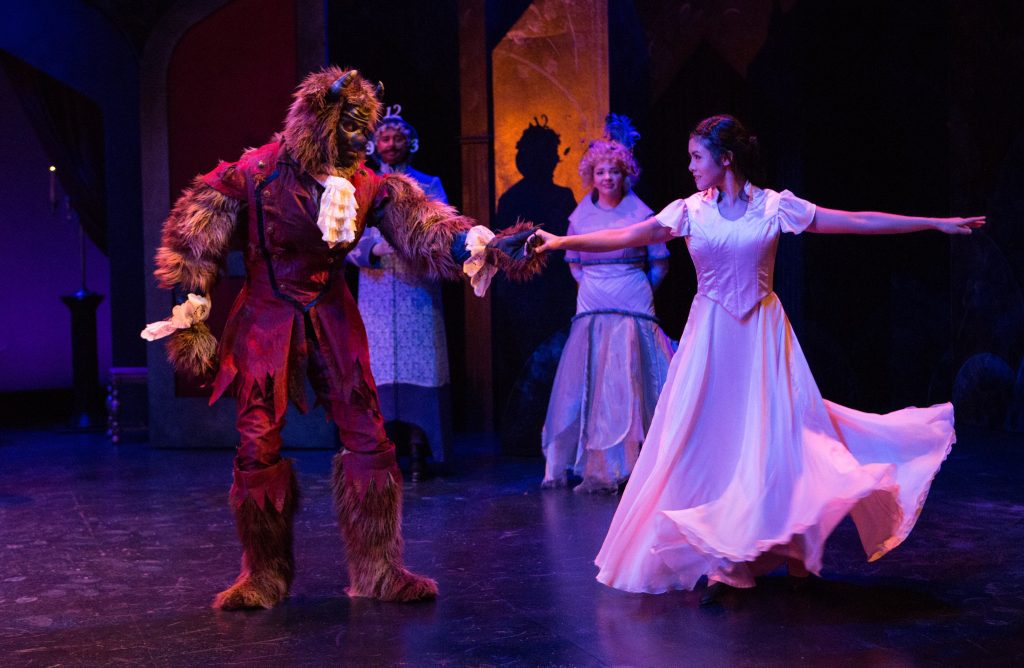 iPhoto caption: Beauty and the Beast. Photo by Cylla von Tiedemann
Beauty and the Beast
Young People’s Theatre
Book by Linda Woolverton, music by Alan Menken, lyrics by Howard Ashman and Tim Rice. Directed by Allen MacInnis At Young People’s Theatre. Runs until December 31.
It’s fascinating how art imitates life in Beauty and the Beast, what with the explosive headlines about sexual assault and impropriety of the last few months, and how bad and ugly behaviour seems to go unchallenged or be accepted if the perpetrator is a person with power.
Before all of this hit the media, the Disney musical could have been seen as a story about how love conquers all, ills and misfortunes alike. Not anymore. Since the news broke about Harvey Weinstein, Kevin Spacey, Louis C.K., and others, Beauty and the Beast takes a different shape. Now it’s a parable of ugly behaviour, misogyny, bullying, and willful ignorance.
In this Disney classic, a young prince (Stewart Adam McKensy) has a curse put on him because of his rude, selfish, arrogant behaviour, turning him into a hairy beast. To lift the curse he has to fall in love with someone and that person has to, in turn, fall in love with him. This turns out to be Belle (Celine Tsai), a confident, feisty, bookish young woman.
Belle is initially startled by the Beast’s appearance, but it’s his horrible behaviour—demanding she eat dinner with him, losing his temper quickly, being a bully—that repels her. Belle, who always treats the Beast with consideration, does not condone his actions, and gradually the Beast’s anger and arrogance dissolve. These two proud people give over to forgiveness and, ultimately, love.
Throughout the production, lines are blurred between what is considered beautiful and handsome and what is ugly and beast-like. The Beast, with fang-like teeth and exaggerated facial features, is considered repulsive, while Gaston (Aaron Ferguson), the village macho man who wants to marry Belle, is swaggeringly good-looking with a head of long hair, which he flicks for effect. He sings with pride: “As you can see I’ve got biceps to spare… and ev’ry last inch of me is covered with hair.” In Gaston’s world masculinity means full body hair.
The musical features two characters who displayed ugly behaviour. One was the prince, who was cursed for his actions and eventually saw the error of his ways thanks to Belle and his servants. The other was Gaston, who got away with everything he did because he was handsome and charming, which granted him currency in that village, and I guess in our world, too. His behaviour was threatening, and he didn’t think anything of it. It takes Belle to clearly point out that it’s not appearance that makes a beast, but bad behaviour.
Designer Sue LePage’s set of the Beast’s castle is large, dark, and imposing, establishing the gloom and forbidding nature of his world. There are wolves in the dark forest whose eyes glow red, a frightening image to be sure. Joanna Yu’s costumes are witty and clever.
The production under director Allen MacInnis’s smooth staging moves seamlessly from scene to scene. The cast is strong, with standout performances by McKensy as the Beast and Tsai as Belle.
Beauty and the Beast might have the Disney feel-good branding on it, but recent headlines give the show a much darker reality. That said, this production works a treat in our new reality. It is engaging on so many levels and makes us look at the story in a deeper way, not just as a redemptive love story.
For tickets or more information, click here.
Lynn Slotkin
Lynn is the former theatre critic for Intermission, and currently writes reviews on her blog The Slotkin Letter. She also does theatre reviews, interviews, and commentary for CIUT Friday Morning (89.5 FM). She was a theatre reviewer for CBC's Here and Now for ten years. On average, she sees 280 shows a year.
LEARN MORE iPhoto caption: Marcel Stewart, Dan Mousseau, Christef Desir, Alex Bulmer, Shakura Dickson in The Story. Photo by Neil Silcox
It was frigid the night I saw the production, and when you are freezing and can’t feel your fingers or toes, time-wasting shenanigans wear thin.
 iPhoto caption: Lena Maripuu, Graham Conway, and Peter Pan ensemble. Photo by Nicholas Porteous
Joy to the world—the most inventive, lively, whimsical production of Peter Pan has arrived for the holidays!
 iPhoto caption: Robyn Stevan in The Mess. Photo by Dahlia Katz
Co-creators Mikaela Davies and Polly Phokeev have devised a short, complex, layered story of how the mess a person creates can affect those around them.
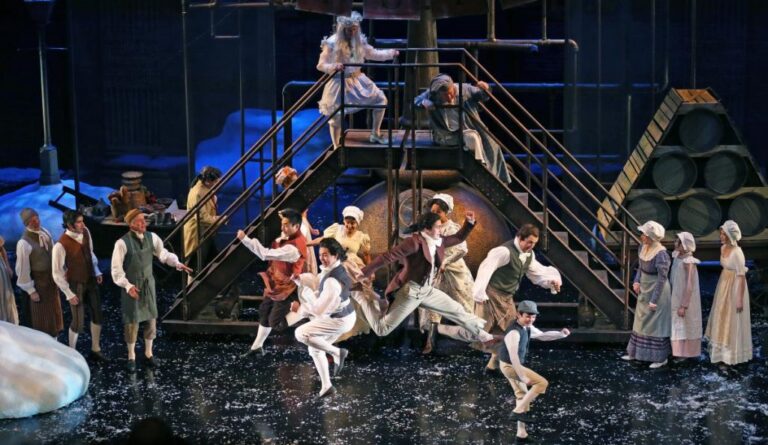 iPhoto caption: Company in the Grand Theatre's production of A Christmas Carol. Photo by Claus Andersen
Reviews: A Christmas Carol (x2)
Reviews of two productions of A Christmas Carol—Ross Petty Productions and the Grand Theatre, in London, Ont.—that couldn’t be more different.
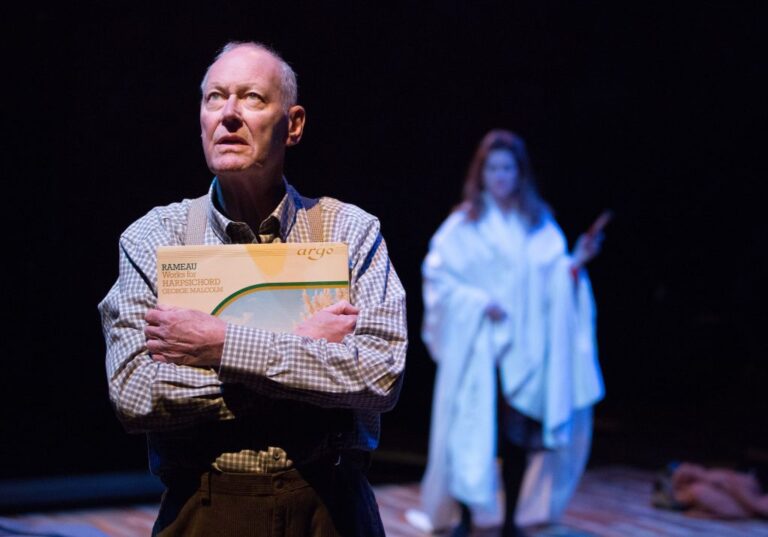 iPhoto caption: David Schurmann and Carly Street in Heisenberg. Photo by Cylla von Tiedemann
Of the three productions I’ve seen of Heisenberg—on Broadway in New York, the West End in London, and here in Toronto—this one is the best.
Comments