
Navigating Art and Censorship
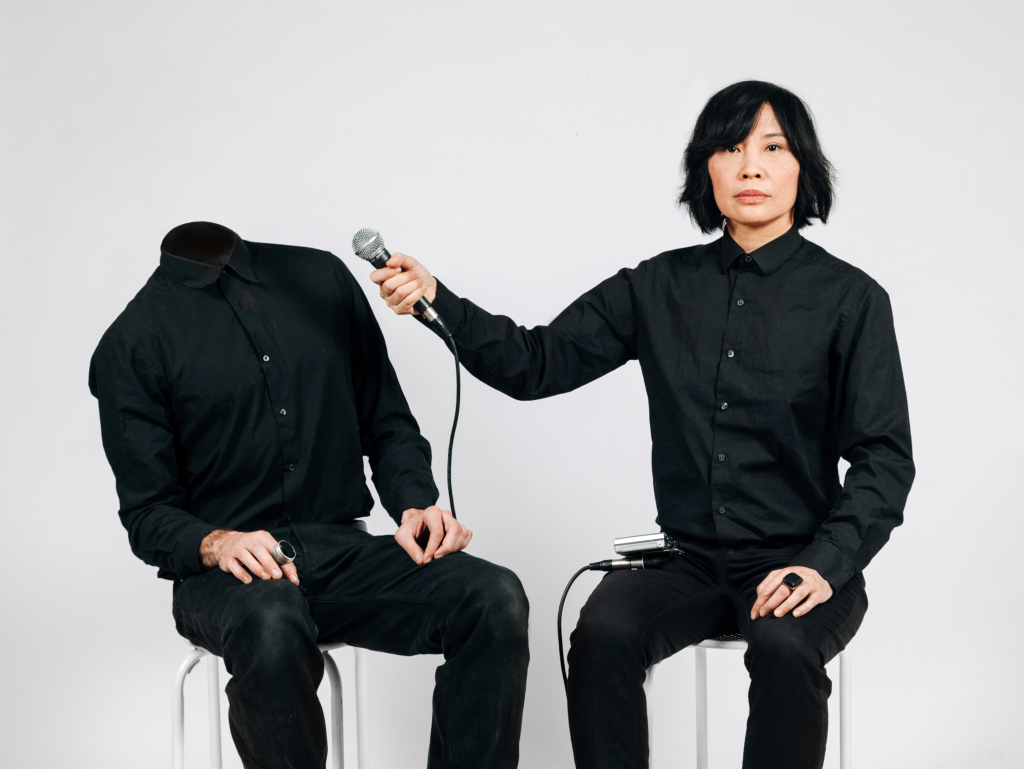
Sook-Yin Lee steps into the spotlight with her first non-dance narrative theatre production, and pulls her audience into the behind the scenes discussions that led to the creation of Unsafe. It’s a meta-narrative about art and censorship that, lest you worry, has no shortage of drama and humour to help it all go down.
Lee—a former VJ, radio host, artist, and activist—had previously only created narrative dance pieces for theatre. With Unsafe, Lee is the writer and creator, and performs alongside Christo Graham. She calls the show a “documentary performance.” It follows the story of how Lee grappled with writing a show about art and censorship, while weaving in curated interviews with artists about censorship. The unorthodox format of the piece was the result of challenges to conceptualize the show.
“Many, many obstacles came up in the creation of the show that I thought, ‘Eureka! This equals conflict and conflict equals drama,’” Lee explains. “I thought the most immediate and honest way to tell this story was to incorporate some of the behind the scenes struggle.”
How can we wrestle this demon
The project began when Matthew Jocelyn (former artistic and general director of Canadian Stage) contacted award-winning director and playwright Zack Russell. Jocelyn wanted Russell to develop a work based on Toronto-based painter Eli Langer, who was accused of painting child pornography in 1993. At an exhibit that year, the Morality Bureau of the Metropolitan Toronto Police confiscated Langer’s work. While this specific case of artistic censorship was certainly intriguing, Russell was inspired to investigate a broader tale. He wound up finding a collaborator in Lee, who was itching to work on a new project and thought the topic sounded like an exciting challenge.
“Very quickly, it became evident how complicated [it would be]. How can we wrestle this demon that has very many tentacles and very many contradictory qualities?” Lee says. “You look one way and you find somebody who says one thing [about art and censorship] and then you turn around and you find another artist that says something else–so how can we embody it?”
Russell was interested in the role of imagination and fiction, while Lee was more interested in basing the show on real life experiences through journalistic documentaries. “We both gave each other the blessing to pursue our curiosities. There was a point where it became clear that the emphasis was more on the documentary stuff. That’s when he was like, ‘Okay, love this, but that’s your thing Sook-Yin.’ He was pretty clear [when he said], ‘I know this is new for you but you need to be the lead on this,’” Lee says.
As a result, Russell took on a creative consultant role while Lee took Unsafe down a new path. Drawing upon her broadcast skills, she interviewed different artists for the piece—including Polaris Music Prize winning musician Jeremy Dutcher and playwright/former Canadian Parliamentary Poet Laureate George Elliott Clarke—asking their opinions on and experiences with censorship for source material. Lee also followed different social media threads of discourse and examined how callout culture can lead to self-censorship. She embraces technology in her storytelling and examines the ways that social media impacts how we relate to one another. All of these discussions are presented in a town hall format alongside the onstage drama drawn from Lee’s own thought process.
Complications arise as different players introduce new perspectives on what kind of art is acceptable and what is not. Lee ensured that the piece would feature artists both pro and against censorship, but director Sarah Garton Stanley adds that the point isn’t to make a decision. “I think censorship is a word that is held often by white male privilege,” says Stanley. “This piece works very quickly to work around a whole other set of values and ways to look at how that word, how that silencing of others comes to bear, and not in the more traditional understandings of what censorship means.”
There are no absolutes
The Langer style of censorship, where art was tried in a court of law, rarely ever occurs anymore. Instead, Lee and Russell explored tolerance and intolerance and what we wish, or seek, to control. Lee asks, “the art we feel is incendiary, dangerous—when is it generative to censor something? When is it necessary? When is it an impingement to freedom?”
Lee has experienced hard censorship firsthand, such as when her job was implicitly threatened after appearing in the graphic LGBTQ film Shortbus. But Lee also points to other, softer forms of censorship that come with society’s growing polarization. She examines historical censorship cases such as an Arab-Canadian art exhibition that was cancelled after 9/11. The artists fought back, and Yin acknowledges that people will freely speak up when they see art they deem hateful. “There are no absolutes to this and the more that we dug into it, the more we could see how complicated it was,” Lee says.
Broaching the topic of censorship is in and of itself, controversial, and at times it was difficult to persuade people to share their experiences. Ironically, albeit understandably, some interviewees wound up censoring themselves from the Unsafe project.
“There are many people who talked to me who called me up afterwards and said, ‘No, I’m sorry you can’t run that. It puts me in a possibly compromising place,’” says Lee. Many of the institutions Lee reached out to choose not to comment or offered “a kind of non-comment.” She emphasizes that the artists featured in the final product that stood by their words are all incredibly brave for speaking their truths.
Stanley argues the central question of Unsafe isn’t even about art and censorship, it’s a matter of what we choose to believe. “That’s part of the tension of the play […],” explains Stanley. “Where do you as an audience member, where do any of us place our faith? Do we place it in a video, a portrayal of an interview of someone who has spoken earnestly and we believe them to, but then there are edits and cuts in those videos that have been manipulated, or do we believe poetry because someone’s heart has most clearly gone into that?”
There are no easy answers. Stanley advises audiences to attend with an open mind, and Lee assures that Unsafe will keep you on your toes. “We are in a fascinating era of technology, information, communication, disorientation, alienation and there are urgent concerns in the world that we have to address,” Lee says. “In the murk of all this other stuff, it is going to become progressively more confusing to know what is what.”
Rachel Chen
Rachel Chen is a Toronto-based freelance writer with bylines in Chatelaine, FLARE and various other publications. She was also featured in The Unpublished City II anthology curated by Dionne Brand, Phoebe Wang, and Canisia Lubrin. A lifelong theatre lover and volunteer costume designer to boot, Rachel is ecstatic to combine her loves for both journalism and theatre with Intermission.
LEARN MORE
Comments