
REVIEW: Dinner is Served at Toes for Dance/Campbell House Museum
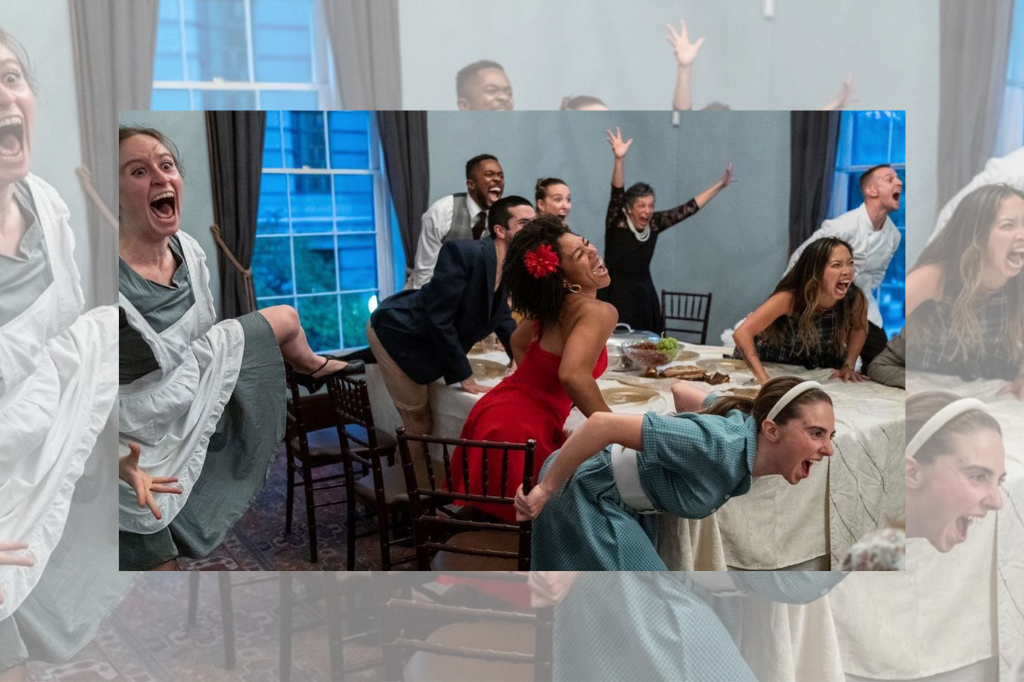 iPhoto caption: Photo by Aidan Tooth.
Dinner is Served is an immersive dance theatre piece that delivers delight on a silver platter. Kristen Carcone’s direction and choreography come to life in an absurd farce set at a 1960s dinner party. The site-specific location is the Campbell House Museum, where the cast fills every room with inventive choreography.
One of the challenges with immersive and site-specific performances is communicating the rules of engagement with the audience and directing them around a space. Too many out-of-character instructions break immersion, but too few can be confusing, and uncertainty is a major distraction. Dinner is Served employs clever but simple systems to organize participants. First, audiences receive an email with information about the performance. The email encouraged us to dress on-theme, a simple way to enhance immersion. Next, front of house staff repeat key information at the front gate, focusing on consent and physical contact. They then give out colour-coded lapel pins to indicate which character we will follow for the performance. My pink pin put me in the group following His Wife (played by Laura Carella).
I walked towards the double doors at the front of the house and immediately felt as though I was attending a highly-anticipated dinner party. In the sitting room, retro music plays on an old stereo. The moments before the show feel immersive with the help of Miquelon Rodriguez’s sound design and the ambiance of the house itself.
The performance begins with introductions of the cast of characters. Each time a guest enters, the Chef (Christian Lavigne) and the New Maid (Bri Clarke) use lampshades to direct light while a commercial plays. Under this makeshift spotlight, each performer stands in the doorway for a moment in character. His Wife, for example, takes a sneaky swig from her flask.
After the final guest enters, the Favourite (Kim Fischer) gives a speech, telling us about each character, and efficiently delivering exposition. He talks about his recently deceased father, who founded a radio broadcasting corporation. This story detail weaves Rodriguez’s sound design of ever-present music and advertisements into the narrative, thus creating an era-appropriate score.
Simple choreography and brief moments of spoken text establish status and relationships quickly. The branching storylines emerge from the complex web of relationships. It’s easy to get swept up in the performance.
The venue is an integral part of the show and clearly a source of inspiration. Carcone finds interesting ways to use the space to inspire choreography that tells us more about these people and their internal and interpersonal struggles.
Carella invites us to witness the inner life of His Wife, as she drinks endlessly in response to a blatant affair her husband, The Favourite, is having with His Secretary (Christine Flores). The duets between His Secretary and The Favourite are fun and passionate — especially a sequence involving a dining table. Carella in particular gives an outstanding performance. She’s endlessly watchable, goes through a massive range of emotions and manages to play drunk and off-balance without ever missing a step.
The Chef and the New Maid return and lead us into the kitchen where the most thrilling choreography takes place, though the room looks more like something out of the 1820s than the 1960s. There are a series of high-energy duets between Lavigne and Clarke which are incredibly joyful, making challenging choreography look easy — at one point Clarke is walking on the ceiling. This is where the dancing becomes its most immersive. The performers get the audience involved in spoon-polishing, napkin folding, and eventually a brief game of limbo (it makes sense dramaturgically, I swear).
The storylines all coalesce in the dining room, where the absurdity and interpersonal conflict reach their climax. At the end of the night, I returned my pink lapel pin, and walked out the door already thinking about how I hardly saw some of the characters, and how repeat viewing would yield a completely different evening.
Overall, the location is amazing, the performers are high-energy, and the concept is solid. Seeing dance this close-up is a different experience from going to a proscenium-style theatre — challenging feats of choreography are all the more impressive at such close range. There were, however, a few moments where the performance dragged or became repetitive. Perhaps with more time to rehearse and polish each storyline, it could be a tighter overall show. That’s not to say it was ever boring; I would just like to see the company take it further to make the story in this inventive presentation even more compelling.
I also wonder what the performance was saying about gender roles. The main story I watched was about two women fighting over a man. The characters are even named His Wife and His Secretary, rather than the Wife and the Secretary. The outdated language surrounding the characters, and the gendered clichés they’re using, may be meant to poke fun at the exaggerated performance of gender in this production. Because of the reliance on stereotypes, I was at times unsure if the show was ridiculing gender roles, or upholding them. If feminist commentary was the intention, the creative team might make it clearer in future iterations.
The original run of this show sold out before opening night, but there is a waitlist for tickets, and an extra performance has been added. Dinner is Served is a fun night out, if only it could reach more people. I think it has broad appeal, especially for people who don’t see a lot of theatre or dance.
Dinner is Served runs at the Campbell House Museum until July 2. Tickets are available here.
Intermission reviews are independent and unrelated to Intermission’s partnered content. Learn more about Intermission’s partnership model here.

Asenia Lyall
Asenia Lyall is a recent graduate of Brock University's Dramatic Arts program. When it comes to theatre she does a little bit of everything, focusing on writing, dramaturgy, and performance. She is a firm believer that brunch can and should happen at any time of day and her favourite acting credits include RED BIKE and Orlando. She is currently enrolled in Toronto Metropolitan University's MFA in Scriptwriting and Story Design.
LEARN MORE
REVIEW: Inge(new) at Theatre Myth Collective/Red Sandcastle Theatre
Inge(new) - In Search of a Musical sets out to tackle a lot: it’s not easy to put feminist discourse on stage in a new way.
REVIEW: A Grimm Night at TranscenDance
Exploring A Grimm Night's lush world of artistic expression is truly, yes, enchanting.
Comments