
REVIEW: With equal parts joy and indignation, Kanika Ambrose’s The Christmas Market shines a light on migrant labour
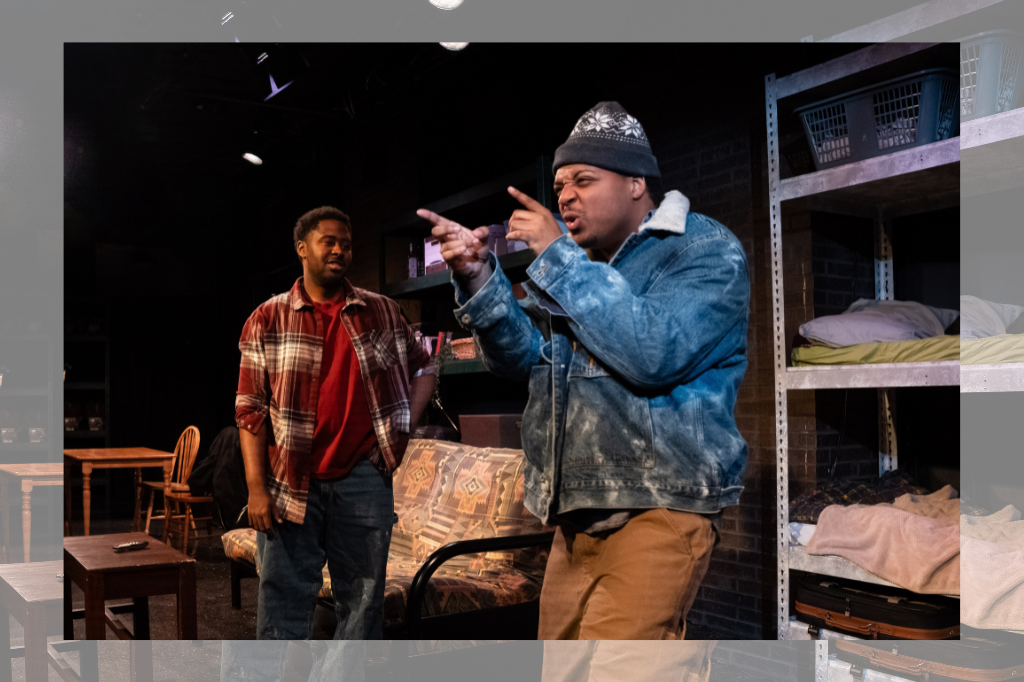 iPhoto caption: Danté Prince and Savion Roach in 'The Christmas Market.' Photo by Kenya Parsa.
Among softly falling snowflakes, dense rum cake, a tree that twirls of its own accord, and a lively soca rendition of classic carol “My Favourite Things,” The Christmas Market unfolds, gradually steering away from familiar festive comforts toward a sharper story of labour and exploitation.
Written by Dora Award-winning playwright Kanika Ambrose (who’s debuting another play in Toronto this month), The Christmas Market brings the warmth of the Caribbean to the snowy landscape of Ontario. The show explores the stories of three migrant workers employed on a Christmas tree farm during their brutal first Canadian winter. Directed by Philip Akin, this world premiere is a b current Performing Arts production, produced in association with Crow’s Theatre and Studio 180 Theatre.
Set designer Ken Mackenzie transforms the Crow’s Studio Theatre into the semblance of an intimate trailer that the men share, illuminated by warm, ambient lamplight (by Shawn Henry). Tiny but surprisingly inviting, the trailer features a drooping couch, steel bunk beds, a robust DVD collection, and a collection of pantry staples.
Joe (Matthew G. Brown) is the ringleader of the trio, instantly endearing and earnest in his desire to host a Christmas Eve Caribbean feast. Roy (Savion Roach) is a firecracker, often eliciting raucous laughter during the performance I attended through his boisterous facial expressions and body language. Lionel (Danté Prince) is the figurative “youngest child” of the bunch, impassioned and emphatic about his numerous frustrations with life on the farm.
The more relaxed exchanges between the three men feel organic, oscillating frequently from jovial and facetious to barbed. This can be credited to Ambrose’s likelife script and the natural chemistry pulsating between Brown, Roach, and Prince — it’s all too easy for me to imagine them as siblings, rather than co-workers thrust together by circumstance.
Their more serious conversations reveal the extent of their dehumanization under the watch of superiors like Ryan (Brenda Robins), a white woman who supervises the farm. The workers are subject to maltreatment and subpar working conditions, including surveillance, a lack of adequate gear, verbal harassment, and the constant threat of deportation, evoking varying responses from the men.
Lionel begins to incite murmurings about workers’ rights that eventually reach his boss. Although they agree that their working conditions are dismal, Joe and Roy are less willing to take an incendiary route. After all, it’s the income from the temporary foreign worker program that provided Joe with the means to purchase land back home in the Caribbean, and the same income that Roy is counting on to hire a lawyer for an unfolding custody battle.
In a heated moment, Lionel lashes out at Joe, exclaiming that “people like you is why the bossmen think they can walk all over us.” Joe retorts: “people like you ruin a good thing.” This exchange underscores how exploitative systems pit workers against one another, blinding them to their common enemy. Neither man should have to choose between a paycheck and a safe work environment, yet Lionel perceives Joe’s reluctance to protest as surrender, while Joe sees Lionel’s defiance as a naive undertaking that jeopardizes what little stability they have.
Among the heaviness, there are snapshots of camaraderie and wonder: Joe shares a stolen moment with Ryan on the farm at night, dancing with her as snowflakes fall around them. Lionel and Roy brainstorm how to scout for women and alcohol in the next town over, swapping cologne and ridicule.
The performances are electric, yet grounded. The actors move through the small set with purpose, reacting to each other truthfully and with immediacy. For me, Roach was the scene-stealer, navigating Roy’s transitions from rage to vulnerability to cheekiness with gusto. The costume design (by Des’ree Gray) thoughtfully incorporates oversized denim, sherpa-lined coats, and pops of a vibrant winter colour palette, including forest green, navy, and maroon.
Ambrose distills the gamut of emotions that arise from the holidays — joy, angst, whimsy, frustration, and love, among others — while shining an unforgiving spotlight on the transgressions of the Canadian temporary foreign worker program. The Christmas Market makes clear that holiday cheer does not look the same for everyone. It invites the audience to reflect on the juxtaposition between Canadians celebrating the holidays in warm homes and the migrant workers who make these celebrations possible — workers who are too often neglected and mistreated.
Ambrose writes and Akin directs with verve, neither losing sight of what makes any given character human (even Ryan, who initially seems the obvious antagonist). The play culminates in a well-crafted, deliberately ambiguous ending that left me reeling. Delicately balanced with humour and emotionally charged dialogue, The Christmas Market is vibrant and moving, bottled up like lightning in 90 minutes.
The Christmas Market runs at Crow’s Theatre until December 7. More information is available here.
Abi Akinlade wrote this review as part of Page Turn, a professional development network for emerging arts writers, funded by the Canada Council for the Arts and administered by Neworld Theatre.
Intermission reviews are independent and unrelated to Intermission’s partnered content. Learn more about Intermission’s partnership model here.

Abi Akinlade
Abi is a Nigerian-Canadian multidisciplinary artist based in Toronto. She holds a Bachelor of Arts degree in English Literature and Drama from the University of Toronto. Represented by AMI Talent Agency, she has performed in both film and theatre productions. She is currently a cohort member of the inaugural theatre criticism program Page Turn, as well as a journalism fellow at Inkspire. Driven by a strong passion for theatre, literature, and film, she aims to use storytelling as a means to uncover a deeper sense of identity and foster meaningful connection.
LEARN MORE iPhoto caption: Tony Ofori and Daren A. Herbert in 'Moonlight Schooner.' Photo by Dahlia Katz.
Kanika Ambrose’s Moonlight Schooner is animated and visually stunning, but its individual pieces don’t come together as neatly as I would've expected.
 iPhoto caption: Benu. Photo by Selina McCallum.
REVIEW: The Sankofa Trilogy is a passionate love letter to Jamaica and Black womanhood
“Politician, yuh have to listen.” “No borders on stolen land.” “No genocide inna Gaza.” These are just three of the rallying cries featured on signs held by picketers in word! sound! powah!, the final installation of d’bi young anitafrika’s Sankofa Trilogy.
Comments