
REVIEW: Migraaaants is not a dark comedy. And that’s okay.
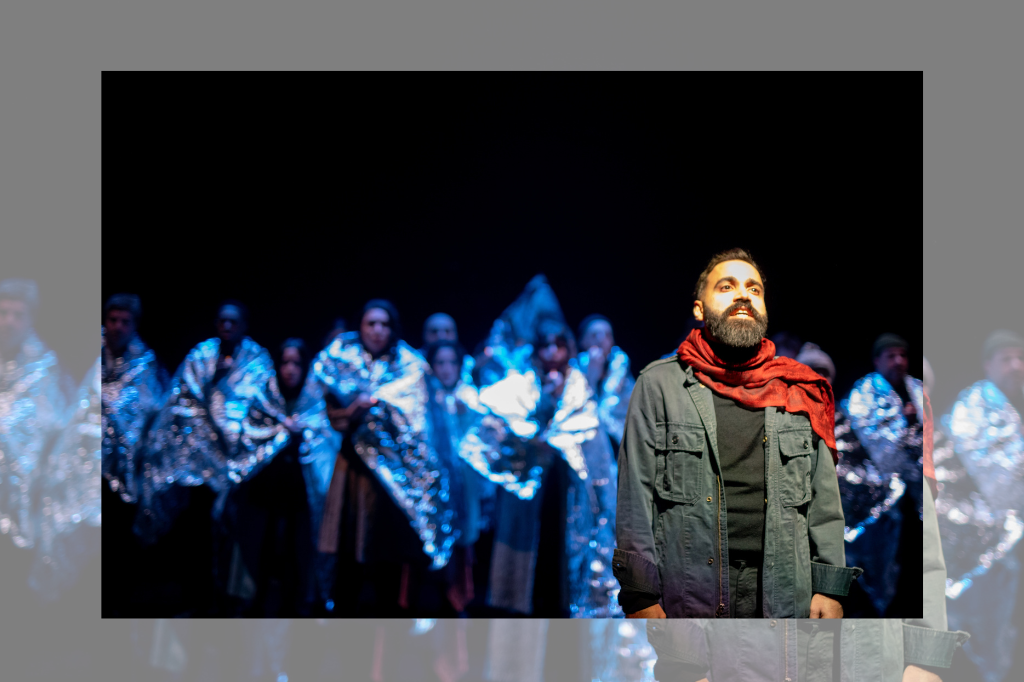
The stage darkens, and we’re on a boat. We’re being yelled at to shove our phones into the small plastic bags we were handed upon entry to Theatre Passe Muraille. At the moment, we’re on board an imaginary boat with the immigrants and refugees seeking a new life in Lampedusa, drifting away from Tripoli. We sit in silence with all eyes on the key to the new life, the Boss (Ahmad Meree).
From the very beginning of playwright Matei Visniec and director Siavash Shabanpour’s Migraaaants, Meree is domineeringly captivating. He is fervent, irritable, and supposedly not like “other traffickers.” We can lay all our trust on him since he has a family to take care of and a God to serve: he can be relied on, for now. And in Theatre Passe Muraille’s (TPM’s) dark, two-storey performance space, there is no choice but to look straight ahead and trust the Boss.
Intertwined with the fast-paced, tense story on the boat are three other peripheral but integral stories. In one, we see a Balkan couple’s dinner scenes, where the cheerful wife (Mahsa Ershadifar) prepares homey meals for her husband (Andrew Chown), whose job is to set up barbed wire on the country’s borders. Their mundane day-to-day lives that seem to project indifference eventually reveal passive but heartfelt compassion towards the refugee children who seek phone charges and simultaneously a place to rest at the couple’s house.
We elevate our gaze to see a separate story of a state leader (Garrett Malloy Scott) and his speechwriting coach (Henry Oswald Peirson) on the upper floor of the TPM Mainspace. With good comedic timing, the two hyperbolically vacillate between politically correct and incorrect rhetoric to describe the surge of refugees. With the help of his right-hand man, the President revises his speech to remove the terms “immigrant” and “refugee” and, instead, replace them with the more socially acceptable “migrants.” In an attempt to seek neutrality amidst the crisis, they neutralize the identity of the refugees and, therefore, neutralize the severity of the situation.
The performance of Parastoo Amanzadeh as a young boy named Elihu is the show’s most disturbing and striking. A faceless, pious man takes advantage of Elihu and manipulates him with a booming Southern American accent: why would Elihu want to keep two kidneys, two eyes, and two legs when God will let him live with one each — with the chilling addition of “cah-pi-tahl,” or capital? Amanzadeh brings a physically small but sobering presence to the stage — all we can do is watch.
If the purpose of bringing playwright and poet Matei Visniec’s work to the stage was to challenge indifference, the show succeeds — but to a limited extent. Migraaaants’ self-categorization as “dark comedy” is not only a misnomer but a nullifier: the comedy is almost too ironic for it to be effective and it inadvertently drains the sincerity of the show.
Two of the three interludes that use comic irony consist of two ebullient but enigmatic presenters, excellently portrayed by Keely Krall and Shannon Pitre. In the first, the presenters advertise to us a Black Mirror-esque technological device dubbed “Anti-Immigration Technology.” The mechanics of the technology are as blunt as its name: the system detects abnormally fast heartbeats around you so that you, too, can live in an immigrant-free environment. In the second interlude, the duo returns as Barbies dressed in “barbied” wire. It’s another skit of commercializing — and attempting to ridicule — the barbed wire used to keep refugees out.
The use of ironic or dark comedy to unveil a dark reality is not only seldom effective but it is also anachronistic. David Foster Wallace wrote in the early 1990s that “illusion-debunking” through irony has repeatedly been done and, unless we look at where we go after that is done, irony can be more enslaving than is liberating. Especially with what Migraaaants builds up throughout the rest of the show, the interludes are better off cut than they are included, and add a futile cynicism that detracts from the rest of the show’s strength. Migraaaants is not dark comedy — and that’s okay.
Two Thousand Feet Up Theatre Company’s production of Migraaaants opened at Theatre Passe Muraille on Tuesday, January 16. And while I write this review on Thursday, segments of the show still vibrantly stay with me as a haunting reminder to stay vigilant of the realities of those who are in need of our attention and compassion — whether it be through our phone chargers or our homes.
Migraaaants, a Two Thousand Feet Up production, plays at Theatre Passe Muraille until January 27. Tickets are available here.
Intermission reviews are independent and unrelated to Intermission’s partnered content. Learn more about Intermission’s partnership model here.

Eleanor Yuneun Park
Eleanor Yuneun Park is an undergraduate student at the University of Toronto, studying English and Religion. She is the Editor-in-Chief of The Varsity, the University of Toronto's tri-campus newspaper, and she participated in the New Young Reviewers Program for the 2023 Toronto Fringe Festival. Eleanor is drawn to postcolonial theatre and anything by the creatives of her generation.
LEARN MORE iPhoto caption: Photo by Dahlia Katz.
REVIEW: The Wrong Bashir is an ode to the hyphenated identities of Canada
Quibbles on the show's comedy aside, The Wrong Bashir will stay with me for a while as a successful ode to hyphenated identities across Canada.
REVIEW: Just like Luke Reece’s life story, As I Must Live It is open-ended
In his 90-minute spoken-word solo show, Recce reaches who he needs to reach, offering a piece full of complexity and nostalgia.
 iPhoto caption: Photo by Dahlia Katz.
REVIEW: In Prophecy Fog, Jani Lauzon ceremonially reclaims the Giant Rock
We are as significant as a star and a stone. A star and a stone are as significant as us. With this logic, Lauzon breathes life into the Giant Rock and reclaims its existence and sacredness.
Comments