
REVIEW: Necessary Angel’s Moonlight Schooner offers a poetic glimpse into the lives of three Caribbean sailors
 iPhoto caption: Tony Ofori and Daren A. Herbert in 'Moonlight Schooner.' Photo by Dahlia Katz.
Seated comfortably in the Berkeley Street Theatre, I watch as teal blue curtains ripple on stage, illuminated by golden spotlights to give the illusion of vast swaths of sea dappled delicately by sunlight. This is the literal calm before the storm — it’s only moments later that the house lights come down and actors playing sailors aboard the Moonlight Schooner barrel onto the stage, fighting for their lives as their characters are flung to and fro by an unforgiving tempest.
Moonlight Schooner, a Necessary Angel Theatre Company production in association with Canadian Stage and Tarragon Theatre, is Toronto playwright Kanika Ambrose’s latest venture, coming on the heels of b current Performing Arts’ The Christmas Market, currently on at Crow’s Theatre. It marks Ambrose and director Sabryn Rock’s third full-scale collaboration, following the critically acclaimed our place and Truth. Moonlight Schooner is animated and visually stunning, but its individual pieces don’t come together as neatly as I would’ve expected.
When the storm clears, we meet three characters: Vincy, a loquacious teenager from St. Vincent (danjelani ellis); Timothy, an audacious, seasoned sailor from Trinidad (Daren A. Herbert); and Shabine (a take on the word “chabin,” for a light-skinned person of African descent), a sagacious poet (Jamie Robinson).
Stranded on the island of St. Kitts in 1958, the sailors seek lodging with Timothy’s friend Lyle (Tony Ofori), a young man living on a generous stretch of farmland with his anxious and overbearing mother (Nehassaiu deGannes). As the characters converse and quarrel with one another, Ambrose’s warm and colourful dialogue flows musically from each actor (especially from Robinson, who frequently soliloquizes with melodious rhythm and an almost Shakespearean flair).
Led by Timothy’s desire to “lime” (socialize), the sailors decide that the appropriate course of action, rather than repairing their splintered ship, is to take a spin around town (it is May Day, after all). The monologues to the audience and conversations during the ensuing revelry leave room for the characters to reminisce on the circumstances that led them to the Moonlight Schooner.
Shabine is a husband and father of four, previously jailed for participating in a liquor-smuggling operation. Through a series of flashbacks, we glimpse his pride at finally securing work as a sailor and delivering the news to his family, played by Herbert as Shabine’s wife and Ofori as his young son. It’s an ingenious directorial choice: Herbert and Ofori bring levity to these secondary roles, playing off each other with an easy, infectious cadence. Des’ree Gray’s almost cartoonish costumes, featuring a stuffed pregnant belly for the former and Boy Scout-esque accessories for the latter, highlight the playfulness of the flashbacks, underlining their contrast with the more sober parts of the narrative.
Shannon Lea Doyle’s minimalistic set features two crescent-shaped wooden structures with built-in hidden staircases along the insides. Although they offer the actors extensive room to play, the design of the structures doesn’t do enough heavy lifting to convincingly function as the walls of Lyle’s home, the tavern the sailors visit, as well as the surface of a ship.
Raha Javanfar’s mesmerizing lighting design bathes the stage in a sea of blue while perfectly accentuating the actors in orange, yellow, and white spotlights.
Near the tail end of the show’s 90-minute runtime, there is a stark, disquieting twist characteristic of Ambrose’s style. I could feel the pit in my stomach growing as deGannes filled the stage’s sudden stillness with a tightly controlled monologue. The aftermath of the twist reveals the sailors in a new light. They are at the mercy of circumstances beyond their control. The evils of imperialism, capitalism, and the slave trade leave them economically and emotionally unmoored — yet, they remain human. Therefore, they remain flawed.
Having just enjoyed the magic of The Christmas Market, my expectations for Moonlight Schooner were high. While the plays share the same bones in regards to Ambrose’s vibrant and intelligent writing, the latter’s message doesn’t land with the same clarity. There are lulls in the show’s action, and Ambrose arguably spends too much time on certain tangents — Janine’s entreaty to Lyle to find a good wife, for example. There are also portions of dialogue that were difficult to understand without an ear attuned to the nuances of patois, which I, as a Nigerian-Canadian viewer, regrettably lack.
The Christmas Market and Moonlight Schooner are both anchored by charismatic trios, strong ties to Caribbean culture and language, believable portrayals of Black men, and a refusal to shy away from the malignancies of colonialism and greed. Though Moonlight Schooner didn’t connect as strongly with me, the two plays make for a stirring and sobering diptych that boldly centres and celebrates Caribbean stories.
Moonlight Schooner runs at the Berkeley Street Theatre until December 14. More information is available here.
Abi Akinlade wrote this review as part of Page Turn, a professional development network for emerging arts writers, funded by the Canada Council for the Arts and administered by Neworld Theatre.
Intermission reviews are independent and unrelated to Intermission’s partnered content. Learn more about Intermission’s partnership model here.

Abi Akinlade
Abi is a Nigerian-Canadian multidisciplinary artist based in Toronto. She holds a Bachelor of Arts degree in English Literature and Drama from the University of Toronto. Represented by AMI Talent Agency, she has performed in both film and theatre productions. She is currently a cohort member of the inaugural theatre criticism program Page Turn, as well as a journalism fellow at Inkspire. Driven by a strong passion for theatre, literature, and film, she aims to use storytelling as a means to uncover a deeper sense of identity and foster meaningful connection.
LEARN MORE iPhoto caption: Danté Prince and Savion Roach in 'The Christmas Market.' Photo by Kenya Parsa.
Among softly falling snowflakes, dense rum cake, a tree that twirls of its own accord, and a lively soca rendition of classic carol “My Favourite Things,” The Christmas Market unfolds, gradually steering away from familiar festive comforts toward a sharper story of labour and exploitation.
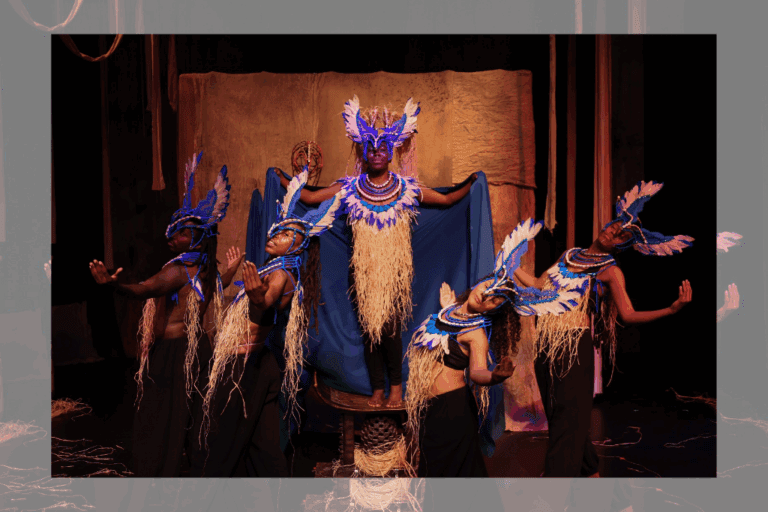 iPhoto caption: Benu. Photo by Selina McCallum.
REVIEW: The Sankofa Trilogy is a passionate love letter to Jamaica and Black womanhood
“Politician, yuh have to listen.” “No borders on stolen land.” “No genocide inna Gaza.” These are just three of the rallying cries featured on signs held by picketers in word! sound! powah!, the final installation of d’bi young anitafrika’s Sankofa Trilogy.
Comments