
REVIEW: This summer, Kingston’s TK Fringe is eclectic as ever
 iPhoto caption: Poster courtesy of Theatre Kingston and Kick & Push Festival.
The first weekend of Theatre Kingston and the Kick & Push Festival’s TK Fringe has come and gone, and as heat waves and thunderstorms wage a battle over southeastern Ontario, there’s never been a better time to seek solace in a cool, dry theatre. Popping between the festival’s three venues with a pen and mini notebook, I took in an eclectic series of performances by local theatre-makers — a new musical, a souped-up history lesson, an ASL variety show, a feminist take on Hamlet, and a Dungeons & Dragons-inspired improv: five of the 19 lottery-selected shows playing during the week-and-a-half-long festival.
48 North: A New Musical (Confederation Place)
Growing up, moving forward… and backward, and forward, and backward. In 48 North: A New Musical, four high school graduates from northern Ontario arrive at a cabin for one last weekend before heading their separate ways. While Kara (Hailey Hatfield) has the group’s 48-hour vacation scheduled down to the last marshmallow, Bailey (Sarah Doyle), Alex (Ryan Killoran), and Matt (Connor Houghton) want to relax and enjoy their time together before everything changes.
What follows is a series of loosely connected two-person scenes that jump between the present and various points in the characters’ futures, from ski-lift arguments to campfire confessions to wistful songs about treehouses and the doldrums of young adulthood. Directed by Victoria J Marmulak for Left Foot Theatre, 48 North combines a song cycle by Jack Oliver Kotanen with a new book by Katelyn Luoma. It’s a somewhat awkward fit — the rapid fluctuations in the timeline, the understated (read: almost inaudible) realism of the directing style, and the way the characters are paired off for most of the scenes make it hard for the friend group’s dynamic to find its footing.
Killoran and Houghton have the best banter, and a few nicely choreographed moments — like bobbing in silence on an uncomfortable car ride — help the pair breathe life and humour into an otherwise sleepy show. While Houghton’s facial expressions soak up the most limelight, Killoran’s subtle, seething eyes project sincere and complex emotion.
Pleasantly peppy songs, quirky staccatos, and light, driving rhythms punctuate the tangled storylines. Many of the lyrics are focused on the forest, and colourful, dappled lighting (designed by Hunter Wolfe) adds a whimsical touch to the outdoor scenes. When the actors’ voices aren’t being swallowed by the conference-room-turned-theatre’s carpeted floor, 48 North offers some promising moments — one ballad-like duet between Hatfield and Doyle features woven harmonies that have potential to grow into something beautiful over the course of the show’s run.
1969 (Baby Grand)
It’s 1969, and 16-year-old Suzie (Gia Silva) is a fierce — and fiercely self-righteous — peace activist who wants to go to Montreal for John Lennon and Yoko Ono’s bed-in protest at the Queen Elizabeth Hotel. Late one night on the side of the road, she meets up with classmate Micheline (Lilli McDonald), a runaway who’s clearly carrying something heavier than her suitcase.
As the teens try to hitchhike from the GTA to the Belle Province, they encounter Sammy (Kieran Chenier), a young American soldier on leave from the Vietnam War who has a tough decision ahead of him. Argumentative sparks fly — Silva and Chenier have something of a Hepburn/Grant Bringing Up Baby dynamic, though the stakes are much higher than golf balls and party dresses — and the characters dig deep into moral and political issues of the day as they wait for a ride.
Janet Kish offers a script rooted in historical background that asks big questions through intriguing characters and a suspenseful plot. Directed by Rachael McDonald for Pub Shed Productions, the cast of 10 — three lead actors, plus seven chorus members who chime in with historical footnotes, stage directions, and occasionally appear as secondary characters — succeed in giving real emotional stakes to a show that, based on its format, might otherwise come across as a souped-up history lesson.
1969’s musical soundtrack is led by Tim Ryan on keys, with the occasional burst of song from the chorus adding a groovy pulse to this smart, earnest story. Multimedia elements, including archival images and footage, draw into focus the harsh truths of violence, greed, and imperialism, and the antiwar message resonates unmistakably with our current political moment. Ample audio and visual components never overwhelm the acting — stage presence abounds as the hitchhikers encounter a colourful string of drivers, from the rude, to the motherly, to the downright creepy. Fuelled with tension and existential questions, 1969 keeps a steady hand on the wheel as it builds to its well-earned, melodramatic climax.
The MaryRobin Show (Davies Lounge)
Housepainting, scuba diving, and makeup tutorials gone hilariously wrong — Deaf Spirit Theatre presents The MaryRobin Show, a dynamic variety act that combines sign language, slapstick, and more in a playful homage to vintage comedy.
Elizabeth Morris and Hayley Hudson have warm, jubilant chemistry, and although their characters wear matching bright red wigs and button-up uniform shirts — think Lucy and Ethel at the chocolate factory — their distinctive clowning styles contrast and complement each other nicely. Morris’ persona, Mary, is bubbly, innocent, curious, though her face can instantly scrunch into a larger-than-life grimace of surprise. Hudson’s character, Robin, has more of a dry, spunky sensibility, with quirked eyebrows and sharp movements.
So that Deaf and hearing audiences alike can stay in on the jokes, The MaryRobin Show makes use of several communication forms at once. ASL, visual vernacular (a blend of sign language, mime, and theatrical techniques), lighting cues, projected background images, and captioned video segments create a visual avenue into the show. Meanwhile, music, vocal sound effects, and live voiceovers by two ASL interpreters add an auditory layer. Morris’ brief introductions to certain sketches offer insight into signature forms of Deaf theatre. One of my favourites was ABC storytelling, where the performers use the handshapes of the ASL alphabet to create gestures that tell a story — for example, the closed fist of a letter A, turned upside down, becomes a hand lifting up a can of paint by its handle, and the long, flat fingers of a B evoke a paintbrush.
Many of the sketches are lighthearted and silly — and one or two dragged on a little long at the performance I attended — but there are also some mesmerizing dramatic moments. Hudson’s ASL performance of the “all the world’s a stage” monologue from As You Like It is particularly spectacular, using an enormous spectrum of physical expression to embody Shakespeare’s seven ages of man.
There were moments when, as a hearing audience member with some knowledge of ASL, I found myself wondering how it might feel to watch the show without voiceover interpretation — especially during scenes that employed visual vernacular, where the interpreters used vocal sound effects (the hum of an airplane, the roar of a lion) to elaborate on the performers’ movements. While I would have liked to try interpreting the visual performance for myself, the interpreters’ collaboration in these scenes ensured that the show was fully accessible to low-vision audience members — and, in the delicate balance between overexplaining and potentially leaving the audience confused, it makes sense that clarity is a priority for this show. These multilayered modes of communication ensure that The MaryRobin Show is a welcoming experience for all, inviting a wide audience to learn and laugh along with Deaf Spirit Theatre.
Madness Lies (Baby Grand)
If you thought Shakespeare’s Hamlet was dramatic, wait until you see Chloë Whitehorn’s. Madness Lies, presented by Mad River Theatre, is another sleek, stylized Shakespearean takedown in the vein of last year’s The Fall After Midsummer — this time, darker and more challenging.
Written and directed by Whitehorn, Madness Lies follows Lettie (Shannon Donnelly) and Leah (Jennifer Verardi) as they find themselves on a wellness retreat of sorts. Lettie is the picture of burnt-out misery — underneath the snarky feminist jabs, there’s a good dash of the classic sadboy-prince-of-Denmark sulk that keeps our protagonist recognizable. Leah is more of a mystery — at first glance, the moniker suggests a direct correlation to Ophelia, but we soon begin to suspect that there’s more to this chatty, fun-fact-fixated character than meets the eye.
Donnelly and Verardi play off each other’s moods with great sensitivity, and the biting dialogue snaps between humour, pain, whimsy, and trauma in a way that seems both effortless and increasingly distressing. I’ve learned never to go to a Whitehorn play without scanning every line for double and triple meanings, and I’m always drawn in by her methodical foreshadowing.
This show was no exception, and it kept my mind whirring for the full hour as plot twists and layers of meaning unfolded. For audience members who prefer not to think this hard, Madness Lies may be inaccessible by the end — although the ’80s movie references, nods to famous Shakespeare lines, jabs at wellness culture, and zingers about patriarchy appear often enough to draw regular laughs.
It’s difficult to write about this play without betraying its secrets — which feels ironic, in a way, as the crux of the story is about the deadly consequences of women being forced to hold in the truth. I’ll leave it at this: if your body is keeping a heavy score, Madness Lies might be cathartic, or it might be a little much to take. If you can handle the darkness, though, it’s well worth venturing into this haunted piece of work.
Father, Forgive Me (Confederation Place)
Improvisation is always a roll of the dice — and in the case of Father, Forgive Me, the die in question is a giant d20 made of purple-painted cardboard. Alex Mclarry’s Dungeons & Dragons-inspired romp is about as unserious as it gets, and armed with a bottomless costume box and a smattering of audience ideas, Mclarry and his motley crew offer a lighthearted interlude of mayhem-filled antics.
Father, Forgive Me starts out somewhere in the realm of realism when a nerdy group of friends (Mclarry, Tony Babcock, and Ethan Watchorn) gather in Alex’s basement and get ready to play a game of D&D. When their fourth party member fails to arrive, Alex’s father, Rick (Wilding), bursts onto the scene, bedecked in the most gloriously goofy ‘80s-rocker-dad outfit, wrench in hand, and offers — well, insists — to join.
With the roll of a die, the party is transported to Illyria, where magic is real and funny voices abound. Babcock shows the strongest comedic control as the sincere and slightly pompous Sir Knight, who, at the performance I attended, rolled a 10 out of 20 to determine his level of fatherliness (this score was quickly pointed out to be a common one among dads).
Watchorn plays Sir Knight’s daughter, a druid, with a nonchalant and markedly un-actorly affect that creates an absurd kind of humour when played against the rest of the cast’s intensity. Wilding, leaping frenziedly between the campaign and the players’ basement world, plays Rick playing a wizard, which adds to the chaos as the well-meaning dad breaks character to ask questions and blurt out interjections — much to the chagrin of Alex, who’s trying to keep it all together as the Dungeon Master.
It can be tricky to keep up a longform improvised story, and while the setup and quest are initially determined by audience participation, I wonder whether some other checkpoints or moments of input along the way might help keep this campaign rolling. While it wasn’t always clear how much of the actors’ fumbling was for the bit, the frame narrative offers plausible deniability — who hasn’t seen a D&D game go off the rails? — and the unpretentious, playful attitude of the cast makes any awkward moments easy to forgive.
TK Fringe runs until August 17. You can learn more about the festival here.
Intermission reviews are independent and unrelated to Intermission’s partnered content. Learn more about Intermission’s partnership model here.

Haley Sarfeld
Haley Sarfeld (she/they) has reviewed theatre for the Kingston Theatre Alliance, Kingston Whig-Standard, and Intermission Magazine. Her coverage of Theatre Kingston's Fringe Festival in 2024 was recognized with a Nathan Cohen Award for Excellence in Critical Writing (Outstanding Emerging Critic). As a playwright and composer-lyricist, her work has been featured in the Shortwave Theatre Festival, Watershed Music Theatre Festival, and Kick & Push Festival. Haley loves word games and is a regular crossword puzzle contributor for The Skeleton Press.
LEARN MOREComments
Leave a Comment
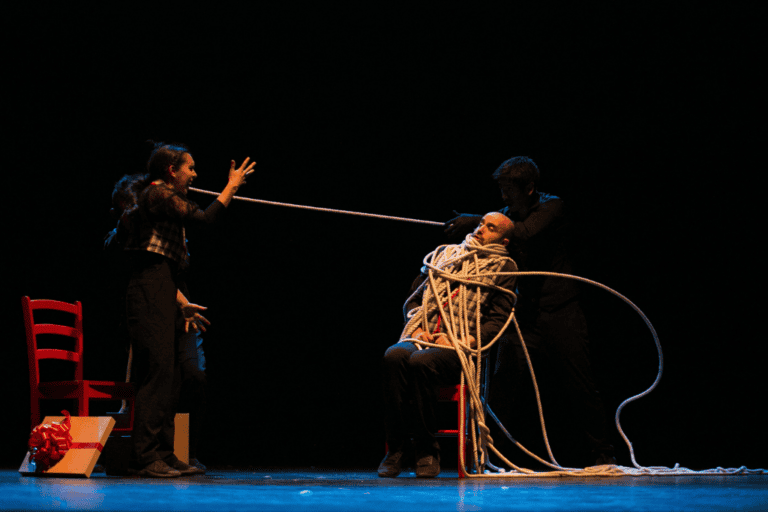 iPhoto caption: Members of the company of 'Pareidolia.' Photo courtesy of La Llave Maestra.
Aluna Theatre’s RUTAS Festival embraces the complex, the controversial, and the magical
“Communities need a space to come together, to breathe together, to think together, to see the same thing together and see different things in the same thing that they're seeing together,” says Aluna artistic director Beatriz Pizano. “That is the belief that we give this space to, to tell these stories.”
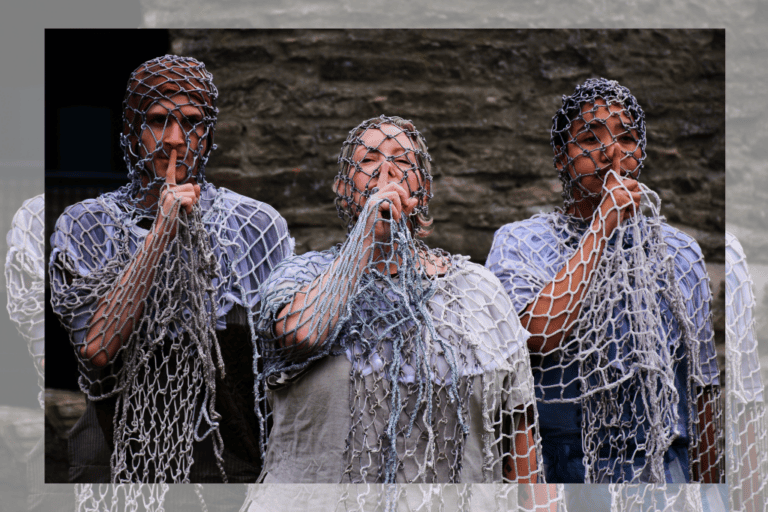 iPhoto caption: Nick Dolan, Cara Pantalone, and Jillian Mitsuko Cooper in 'Macbeth at the Tower.' Photo by Deanna Clark.
REVIEW: Immersive Macbeth at the Tower brings Shakespeare to the banks of the St. Lawrence River
Why shouldn’t a thane wear gaiters if he’s out in the mud?
 iPhoto caption: Photo by Lin Yu Huan.
REVIEW: The Storyville Mosquito buzzes brilliantly at NAC English Theatre
Although The Storyville Mosquito is about being happy with what you’ve got, I left the theatre itching to see it again.
 iPhoto caption: Found Fest 2021. Photo by Mat Simpson.
Although Walker conceived and workshopped This Is the Story of the Child Ruled by Fear just prior to COVID-19 lockdown, it’s perhaps best understood and appreciated as a pandemic project. Its festival appearances began in 2021, at which time the “I’m alone in the world”-ness of it all must have felt cathartic, and reciting lines together in person would have been nothing short of a spiritual experience.
 iPhoto caption: Logo courtesy of TK Fringe.
REVIEW: TK Fringe brings a strong mélange of summer shows to Kingston
This year’s lineup includes a mix of touring and local productions, and of the made-in-Kingston variety, there’s a good blend of student, amateur, and professional work.
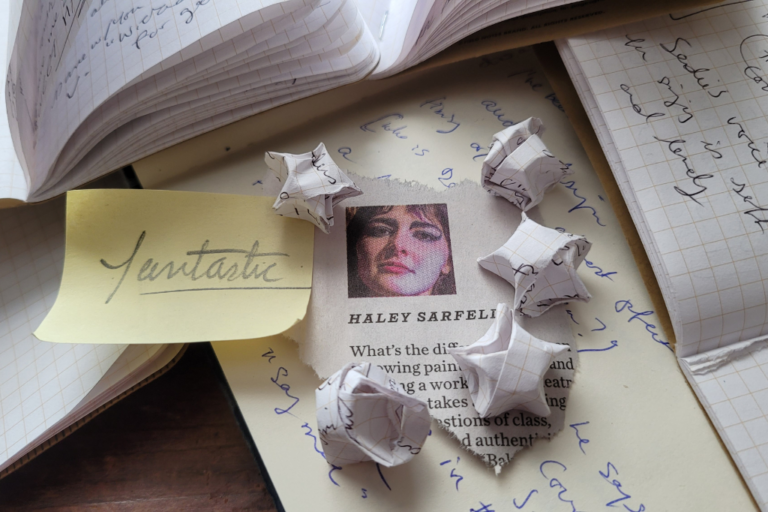 iPhoto caption: Image by Haley Sarfeld.
Every play is fantastic: A small-city theatre critic’s manifesto
My top priority as a critic will be to furnish every marketing team with as many easily quotable compliments as possible. I'll do this dutifully and without ambivalence.
Hi Haley,
I enjoyed reading your reviews of some of the TK Fringe shows. I’d love to invite you to see and review one of the last 2 shows of Oh Mother F#@%*! at the Davies Lounge (Kingston Grand).
I have a show tonight at 720 and tomorrow 840