
REVIEW: Family tensions run high in TIFT’s intimate Twelve Dinners
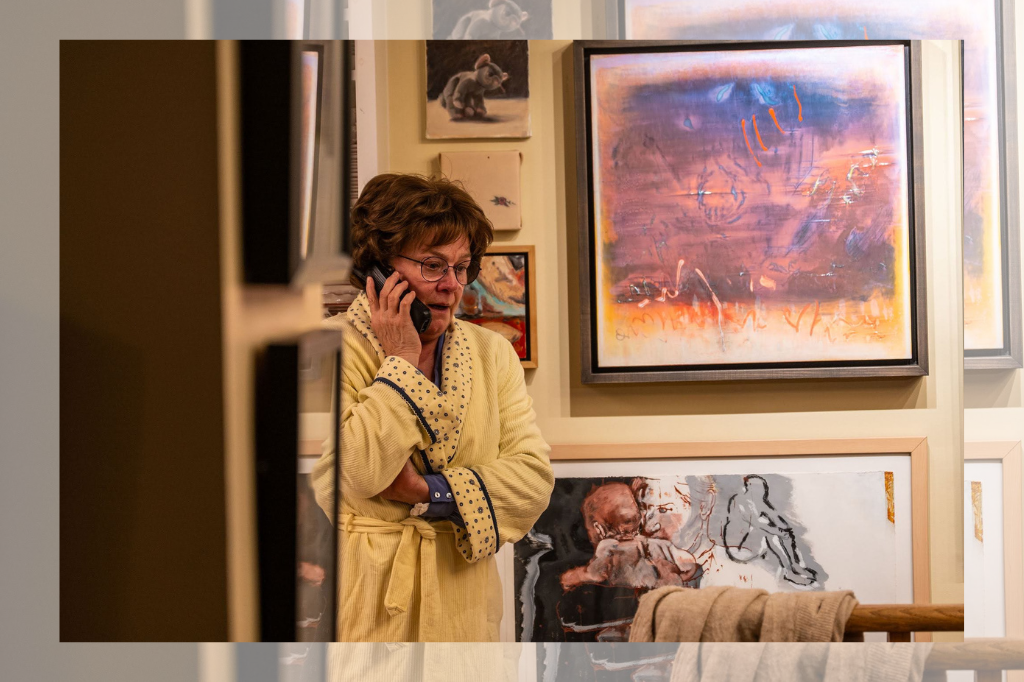 iPhoto caption: Jane Spidell in 'Twelve Dinners.' Photo by Dahlia Katz.
Over more than 20 years in the Stratford Festival ensemble, Steve Ross has played several dozen roles. From Nicely-Nicely Johnson in Guys and Dolls to Bagot in Richard II to Avram in Fiddler On The Roof, Ross has showcased his ability to deliver a wide range of accents and affects. In the now-closed Twelve Dinners, an autobiographical play written and directed by Ross, audiences received intimate access to an unvarnished version of a younger Ross through 12 evening meals with his parents.
Set in Beamsville, Ontario in 1995 and 1996, the play follows a 30-something Steve (Noah Beemer) as he visits his elderly parents for a monthly dinner. During the early encounters, everything — from the food to the place settings to the conversation — is unremarkable: Steve fields predictable questions about his job, romantic life, and finances, over (invisible) roast beef and mashed potatoes from a box.
Yet, for all the mundane banter and pleasantries, the dinner table bristles with tension. Ross’ mother Bettye (Jane Spidell) is a mercurial woman, oscillating between criticism of Steve, long bouts of silence, and serving sherbet. In between this tension sits Ross’ father, Jim (Kevin Bundy), a perennial fixer eager to preserve peace at all costs.
As the dinners progress, the true source of the animosity between mother and son surfaces. Bettye’s biting critiques are not the trespasses of an overbearing mother but rather the guilt-ridden actions of a woman battling chronic depression and a debilitating sense of personal responsibility for her son’s recent bipolar diagnosis. “Do you have any idea the guilt I feel passing something like this on to you? Do you have any idea the nights I lie awake worrying what I’ve done to you?” Bettye asks Steve during a particularly tense interaction.
The production takes place in the dining room and kitchen of an actual house on a quiet residential street in Barrie. Upon arrival, guests trade outdoor shoes for slippers before making their way to the living room to form an intimate seated audience. Jim and Bettye are seemingly unaware that they are in a fishbowl, but Steve toggles his attention between the audience and the dinner table, essentially translating the subtext that fills each scene. These moments of direct address chart Steve’s shifting perception of his mother. What begins as a child-parent relationship charged with antagonism evolves into a complex and moving reckoning between two adults grappling with mental illness, loneliness, and uncertainty.
Costuming by Sequoia Erickson and a handful of props coordinated by Lauren Cully — a cordless phone; a framed, sun-kissed 4×6 family photo; Steve’s Guns N’ Roses T-shirt — firmly establish the mid-1990s, upper-middle class, suburban moment of this play among an otherwise minimal set. Here, we find the beautiful tension within Twelve Dinners: the minimalism of the dinner table contrasts with the maximalism of the concerns just beyond it — generational trauma, family secrets, anguish, and stigma. Bettye says she’s fine but her actions, such as serving her son’s least favourite meal, chicken cacciatore, tell the audience otherwise. Bettye, Jim, and Steve are the quintessential family that talks around but rarely about difficult subjects.
For much of the play, immersion in the family’s world is full and profound. At the performance I attended, the audience, often only a few metres away from the actors, was perfectly quiet as they watched Steve’s family interact. But I did find that the addition of music to more sombre moments pulled me out of the experience.
Spidell’s depiction of Bettye is assured and vulnerable. She is relentlessly critical of Steve, yet the source of her criticism — her deep insecurity and self-loathing — is never far from reach. She is tragic, painfully infuriating, sharp, and occasionally hopeful. Bundy’s Jim is equally rich. The sparseness of his interventions pair with his endless supply of random facts to underscore his own helplessness in the face of his wife’s and son’s depression.
As interlocutor, Beemer handles the audience with great care, offering levity during some of the heavier scenes as well as tremendous kindness and insight. Given the range of dynamics Steve must navigate — with his mother, his father, and even with himself — Beemer’s performance is impressively courageous and self-reflexive.
With Twelve Dinners, Talk Is Free Theatre offers an immersive experience that delves into the ugliness of family dynamics while preserving the humanity and dignity of each character. There are no villains, just people across generations and experiences trying to do the best they can with the tools they’ve got.
Twelve Dinners ran at 59 Shanty Bay Road in Barrie from November 20 to 29. More information is available here.
Phillip Dwight Morgan wrote this review as part of ON Criticism: The 2025/26 Theatre Critics Lab, a collaboration between the Grand Theatre, Talk is Free Theatre, Tarragon Theatre, Theatre Aquarius, and Intermission.

Phillip Dwight Morgan
Phillip Dwight Morgan is a Toronto-based writer, playwright, and editor with bylines in the Walrus, Maclean's, Brick Literary Journal, and the Toronto Star, among others. He is the 2025 winner of the RBC Bronwen Wallace Award for Emerging Writers (nonfiction) and was a participant in the 24/25 Obsidian Playwrights Unit and 2025 Banff Playwrights Lab.
LEARN MORE iPhoto caption: Monica Dottor and Ellora Patnaik in “cicadas.” Photo by Jae Yang.
REVIEW: cicadas is a jam-packed eco-thriller experiment with a dual personality
Hauntings (of people and land), climate anxiety, existential uncertainty, family history, and mathematics all collide, leaving the audience with a tremendous amount of story to digest.
Comments