
REVIEW: Lester Trips’ stylish Public Consumption captures the internet’s profound emptiness
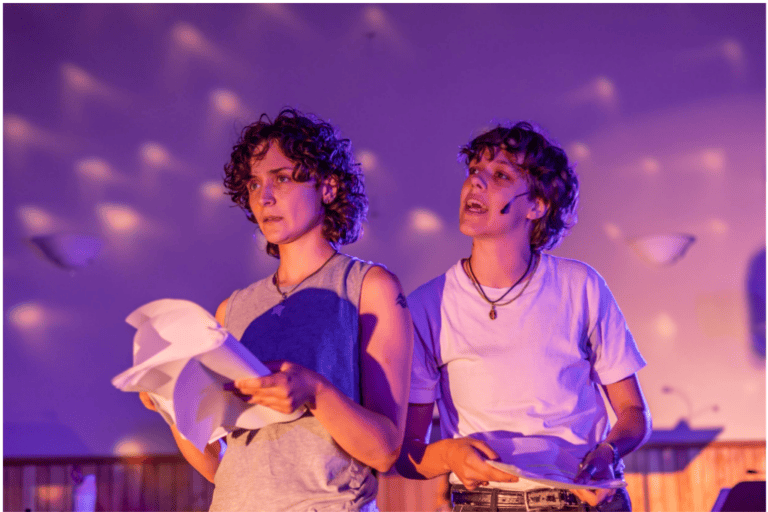
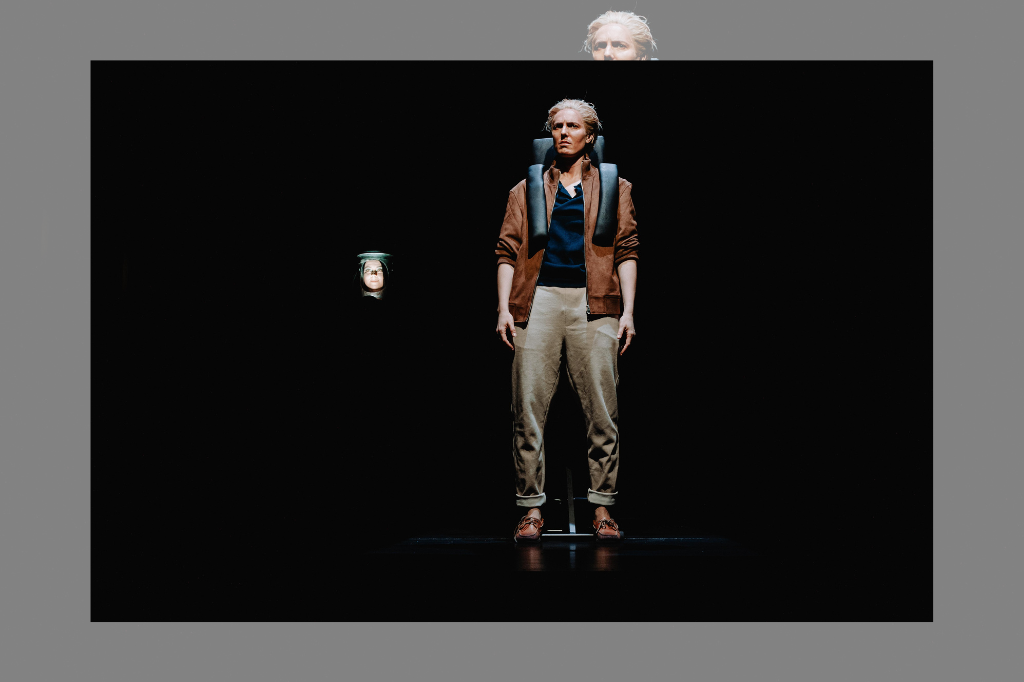 iPhoto caption: Lauren Gillis and Alaine Hutton in 'Public Consumption.' Photo by Eden Graham.
Shows intending to critique the internet can grow slack when they rely on literal representations of the digital realm to entertain the audience. I found this to be the case with the recent Canadian premiere of Octet: the flashing screens that littered the playing space made the musical’s depiction of internet addiction fun, but perhaps a little hypocritical, in that the visuals entranced us by scratching similar dopamine receptors as our phones.
Lester Trips (Theatre), led by creator-performers Alaine Hutton and Lauren Gillis, offers an opposing vision of the internet: one not bright and maximalist, but empty and void-like. Rather than directly representing online life, the duo speculates — with virtuosity — about how the digital world affects our bodies. And their findings are by no means comfortable.
The company’s latest world premiere, Public Consumption, is the second in a trilogy of horror-inflected works about digital spaces, AI, and labour; like the first, Honey I’m Home (which I loved), it’s around an hour long, set in a dystopian near-future, and makes excellent use of Factory Theatre’s narrow Studio Theatre stage. Honey I’m Home centred a relatively sympathetic office worker, but Public Consumption‘s protagonist is asshole movie star Navy Caine (Hutton), whose military first name and viral cannibal sexts call to mind the actor Armie Hammer.
A conviction of sexual assault has left Navy socially ostracized and under house arrest for 120 days. Eager to film his next flick, he asks for help from his lawyer (played by Gillis in rear projection), who submits him to a job bank offering brief, unpleasant contracts that would alleviate his sentence if successfully completed. The three gigs he tries are unbearable: a month of scrubbing smutty fanfiction for obscene language, a week of moderating violent videos, and an hour of appearing in deranged custom content commissioned by strangers.
As I’ve touched on in a couple of previous reviews, the drudgery of work has become an increasingly common theatrical theme in Toronto — this isn’t even the first 2025 production to reflect on the unenviable task of working as a content moderator. But, as in Honey I’m Home, Hutton and Gillis enrich their exploration of internet-era labour by weaving in several other compelling threads. The figurative roulette wheel of sentence-reducing jobs riffs on the ongoing gamification of our lives. An AI content-moderator-in-training named Ducky (played by Gillis) gets more powerful as the show progresses, paralleling the tech race of the moment. And the fact that Navy is so cartoonishly repulsive complicates the piece’s morals: Could he, maybe, deserve this just a lil’ bit?
These layered themes find their match in a singular aesthetic, defined in large part by the expressionistic lighting design of André du Toit, who constructs a distinctive visual frame for each character. When Navy moderates content, bright white light hits his whole body as he floats in an ocean of darkness — alone except for Ducky, who holds a glowing object that illuminates just her face. During Navy’s first two jobs, Ducky is creepily disembodied; in one startling sequence, her head even seems to levitate in waves across the stage. But by gig number three, du Toit lights her whole body and she dresses as a Gen Z influencer (set/props/costumes by Gillis and Hutton), making her appear as human as Navy.
Hutton and Gillis’ performances are piercingly economical. Navy struts with the simple confidence of someone who’s never been told no, but Ducky, with her clipped vocal patterns and static face, is an obstacle immoveable enough to disrupt his macho mustached momentum. As Navy begins to break down, his newfound torment wrenchingly contrasts his original self-assuredness. Yet the piece’s scariest scenes rest not on emotional outbursts, but utter numbness. Particularly memorable is the sequence where Navy’s chest seems to float toward the ceiling as his mouth hangs blankly open, but his voice continues speaking. The Factory website labels Public Consumption as “body horror speculative fiction,” but during moments like these, I found myself wondering if we might call it disembodiment horror.
You don’t need to have seen Honey I’m Home to appreciate Public Consumption. That said, in terms of length, both shows are just barely full meals, so I hope there’s one day a chance for Toronto audiences to take in the whole trilogy back-to-back. And then these diviners of digital discontent need to tour the country and world. Or at least the metaverse.
Public Consumption runs at Factory Theatre until December 7. More information is available here.
Intermission reviews are independent and unrelated to Intermission’s partnered content. Learn more about Intermission’s partnership model here.

Liam Donovan
Liam is Intermission’s senior editor. He lives in Toronto. His Substack newsletter is available at loamdonovan.substack.com.
LEARN MORE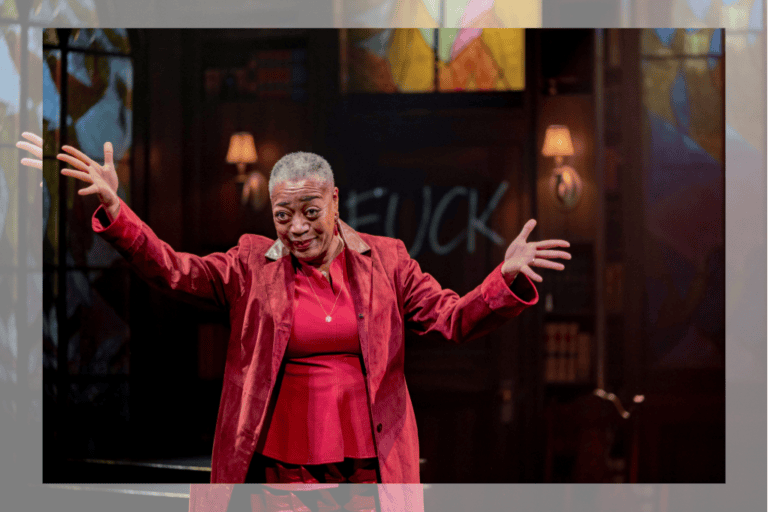 iPhoto caption: Karen Robinson in 'Prophetess.' Photo by Jae Yang.
REVIEW: In Tarragon’s outstanding Prophetess, language is both mighty and inadequate
Margaret’s facility with text helps her maneuver through an institution like York University, where words hold significant power. But the brilliant middle-aged scholar finds herself surprisingly unequipped to process the true sense of more elemental forces: love, grief, spiders.
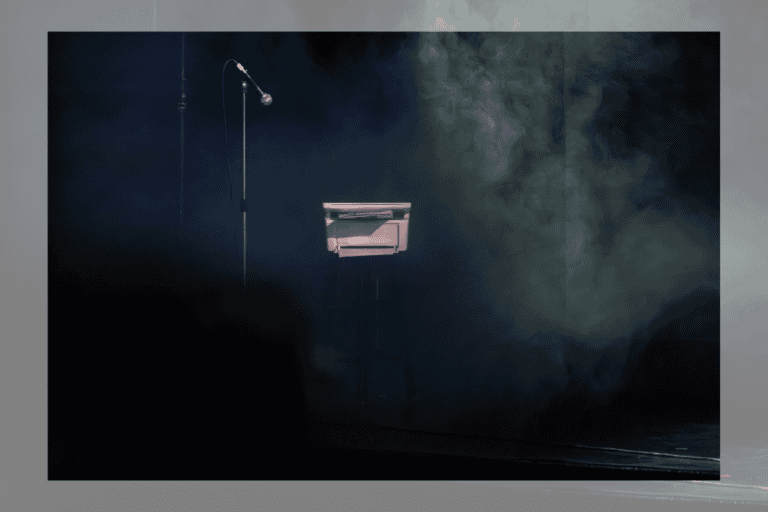 iPhoto caption: 'Documents Perform 3.' Photo by T Photo Factory.
Joining online from across the Americas, more than a dozen artists, artistic producers, cultural leaders, and policymakers add live suggestions to the document, together transforming stuffy bureaucratic language into a rowdy patchwork of compassionate imagining.
 iPhoto caption: Stratford's Tom Patterson Theatre. Photo by Ann Baggley.
2027 highlights include a new Canadian Jacob Two-Two musical and two of the Bard’s thornier plays: The Merchant of Venice and The Taming of the Shrew.
 iPhoto caption: Devon Michael Brown as Rusty Charlie with members of the 'Guys and Dolls' company.
“It's so exhausting, but it's really rewarding when you get to dance so full-out,” says Devon Michael Brown. “You get to use your technique and your training to the fullest extent.”
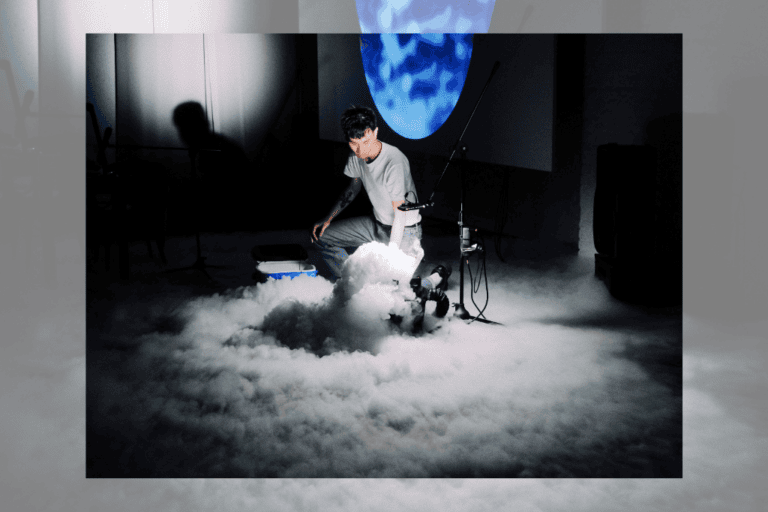 iPhoto caption: Ping-Hsiang Wang in 'Retina Maneuver.' Photo by Hang Su.
REVIEW: At this year’s SummerWorks Performance Festival, physical storytelling is central
From a dancer becoming a canine to a shy theatre director practicing his swordsmanship, the shows I’ve seen so far use performers’ bodies to dramatize defiance.
 iPhoto caption: Anna Morreale and Luca McPhee perform in 'From Stardust' at the 2025 MADGEN Theatre Festival. Photo by Dave Klassen.
MADGEN Theatre Festival returns to the Danforth
Theatre of the Beat selected four producers under the age of 30 to receive paid mentorship from Toronto theatre-makers. From August 20 to 22, each member of the cohort mounts a new one-act Canadian play.
Comments