
REVIEW: Punctuate! Theatre’s Strife opens up perspectives on grief, activism, and the oil industry
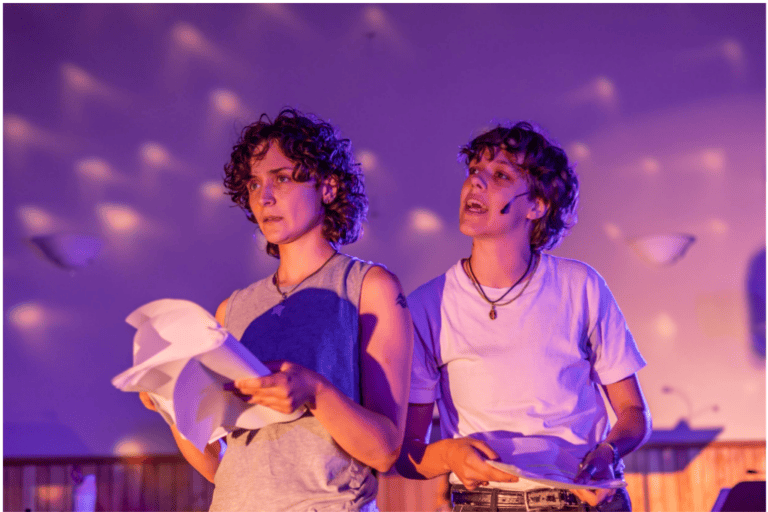
 iPhoto caption: Tracey Nepinak and Teneil Whiskeyjack in 'Strife.' Photo by Jae Yang.
Opinion is the engine of Métis playwright Matthew MacKenzie’s Strife, playing in a Punctuate! Theatre production at the Tarragon Theatre Extraspace.
In Edmonton, a young man named Nathan meets an abrupt death, and everyone in his Indigenous community interprets the situation differently; viewpoints take form, then clash.
To further describe the world premiere’s events is, inevitably, to take sides. Language does that. But MacKenzie and director Yvette Nolan have crafted a drama in which every character is worth hearing. What follows is my attempt to listen — perspective by perspective.
THE SISTER, played by Teneil Whiskeyjack (Cree)
Monique lost a brother.
A month ago, Nathan was killed in the aftermath of a protest. He and Monique weren’t speaking at the time; his climate activism had grown all-encompassing, and Monique considers herself apolitical. For her, protesting is based on the questionable foundation that someone powerful is going to listen.
Dressed in a leather jacket and blue jeans (costumes are by Jackie Chau), Whiskeyjack’s Monique confronts her pain with dignity: shoulders wide, gait firm, head high. But she struggles to make sense of her Nathan-less world, and wonders about grief’s purpose. Months pass as she thinks through her existential questions with a counsellor, who assesses her readiness to return to work in the tar sands — a job Nathan was OK with her having, until he wasn’t.
When journalists start to call, she’s happy to leave the microphone to Nathan’s mentor, a 60-something-year-old professor who he spoke of highly.
THE MENTOR, played by Valerie Planche (Métis)
Eleanor lost a student.
Before Nathan died, he was a research assistant completing a master’s degree. She’ll never forget his insatiable curiosity about how systemic injustice affects their people.
The police say Nathan’s death is a mystery, but she knows that’s bullshit: he was an Indigenous climate activist, killed after a protest demanding climate justice. How could the motive be anything but political? Extractivist capitalism has brainwashed law enforcement, the media, and a vast swath of locals. It’s her duty to keep up the pressure.
THE BROTHER-IN-LAW, played by Jesse Gervais (Métis)
Eddy lost a friend.
Monique’s common-law partner, Eddy is proud to work as a manager in the oil industry. He and Nathan were political opposites, but their debates belied love: Nathan was just a teenager when Eddy and Monique started dating, and the two men’s relationship became family-like.
What pisses him off is Eleanor. In his view, she’s politicizing Nathan’s death without evidence. He’s doubtful that vilifying the police during vigils, protests, and speeches will convince them to dedicate time to the case. But it might help Eleanor sell books.
Gervais’ Eddy complains about Eleanor to Monique with an almost belligerent insistence. Wearing Edmonton Oilers merch, he charges, bull-like, through the space, his words dripping with skepticism. Monique describes Nathan as similarly mouthy; it’s easy to imagine how his energy would’ve balanced out Eddy’s.
THE SOULMATE, played by Grace Lamarche (Cree/Métis)
Sarah lost a partner.
While others in Generation Z scuttle from one social cause to another, she and Nathan believed in prioritizing climate justice. With him gone, she’s doubled down on her support for Eleanor; she sees the attack on Nathan as an attack on their entire community, and appreciates how their professor is uniting people.
Lamarche’s Grace allows emotion to sweep her away. She recalls Nathan’s openness to nature, and regrets not being with him on that fateful night. Her tears yank the tragedy back to a human scale.
THE COUNSELLOR, played by Michaela Washburn (Métis)
Andrea watches from her office.
She parses Monique’s life story, touching on a range of memories, from the night she met Eddy to the moment she discovered Nathan had gone missing.
Clean-cut, professional, and blazer-clad, Andrea only hints at her opinions. She prods Monique toward feeling proud about having cared for Nathan after their grandmother died. And she frames grief as the “act of trying to comprehend the incomprehensible.” But mostly, she listens.
THE CRITIC, played by Liam Donovan (settler)
Liam watches from an aisle seat in the sixth row.
He recalls MacKenzie telling Intermission that he hopes Strife can be “a space where Indigenous characters engage with Indigenous issues on their own terms, free from parameters set by settlers.” And as the play unfolds, a town-hall-like quality emerges: the actors often seem to be projecting the script’s pointed arguments at the crowd as much as at each other. Their words frequently relate to the oil industry, but, it seems to Liam, the drama’s real focus is Nathan, and the question of who has the right to speak for him, as well as Indigenous communities more generally.
A couple of natural follow-ups arise: Which spectators have the right to speak for Nathan, his family, and his friends? And where does that leave critics? Nolan seems to acknowledge these ambiguities through the staging of Eddy’s first entrance, which physically frames him as an audience member. He sits among the crowd (on the aisle!), guzzling beer and ranting about anti-pipeline policies over a blaring hockey-game soundscape designed by Richard Feren.
Liam experiences a range of in-the-moment personal reactions. He admires the bloody moon that looms on the backdrop of Chau’s set, and the way it combines with Za Hughes’ textured lighting design to create a painterly effect that persists even as the narrative leaps from location to location with the help of three differently sized tables. He appreciates MacKenzie’s approach of interweaving perspectives, though he finds that in Nolan’s production, the tone swerves with a sometimes disorienting ferocity — from Eddy’s farcical bluster to Grace’s heartbroken sobs.
He wonders about the capacity of a traditional theatre review to describe, analyze, and evaluate a show that itself destabilizes who can comment on its narrative.
Through research, he’s able to decode the untranslated Cree syllabics integrated into Chau’s miniature scenic depiction of a streetcar on Edmonton’s High Level Bridge: ᐊᒥᐢᑿᒌᐚᐢᑲᐦᐃᑲᐣ means “beaver hills house,” and is the Cree name for the area.
What other, more subtle things did he miss while watching? And how can criticism be useful while emphasizing that it, too, is only one perspective? Perhaps the fact that these questions feel urgent is a sign MacKenzie has succeeded in complicating the conversation.
THE OWL, played by Tracey Nepinak (Cree)
A great grey owl watches from a perch on the bridge.
She shadows the play’s grieving characters and offers occasional commentary. Mostly she encourages people to follow their instincts, but there are wry dashes of critique; with an eye-roll to the audience, she deems one of Eleanor’s more extreme statements “a crock of shit.”
The play offers plenty of hints as to what this animal might symbolize, with Andrea asking, rather literally: “What do you think the Owl represents?” The answer, or the start of it, is that Nathan loved the creatures, and was both fascinated and terrified by the way they regurgitate undigested bones. Early on, the Owl identifies herself as a “harbinger of change,” which fits the drama’s howling political and emotional winds.
Also pertinent, in a show where viewpoints are central, is the Owl’s role as spectator. Even as fog engulfs Edmonton, the Owl sees and hears all: the sister, working through her numbness; the mentor, rousing protestors; the brother-in-law, raising his voice; the soulmate, grieving in front of a river; the counsellor, taking notes in her binder; and the audience, gazing back from their seats.
With her ancient habitat playing unexpected host to considerable strife, it’d be understandable if she retreated to safer treetops.
Instead, she hears an argument, and leans in.
Strife runs at Tarragon Theatre until April 26. More information is available here.
Intermission reviews are independent and unrelated to Intermission’s partnered content. Learn more about Intermission’s partnership model here.

Liam Donovan
Liam is Intermission’s senior editor. He lives in Toronto. His Substack newsletter is available at loamdonovan.substack.com.
LEARN MOREComments
Leave a Comment
 iPhoto caption: Devon Michael Brown as Rusty Charlie with members of the 'Guys and Dolls' company. Stratford Festival 2026. Photo by Ann Baggley.
“It's so exhausting, but it's really rewarding when you get to dance so full-out,” says Devon Michael Brown. “You get to use your technique and your training to the fullest extent.”
 iPhoto caption: Ping-Hsiang Wang in 'Retina Maneuver.' Photo by Hang Su.
REVIEW: At this year’s SummerWorks Performance Festival, physical storytelling is central
From a dancer becoming a canine to a shy theatre director practicing his swordsmanship, the shows I’ve seen so far use performers’ bodies to dramatize defiance.
 iPhoto caption: Anna Morreale and Luca McPhee perform in 'From Stardust' at the 2025 MADGEN Theatre Festival. Photo by Dave Klassen.
MADGEN Theatre Festival returns to the Danforth
Theatre of the Beat selected four producers under the age of 30 to receive paid mentorship from Toronto theatre-makers. From August 20 to 22, each member of the cohort mounts a new one-act Canadian play.
 iPhoto caption: Steven Sutcliffe and company in 'Twelfth Night.' Photo by Dahlia Katz.
REVIEW: High Park Twelfth Night pays tribute to the crazy things we do for love
As the play’s events ping-pong between seriousness and frivolity, Caroline Toal’s Viola appears constantly aware of the dangerous contradictions in the air, remaining guarded against the chaos' pull — and yet never entirely abandoning the possibility of enchantment.
 iPhoto caption: Paul Gross in 'Waiting for Godot.' Photo by David Hou.
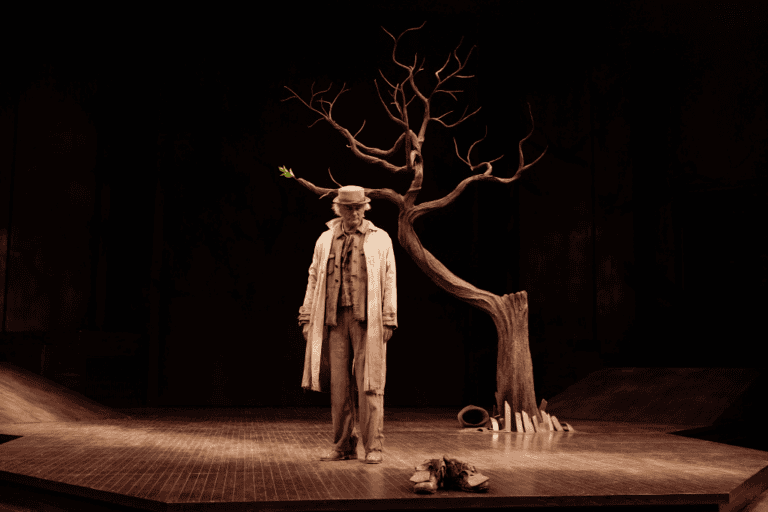
Why Paul Gross thinks Waiting for Godot is ‘one of the great achievements of human creativity’
“The audience is with you. You bring them in. There isn't a big division between the stage and the audience,” says Gross, currently playing Vladimir in Waiting for Godot at the Stratford Festival. “They’re the final piece of the storytelling. We need them to complete the circle.”
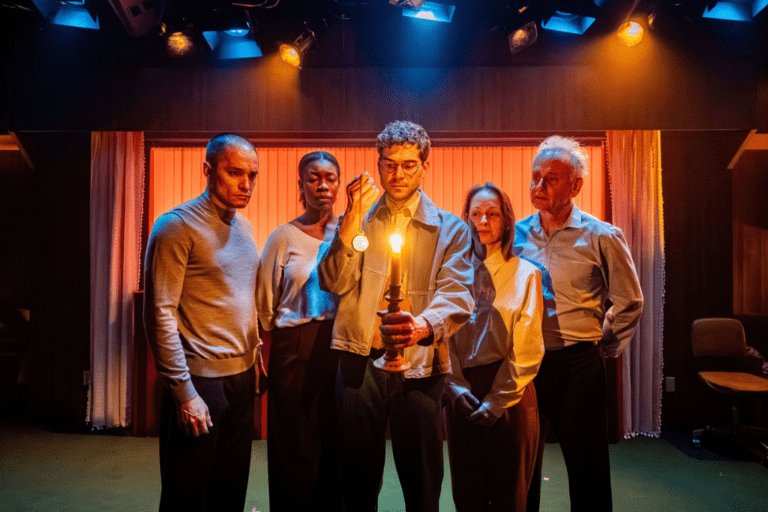 iPhoto caption: Karl Ang, Ivy Charles, Daniel Maslany, Mariya Khomutova, and Alon Nashman in 'The Division.' Photo by Dahlia Katz.
Productions at Crow’s and Theatre Passe Muraille win top honours at the 2026 Dora Awards
This evening at Meridian Hall, the Toronto Alliance for the Performing Arts (TAPA) announced the recipients of the 46th annual Dora Awards, celebrating local theatre, dance, and opera.
Damn. Just … damn. It oughta be illegal to write a review this good. Keep it up!