
In Ballets Jazz Montreal’s Dance Me, three choreographers put their own pirouette on a tribute to Leonard Cohen
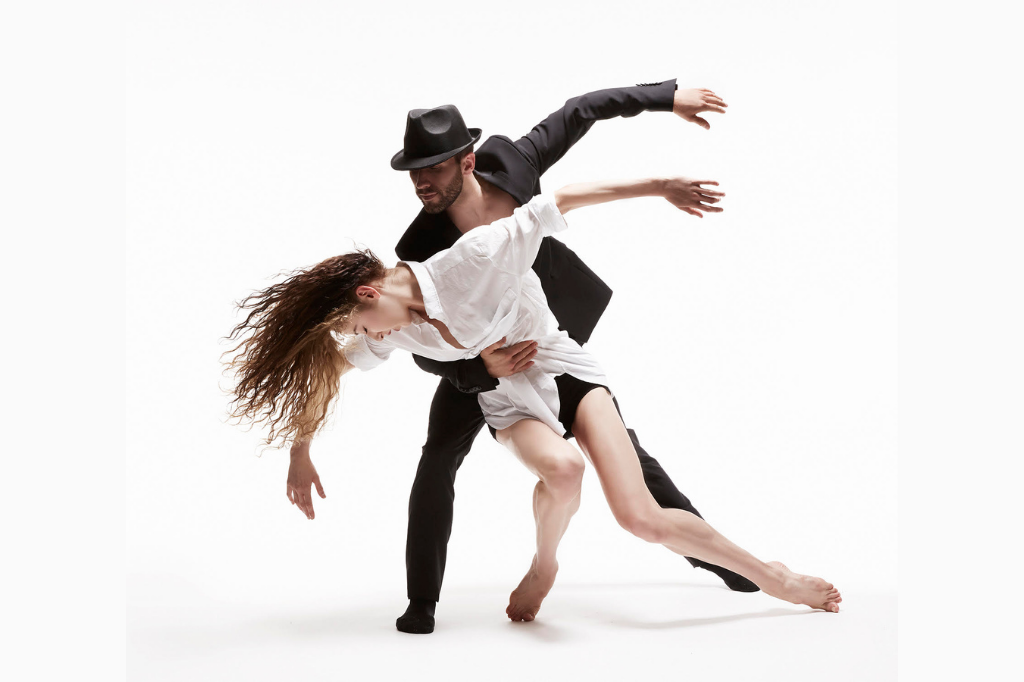 iPhoto caption: 'Dance Me,' choreographed by Andonis Foniadakis, Annabelle Lopez Ochoa, and Ihsan Rustem. Photo by Marc Montplaisir.
Next week, Toronto audiences can watch a storied dance company duet with the legacy of a Canadian icon.
Dance Me, created by Ballets Jazz Montreal (BJM) and presented by TO Live, fuses contemporary choreography with the work of musician and poet Leonard Cohen. Louis Robitaille, who led BJM from 1998 to 2020, conceived the idea for the production, which premiered in 2017. Over 75 minutes, 14 dancers animate a collage of songs and poetry from a broad swathe of Cohen’s career, spanning 1967 to his death in 2016.
The production itself is much more than a pas de deux. Director and dramaturge Eric Jean sculpted Dance Me in partnership with three different international choreographers: Andonis Foniadakis, Annabelle Lopez Ochoa, and Ihsan Rustem. In a phone call, BJM’s artistic and executive director Alexandra Damiani discussed this collision of styles.
“It’s very ambitious,” she said. “Each choreographer has a clear vision and language. Leonard Cohen wrote, ‘There is a crack in everything, that’s how the light gets in.’ When I see Foniadakis work with Cohen’s music, he finds the cracks between the notes, beats, and words.
“Rustem was more interested in the origin and making of the songs,” she continued. “Lopez Ochoa, in a duet at the end [of the show, made] something very human, with a different, feminine sensibility. It’s a wonderful journey because there’s so much contrast.”
Crucially, Dance Me doesn’t try to funnel Cohen’s words and music into a traditional narrative or predetermined message. Instead, it uses abstraction to facilitate personal connection.
“One of the strengths of the show is that you can immerse yourself in it and trust your own journey,” said Damiani. “The piece has these cryptic, simple moments that give each one of us the opportunity to create a story, or recall a memory.”
Damiani said the organizing principle of this journey is seasons. “Seasons of the year, but also of our lives,” she explained. “We have a dancer who represents Cohen, and we walk with him through his life, his work, and our memories of that work.” Video design by Hub Studio contributes to what Damiani described as Dance Me’s capacious, inviting feel.
Cohen was born and raised in Montreal, and referenced the city throughout his writings. Damiani said that audiences who pay close attention will note five, not four, seasons in Dance Me: a tribute to the heatwave that often greets the city in October.

Damiani herself is a Montreal transplant. Born in France, she spent 10 years as the artistic director of Cedar Lake Contemporary Ballet in New York, and even appeared in Darren Aronofsky’s film Black Swan as an uncompromising ballet mistress. Although Dance Me wasn’t a project she originated, she talked about her deep connection to this Cohen tribute: “I didn’t realize how much his music and his work were part of [me],” she reflected. “I realized that songs like ‘Hallelujah’ had been a soundtrack of my life without me realizing.”
For her, the pervasiveness and unifying power of Cohen’s music is what makes Dance Me so resonant.
“We performed in the States last year, and we had audiences singing along,” she said. “Cohen’s work is so unifying and encompasses so much of life. It’s beyond words. His poetry disarms you and connects you deeply to your humanity. In this moment where we’re getting more protectionist and divided as a society, it’s like a balm to the heart.”
Dance Me has toured internationally for the past nine years. (The COVID-19 pandemic forced a temporary hiatus.) 2026 will be audiences’ last chance to catch the production: BJM’s authorization to use Cohen’s music expires in December.
“It’s like wine, when you decant it and let it breathe,” Damiani said, reflecting on the production’s nine years in BJM’s repertoire. “It takes on a life of its own [after] meeting oxygen.
“Even with dancers coming and going over the years,” she continued. “I find there’s even more delicacy to the piece now. We know all the corners of these 75 minutes. It’s like a leather coat that’s been worn so many times, that now it’s like a second skin.”
For most of those 75 minutes, Dance Me relies on movement and image to communicate. But it also lets a few dancers exercise a muscle they seldom use onstage.
“There are dancers singing live during the show,” said Damiani. “It’s always surprising and touching, because you don’t expect that. It’s a moment of vulnerability and beauty.”
Dance Me – Music by Leonard Cohen runs April 10 and 11 at Meridian Hall. Tickets are available here.
TO Live is an Intermission partner. Learn more about Intermission’s partnership model here.
Nathaniel Hanula-James
Nathaniel Hanula-James is a multidisciplinary theatre artist who has worked across Canada as a dramaturg, playwright, performer, and administrator.
LEARN MORE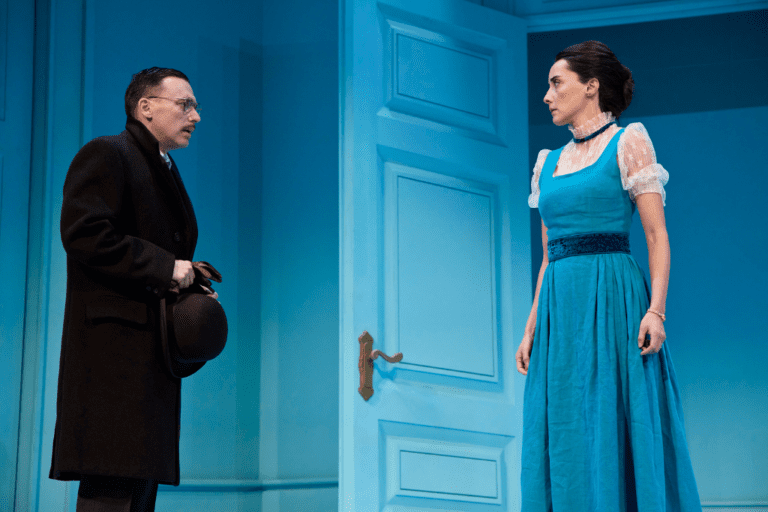 iPhoto caption: (L to R) Ron Pederson (Nils) and Alexandra Lainfiesta (Nora) in 'A Doll's House.' Photo by HarderLee.
Anita Rochon, director of A Doll’s House at Theatre Calgary, knows a good play has your back
“[I know] the rhythms and aspects of humanity that she’s interested in exploring,” Rochon said. “I’m always attracted to the complex, troubled, imperfect human. Ibsen and Herzog invite in complexity.”
 iPhoto caption: Headshots of Signy Lynch, Martin Julien, Anita Majumdar, Donna-Michelle St. Bernard, and Derrick Chua.
Five theatre professionals champion Canadian plays that deserve more life
Across the country, second productions are rare, especially for shows that premiered pre-pandemic. With this in mind, I spoke to five theatre folks about the Canadian play that each of them thinks deserves another live production.
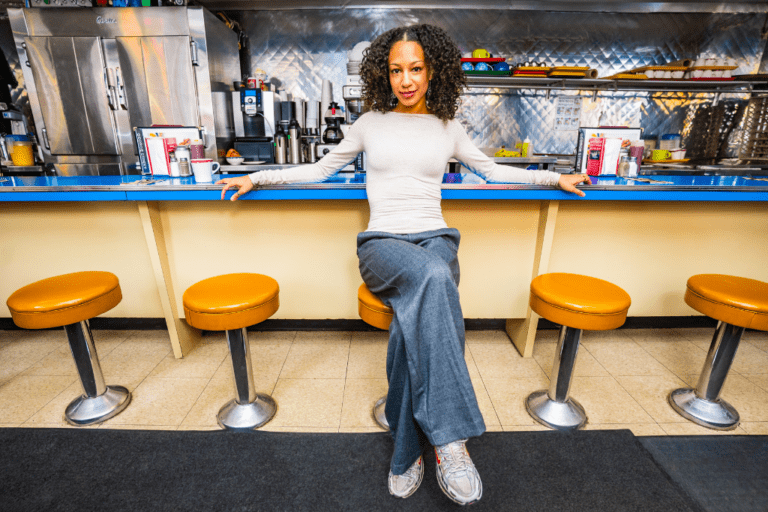 iPhoto caption: Jasmine Case for Intermission Magazine. Photo by Dahlia Katz. Shot at The George Street Diner.
Jasmine Case’s role in Clyde’s at Canadian Stage gives the dynamic performer plenty to chew on
“She’s a mother who has a child that deals with epilepsy,” says Case. “I grew up with epilepsy. I had a grand mal seizure as a kid. So I have a weird understanding of her relationship to her child.”
 iPhoto caption: Headshot by Andy Moro.
“A big part of what I consider this writing to be is an honoring of ancestors that I will never meet in person,” says Beagan. “[That includes Indigenous] ancestors who [may only be] distantly related to me, or not actually bloodline-related to me at all, because it feels like we have to do that wherever we are in this colonized nation."
 iPhoto caption: Photos of Eric Woolfe (by Dahlia Katz), Catherine Savoie, Evan Klassen (by Jerry Grajewski), and Heather Redfern.
"Arts centres are going to have to apply to a new housing and infrastructure ministry program, which hasn’t been created yet, in order to access funds," says Heather Redfern, executive director of the Cultch in Vancouver. "So I’m very concerned that federal [funding] for cultural infrastructure in this country has completely disappeared."
 iPhoto caption: Clare Coulter in 'Queen Maeve.' Photo by Jae Yang.
Clare Coulter brings a lifetime of experience to Judith Thompson’s Queen Maeve at Tarragon
“This is the first stage play I've done in such a long time,” says Coulter, “but I feel I've really learned what the stage asks of the actor: that they go beyond what we used to call the footlights and settle in to where the audience is.”
Comments