
REVIEW: Coal Mine’s American Buffalo humanizes its prickly central characters — for better or worse
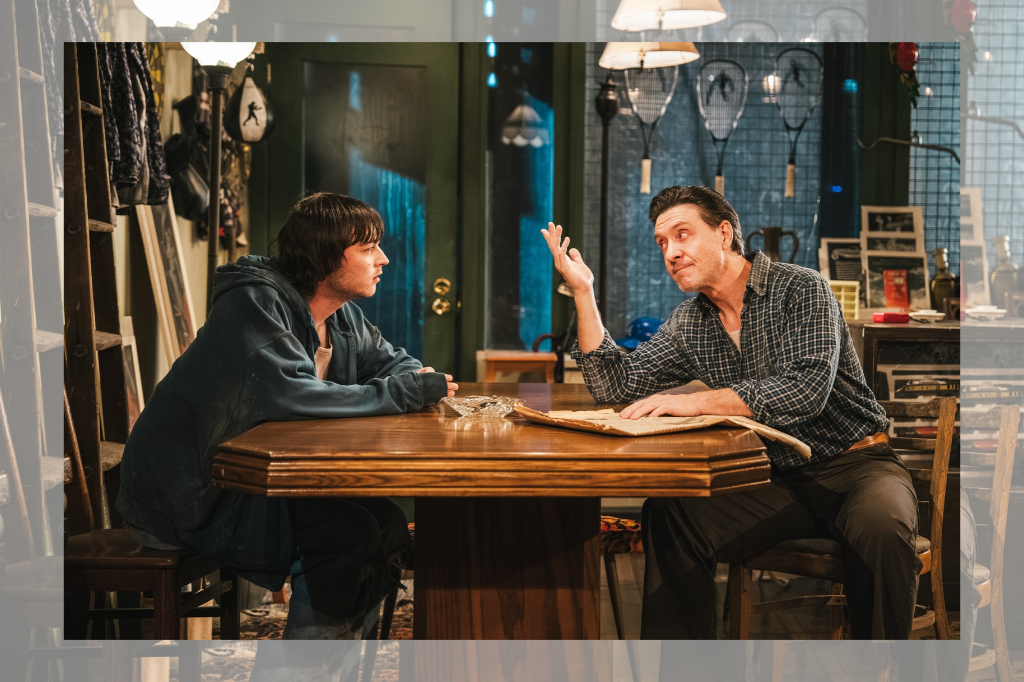 iPhoto caption: Mackenzie Wojcik and Shawn Doyle in 'American Buffalo.' Photo by Elana Emer.
How do you conduct business and form friendships in a world that trains you to trust no one? David Mamet’s 1975 play American Buffalo explores this question through the story of three men in Chicago who plot to steal a customer’s coin collection. The 105-minute play, directed by Jordan Laffrenier at Coal Mine Theatre, provides a bleak portrait of masculinity and capitalism that still resonates today — for the most part.
The show’s first act takes its time introducing Mamet’s characters: Don (Shawn Doyle), a resale shop owner; Bob (Mackenzie Wojcik), a recovering addict Don has taken under his wing; and Teach (Ted Dykstra, Coal Mine’s artistic director), Don’s erratic friend. They talk of business, poker, and the local diner, their lives seemingly unremarkable. Don breaks the humdrum when he reveals his plan to steal a coin collection from a customer, who bought a rare buffalo nickel from him for less than its value, and their day begins to unravel.
Mamet’s script is full of twists and turns. The playwright is known for his crude language — although 51 years later, the casual racism, homophobia, and misogyny are more shocking for their blatant show of prejudice than they are for their vulgarity. At the same time, Mamet works to humanize his characters, uncovering the love, friendship, and search for belonging that hide behind their machismo.
Take Teach, for example. On the surface, he shows a disdain for anyone and anything. He starts the show ranting about Ruthie, a queer woman who won $200 in their poker game the previous night, after she commented on him eating her partner’s food. He seems like the epitome of masculinity and swaggered confidence. But he also worries about his appearance, displaying weakness, and upsetting his friends. He even asks Don, “Are you mad at me?” like a son asking his dad for reassurance. Dykstra brings out the character’s softness, masterfully moving between overconfident macho-man and insecure boy.
Doyle matches Dykstra evenly, handling Mamet’s script with skill. The two verbally spar as Don and Teach argue about their different views. They flow from fighting partners to friendship to something almost parental, navigating the relationship’s complexity with seeming ease. At one point when everyone is on stage, the pair’s dynamic mirrors Don and Bob’s. Doyle’s Don attempts to parent both Teach and Bob at the same time, using different approaches for each man as he tries to get them to listen. Wojcik’s mousy and restless Bob grows more tragic as the show progresses and his desperation to please his surrogate parent increases.
Ken MacKenzie’s set and Steve Lucas’ lighting turn the Coal Mine’s proscenium stage into pages of an I Spy book. An array of lamps and ceiling lights illuminate the junk shop, the latter of which extend into the audience, making the show feel immersive. Assorted ’70s-era items cover the shop — it’s chaotic yet cohesive. In one display case, a statue of the Virgin Mary sits, overseeing the action. When things turn for the worse, a character’s movement cleverly places a chair in front of her, hiding her from view.
The play takes place in 1970s Chicago during a time of immense change. The program builds on the production’s context, mentioning the decline of local industry and gentrification during this time. However, the production leaves out some of the broader context and tensions of the time, including the rise of the women’s and queer rights movements, racial desegregation, and the responding rise in conservative populism. To many men, it felt like what they were owed was taken from them. Without this context, the play’s central conflict around stealing coins feels like an act of desperation. But for these men in that time, those coins would have been representative of much, much more.
Although the actors and production design are excellent, the lack of context and the script’s unsatisfying conclusion for its incorrigible characters left me underwhelmed. This is a story of male disillusionment and its power to destroy, which feels tiredly familiar in today’s society. The Coal Mine website states that “Mamet’s uncanny prescience makes us feel the birth of MAGA in 1975.” But in light of his changing political beliefs (hinted at in the program) and his recent Kennedy Center Honor from President Trump, the play’s social commentary felt hollow to me. In humanizing the characters and making them relatable, this production felt like it let them, and in turn Mamet, off the hook. Their behaviour was not inevitable, and I wish Coal Mine’s American Buffalo acknowledged this more.
American Buffalo runs at Coal Mine Theatre until December 6. More information is available here.
Intermission reviews are independent and unrelated to Intermission’s partnered content. Learn more about Intermission’s partnership model here.

Shivani Nathoo
Shivani (she/her) is an engineer and an interdisciplinary artist. Growing up, she floated between many mediums, including fibre and beading arts, music, and writing. As an adult, she carries this curiosity with her, continuously trying new things and growing her artistic practice. She was a participant of the Toronto Fringe's New Young Reviewers program in 2025. She also runs the blog Arts in the City, where she publishes reviews and essays on the Arts scene in Toronto. She is passionate about equity in the arts and STEM, and an avid fan of live performance. When she’s not working, you can find her in the audience at a theatre or concert hall.
LEARN MORE iPhoto caption: Ben Yoganathan and Anand Rajaram in 'A Fine Balance.' Photo by Dahlia Katz.
REVIEW: Crow’s adaptation of A Fine Balance sets a high bar for the 2026-27 Toronto theatre season
I left the theatre teary-eyed and heartbroken, but hopeful. As Canadians navigate rising poverty and our own economic crisis in an increasingly individualistic society, A Fine Balance is a poignant reminder of how life-changing coming together can be.
 iPhoto caption: Reese Cowley, Asher Rose and Jeff Yung in 'Pastoral.' Photo by Mike McPhaden.
REVIEW: Shakespeare in the Ruff’s Pastoral brings As You Like It into our unstable present
Through a reworked version of the famous “all the world’s a stage” monologue, it reminds audiences of humanity’s relative unimportance.
 iPhoto caption: Anne van Leeuwen and Kaitlin Race in 'Anywhere.' Photo by Mark Kreder.
REVIEW: Anywhere simmers with tension at the Assembly Theatre
The back and forth between actors Kaitlin Race and Anne van Leeuwen, who swap roles nightly, is exhilarating to watch.
 iPhoto caption: Gabriella Sundar Singh in 'Through the Eyes of God.' Photo by Jae Yang.
REVIEW: Anusree Roy’s Through the Eyes of God is a fast-paced, one-woman thriller
This sequel to Pyaasa revisits the themes of motherhood and sacrifice in present-day India through the experience of Chaya, a lower caste Bengali woman.
Comments