
REVIEW: Anusree Roy’s Through the Eyes of God is a fast-paced, one-woman thriller
 iPhoto caption: Gabriella Sundar Singh in 'Through the Eyes of God.' Photo by Jae Yang.
Chaya Das, the protagonist of Anusree Roy’s one-woman play Through the Eyes of God, will not let her daughter suffer the way she did. This sequel to Roy’s Dora Award-winning Pyaasa revisits the themes of motherhood and sacrifice in present-day India through the experience of Chaya (played by Gabriella Sundar Singh), a lower caste Bengali woman. No longer the child she was in Pyaasa, Chaya is now mother to a young daughter of her own, and determined to give the girl a better life.
The 50-minute one-act play opens with Chaya jailed for stealing food for her daughter. There, she learns that a cruel and ruthless man has trafficked her daughter almost 1,500 km away, to Delhi. What follows is a desperate and fast-paced journey to India’s capital city, as Chaya hunts for the kidnapper.
In Pyaasa, Roy explored how poverty, casteism, sexism, and corruption intersected in early-2000s India. By revisiting Chaya’s world in Through the Eyes of God (directed by Thomas Morgan Jones), she demonstrates how little has changed in 20 years. Although the casteism Chaya faces is less overt, the discrimination and barriers are still present.
In the first 27 days of 2026, 191 kids went missing in Delhi alone, and most were girls. The play takes the audience beyond this statistic, showing the immense barriers families face in getting their children back.
Roy’s work demonstrates how women and children face the brunt of poverty. And the struggles it represents stretch beyond India. On my Uber ride home from the show, the Afghan driver shared how women are banned from school, and millions are going hungry in his country. Here in Canada, according to statistics collected three years ago, 10.7 per cent of all children and almost 30 per cent of children in women-led single-parent households were living in poverty.
As a member of the Indian diaspora, I found Through the Eyes of God’s script accessible to western audiences without compromising its setting. While it contains less Bengali than Pyaasa, the syntax of the spoken English is still very Indian. For example, characters refer to each other by kinship terms out of respect, but where they would use the Bengali word (e.g. Didi) in Pyaasa, they instead use the English equivalent (sister). With the fast pace of the play, this grounds the audience in the Indian setting without losing them in translation.
The play features a rich ensemble of characters. From a police officer with eczema to a noodle wala (food vendor) who likes riddles, every supporting character has their own personality and quirks, which Sundar Singh steps into fully, moving between them with extreme precision.
Her Chaya has an intensity and a rugged determination that is evident from the start. When she speaks about her daughter, it is unmistakable that Chaya will go to any lengths to get her back. The character also radiates warmth and maternal instincts. In one scene where Chaya meets a young boy, Sundar Singh’s softness and gentleness allows the audience to see the type of person Chaya could be if circumstances were different.
Sundar Singh’s acting prowess shines most in scenes where her characters have quick moments of back-and-forth dialogue with each other. In one instance, Chaya is talking to the noodle wala and sharing riddles. The characters erupt into laughter, and Sundar Singh seamlessly transitions between the two, embodying their physicality, facial expressions, and laughs as they joke with each other.
Jawon Kang’s set is uncomplicated — a black box on which Singh stands, with shutters behind her on either side of the stage. David DeGrow’s lighting transforms the set into the various stops along Chaya’s journey. When she’s in jail, light shines through the shutters suggesting cell bars. Later, when she travels to Delhi, the lighting flickers, mimicking the train’s motion. Romeo Candido’s sound design is the final piece, providing background noise for each location and further activating the audience’s imagination.
Although Chaya draws a bad hand, she plays her cards with intentionality, grit, and a determination not to let her circumstances define her. It’s a drive she learned from her mother in Pyaasa, and is passing on to her daughter. As the mothers in both shows say: “Life is hard, but you have to believe in it.”
Through the Eyes of God runs at Theatre Passe Muraille until February 21. More information is available here.
Intermission reviews are independent and unrelated to Intermission’s partnered content. Learn more about Intermission’s partnership model here.

Shivani Nathoo
Shivani (she/her) is an engineer and an interdisciplinary artist. Growing up, she floated between many mediums, including fibre and beading arts, music, and writing. As an adult, she carries this curiosity with her, continuously trying new things and growing her artistic practice. She was a participant of the Toronto Fringe's New Young Reviewers program in 2025. She also runs the blog Arts in the City, where she publishes reviews and essays on the Arts scene in Toronto. She is passionate about equity in the arts and STEM, and an avid fan of live performance. When she’s not working, you can find her in the audience at a theatre or concert hall.
LEARN MORE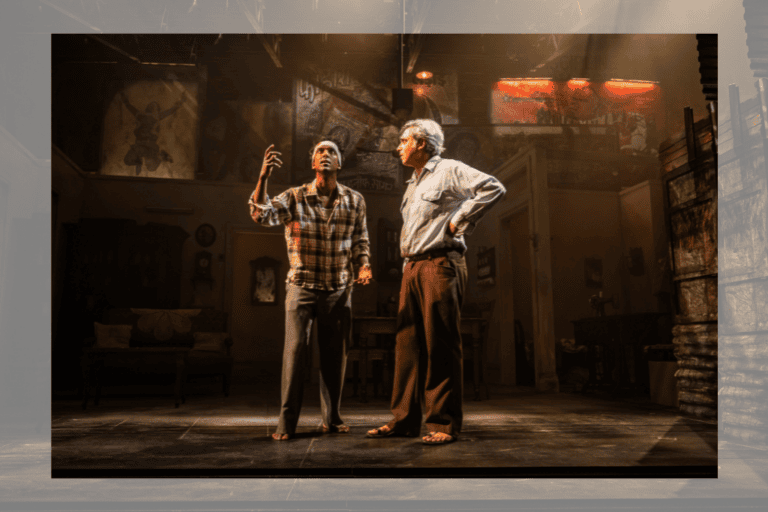 iPhoto caption: Ben Yoganathan and Anand Rajaram in 'A Fine Balance.' Photo by Dahlia Katz.
REVIEW: Crow’s adaptation of A Fine Balance sets a high bar for the 2026-27 Toronto theatre season
I left the theatre teary-eyed and heartbroken, but hopeful. As Canadians navigate rising poverty and our own economic crisis in an increasingly individualistic society, A Fine Balance is a poignant reminder of how life-changing coming together can be.
 iPhoto caption: Reese Cowley, Asher Rose and Jeff Yung in 'Pastoral.' Photo by Mike McPhaden.
REVIEW: Shakespeare in the Ruff’s Pastoral brings As You Like It into our unstable present
Through a reworked version of the famous “all the world’s a stage” monologue, it reminds audiences of humanity’s relative unimportance.
 iPhoto caption: Anne van Leeuwen and Kaitlin Race in 'Anywhere.' Photo by Mark Kreder.
REVIEW: Anywhere simmers with tension at the Assembly Theatre
The back and forth between actors Kaitlin Race and Anne van Leeuwen, who swap roles nightly, is exhilarating to watch.
Comments