
REVIEW: Orphan Song at Tarragon Theatre
You never know where a play by Sean Dixon might transport you. His previous works include A God in Need of Help, about the transportation of a valuable painting across the Alps in the early 17th century; The Wilborforce Hotel, a slice of 19th-century Black history in Canada that featured blackface performances; and The Orange Dot, a workplace drama about two contemporary Toronto arborists that turns into an archetypal, bloody showdown.
His latest, Orphan Song, takes us back to 40,000 BCE and stages a clash of cultures as an early modern human couple attempts to parent a Neanderthal child. Deeply rooted in Dixon’s own experience as an adoptive father and informed by impressive linguistic research, Orphan Song marks a point in which Dixon’s ambition may have gotten the better of him – or at least, cannot be realized within the limitations of the non-profit Canadian theatre funding model. As with several other productions in Tarragon’s current in-person programming, Orphan Song had been slated for the theatre’s 2019-20 season and was postponed for two years due to the pandemic.
The play’s complexities begin in its approach to language. The early modern characters speak an elementary form of English based on the Swadesh list, a compilation of 200 ideas and concepts that form the basis of most languages, while the Neanderthals’ speech is made up of musical whistles, hums, and trills. The difficulty that parents Gorse (Beau Dixon) and Mo (Sophie Goulet) have in connecting with their adoptive child Chicky (Kaitlin Morrow, who is also the production’s puppet designer) takes aural form as they speak to them in basic combinations of words we recognize (“Come chicky chicky. Come eat.”) and they respond in what sounds like birdsong.
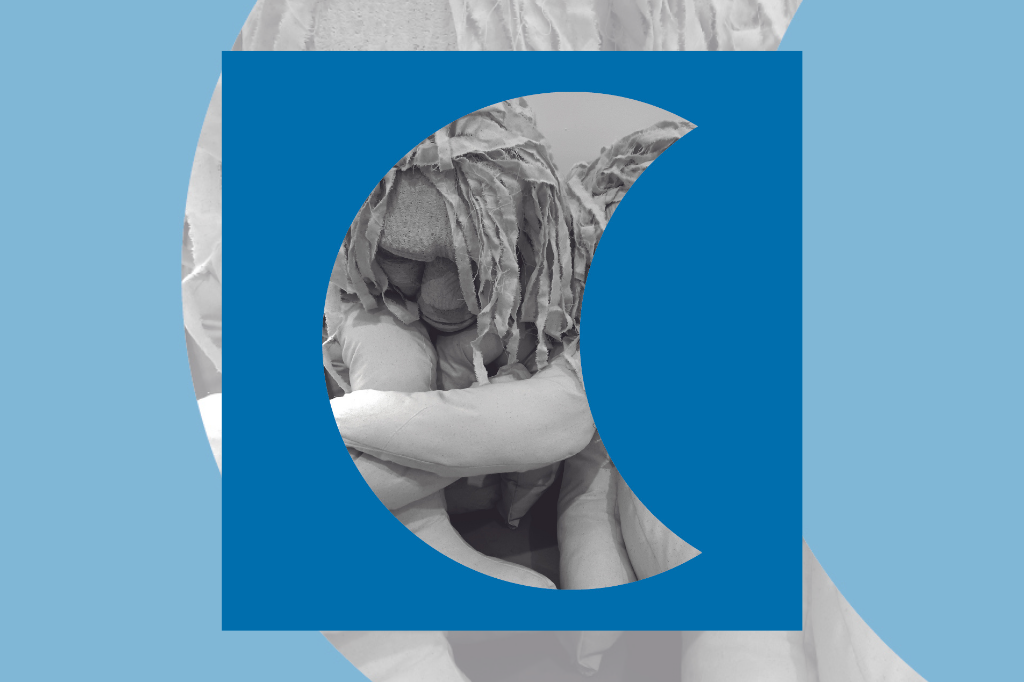
Dixon developed the play in dialogue with director Richard Rose, Tarragon’s former artistic director, who also directed A God in Need of Help. Rose’s production of Orphan Song attempts to create a layered physical and visual environment to complement and enhance Dixon’s work with language, theme, character, and relationship. The 11-person cast includes a chorus in simple black clothes and head coverings who play the Neanderthals by strapping Morrow’s white cloth puppets around their bodies. They also embody animals such as a large carrion bird, with two of them operating big wings and the other a head, moving together deftly. In such moments Morrow’s puppets, the actors’ physical work, Dixon’s writing, and Rose’s direction come together in a lovely, visually poetic way.
This is in contrast to the rough, basic nature of the early modern characters’ language, and this is where the production falters for me. Dixon, Goulet, and Terry Tweed (playing Gorse’s mother) labour to convey intense, complex emotion and relationship through the few words their language affords them and a generally 20th-century-naturalistic approach to physicality. With more time and resources, perhaps, a physical language of performance could have been developed that would have extended the characters’ expressivity, but with just the few words to carry the ideas here, there’s a clash. The brief passages when Gorse and Mo are afforded full access to contemporary English bring relief, as acting style and language approach unison.
The Neanderthal language is somewhat more effective, thanks to Morrow’s intense, physically engaging portrayal of the child Chicky, their non-verbal noises combining with motions and gestures in a compellingly expressive way. Musical director and sound designer Juliet Palmer has worked with the chorus to create an engaging sonic landscape of animal and other natural sounds.
Effort has clearly been spent in the rehearsal process on crafting an ensemble, but again, the amount of resource and time needed to bring a production of this ambition together seems well beyond what’s possible within the constraints of a single production budget. At times I found myself thinking of landmark 1990s production The Three Lives of Lucie Cabrol by UK-based Théâtre de Complicité (now called Complicité), in which an ensemble working collaboratively with Lecoq-trained director/actor Simon McBurney created an entire rural environment, with actors playing cows, flocks of birds, and even the land itself, manipulating all the props and set pieces themselves. Building such shared skills, vocabulary, and (yes) complicity takes months and years of ensemble work that were not available here.
There are also aspects of production that did not come to fruition. The show was initially announced to involve projection design but this was cut, and as of the afternoon of April 2, there is no credited lighting designer. This contributes to a visuallly static visual environment; more varied lighting effects might have distinguished different playing areas on stage and aid transitions which sometimes become muddy. The centrepiece of Graeme S. Thomson’s scenic design is three big fabric panels: projections onto these might have helped locate what was sometimes a confusing physical journey, particularly in the second act as the central characters move towards and away from a geographical area called the Big Water, where Chicky’s Neanderthal relatives have congregated.
There are profound concepts in this play which Dixon is clearly passionate about exploring, but which get bogged down by the weight and unfinished nature of the production. The shift in significance of the moon – which at first structures the characters’ lives and then becomes unreliable, in an intriguing monologue delivered by Kaitlyn Riordan – does not come through clearly, but seems related to the historical crux Dixon wishes to punctuate between the pre-modern and modern ages. Another set of references that pinged through my consciousness during the play’s final scenes were ET and Close Encounters of the Third Kind – those moments when contemporary human characters have their minds and spirits totally blown through encounters with sentient beings who we now might call more-than-human. As with theatre, successful sci-fi fantasy requires detailed and lengthy world-building to deliver wow moments: to the detriment of Orphan Song, that’s the kind of world-building that did not get completed here.
The subject matter and scope of reference in this play are well outside what one usually sees on Toronto stages, and even though the production didn’t get where it needed to, it seems certain to spark conversations among adventurous theatregoers.
Orphan Song runs at Tarragon Theatre through April 24. For more information, click here.
Karen Fricker
Karen Fricker is Intermission’s editorial director and adjunct professor of Dramatic Arts at Brock University. She has worked as a critic in Toronto, London (UK), Dublin, and New York City, and has a PhD in theatre studies from Trinity College, Dublin. Sustaining the field of theatre criticism in our digital age is a big focus of her work, through academic research projects and training/mentorship ventures including Page Turn and Youareacritic.com. She is co-director of the international research network Circus and its Others, and has researched the Eurovision Song Contest for two glorious decades and counting.
LEARN MORE iPhoto caption: Headshot of Antoni Cimolino. Photo by Ted Belton.
“You want to choose things that feel important to the moment,” he says about building a Stratford Festival season. “If you choose plays and they don’t resonate, it’s very hurtful. You believe in them and the power of them.”
 iPhoto caption: Members of the company in 'Ransacking Troy.' Photo by David Hou.
REVIEW: At the Stratford Festival, two adventurous new plays reflect on war
Erin Shields’ brilliant Ransacking Troy reimagines one of Western culture’s foundational narratives — the Trojan War — from the perspective of the women implicated in it. And in The Art of War, Yvette Nolan thoughtfully imagines the life of a Canadian soldier-artist in the Second World War, who’s wracked both by what he witnesses and the responsibility of recording it.
 iPhoto caption: Philip Myers as Mamillius (left) and Lucy Peacock as Time in 'The Winter's Tale.' Photo by David Hou.
Stratford Festival reviews: The Winter’s Tale and Anne of Green Gables
A winter story told by a melancholy child and a fanatical Lucy Maud Montgomery book club help frame the final two productions in the Stratford Festival’s 2025 opening week.
 iPhoto caption: Graphic by Krystal Abrigo.
York University’s Facing Backlash symposium builds solidarities in tough times
The symposium’s two packed days felt to me like the collective pursuit of an elusive, shape-shifting prey. But as participants shared experiences, and common-interest groups opened up their internal dialogue to the rest of the symposium, the contours of what we’re all up against started to come into focus for me, and I felt a collective sense of purpose growing.
 iPhoto caption: Photo by Jae Yang.
REVIEW: Guillermo Verdecchia’s Feast is a fascinating text, but Tarragon’s new production feels hazy
I found the play really resonant and rich and layered. It’s about globalization, privilege, travel, displacement, and inequity, and it brought up many associations and past experiences for me. But I don’t feel that Soheil Parsa’s production fully comes together.
 iPhoto caption: Photo by Marie-Andree Lemire.
REVIEW: Titaníque loves Céline Dion with all its heart
Content quibbles aside, Titaníque’s inarguable accomplishment is musical: What an amazing showcase for a Canadian cast’s vocal chops and capacity to deliver character through song.
Comments