
REVIEW: The Ballad of Johnny Longstaff at Harbourfront Centre

“We’re not actors…this might be a good time to mention there is no refund policy,” quip the Teesside-based folk trio known as the Young’uns as the lights in the theatre dim. This endearing, irreverent rapport will continue throughout much of the evening, but when the trio begins to sing, they handle their material with care. As it turns out, it doesn’t really matter whether or not they can act. They’re storytellers – effective ones – and the story they’re telling is worth listening to.
Co-produced by the Young’uns, Northern Stage, and Harbourfront Centre, The Ballad of Johnny Longstaff is making its North American debut after premiering in London’s West End to critical acclaim, and tells the inspirational story of its namesake. Born in the early 20th century in northern England into extreme poverty, Johnny grew up in the midst of the Hunger Marches and the Battle of Cable Street and went on to fight fascism in the Spanish Civil War (volunteering at just 17 years old, despite Britain’s official policy of non-intervention) and later World War II. A freedom fighter through and through, Johnny chose to sacrifice over satisfice time and time again in the face of oppression. His is a life with all the makings of a true folk hero, and when Johnny’s son, Duncan Longstaff, approached the Young’uns after a performance to suggest they write a song about him, it’s easy to see why they said yes.
The result of Duncan’s suggestion is actually a collection of folk songs – some humorous, some heartbreaking, all featuring the trio’s signature tight harmonies and lilting melodies – strung together with spoken narration and punctuated by extraordinary video design from animation designer Scott Turnbull and animator Aaron Brady.
The final piece of the puzzle is Johnny Longstaff himself. Conjured from historical photographs, original graphic design, and archival audio recordings (sound design by Mariam Rezaei), Johnny is as present in the theatre as the Young’uns. To hear Johnny speak of friendship, loss, and his relentless battle against the evil he saw in the world in his own words feels like a gift, and one that keeps on giving – you can listen to all six hours of Johnny’s oral history recordings on the Imperial War Museum’s website.
Given all the narrative mediums at play in this piece, it makes sense that Lorne Campbell has opted to practice restraint with his direction. Clean and functional, Campbell’s staging sees performers Sean Cooney, David Eagle, and Sam Carter shift through a series of linear formations within a compact set (Cooney and Eagle are original members of the Young’uns, Carter is a recent addition for this production and keeps up admirably well considering he’s only been performing the show for a few days). The simple scenic design from Kai Fischer (who also designed costumes, AV, and lighting )is a perfect complement for both the direction and video design. It features two projection surfaces, the larger of which unravels at the bottom evoking the image of a tattered flag. While the performers may sometimes be sidelined in favour of the more dynamic visuals happening on the projection screens, it feels fitting that the narrators of this story should hang out on its periphery, allowing Johnny to take centre stage.
An addition to the original script for its North American residency sees tidbits about Canadian involvement in the events covered in the production, including the Spanish Civil War, woven throughout The Ballad of Johnny Longstaff. The result is a little extra tug at local audiences’ heartstrings in what is already a very moving and uplifting piece of theatre.
The more cynical among us might suggest that perhaps The Ballad of Johnny Longstaff is too heartwarming a tale to impart the immediacy and the weight of the subject at hand. It could also be said that the bardic quality with which the Young’uns spin Johnny’s life into lore may serve to distance us from the relevancy of the oppressions Johnny chose to fight against in the not-so-long-ago past (somewhat shockingly, still less than a century ago).
However, this possibility is mediated by a dedication delivered at the opening of the performance honouring Joseph Hildebrand, a Canadian Forces veteran who was killed in Ukraine last week fighting against the Russian invasion. According to The Globe and Mail, in his application to join the efforts in Ukraine, Hildebrand stated that he was signing up because “the whole world needs to stand up against Putin and Russia’s aggression” and that “this is the best way I can support and uphold my morals and beliefs.” A modern day, Canadian Johnny Longstaff. Choices like Hildebrand’s remind us that Johnny’s story is not one of distant, heroic past. The themes in Johnny Longstaff are not just inspiring, they’re urgent, and an invitation for us all to reflect on what we’re willing to risk when we see freedom being threatened.
The Ballad of Johnny Longstaff runs until November 27 at the Harbourfront Centre Theatre. Tickets are available here.

Elizabeth Amos
Elizabeth Amos (she/her) is a New York and Toronto-based dramaturg, podcast producer, and theatre critic. A graduate of the American Repertory Theater Institute for Advanced Theater training at Harvard University and the Moscow Art School, recent credits include Jagged Little Pill (Broadway, American Repertory Theatre) and 1776 (Broadway, American Repertory Theatre).
LEARN MORE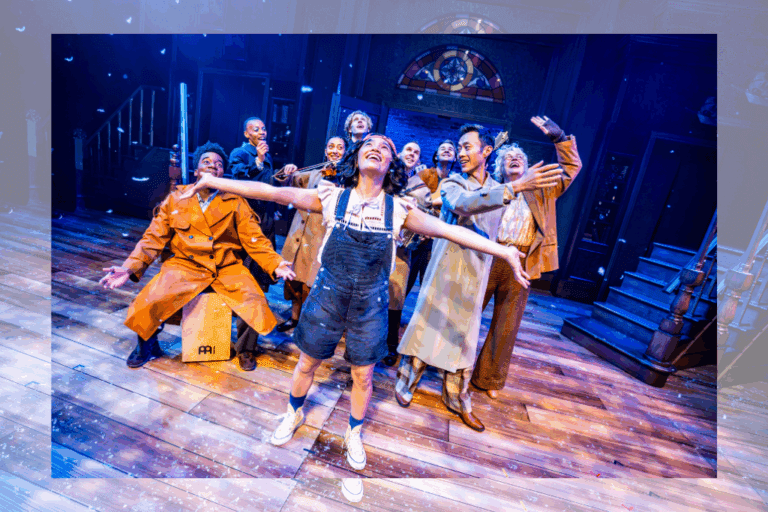 iPhoto caption: Members of the company of 'Narnia.' Photo by Dahlia Katz.
REVIEW: Bad Hats’ Narnia is a joyful, heartwarming escape
The spirit of openness and the joy of discovery rule over this Narnia. Open the wardrobe and see.
 iPhoto caption: Members of the company of 'Robin Hood.' Photo by Dahlia Katz.
REVIEW: Canadian Stage’s Robin Hood panto is anti-capitalist fun for the whole family
Following Ross Petty’s legacy of scene-stealing, Damien Atkins as the evil Prince John is easily the greatest delight of the show.
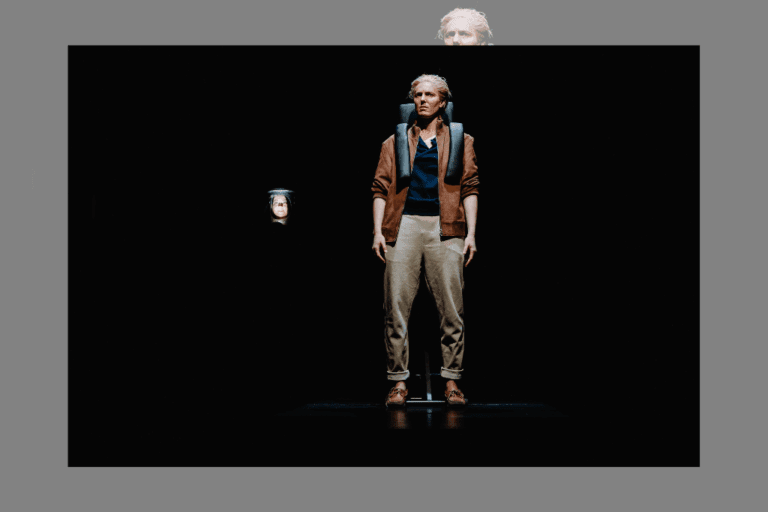 iPhoto caption: Lauren Gillis and Alaine Hutton in 'Public Consumption.' Photo by Eden Graham.
REVIEW: Lester Trips’ stylish Public Consumption captures the internet’s profound emptiness
Rather than directly representing online life, Public Consumption speculates — with virtuosity — about how the digital world affects our bodies. And the show's findings are by no means comfortable.
 iPhoto caption: Tony Ofori and Daren A. Herbert in 'Moonlight Schooner.' Photo by Dahlia Katz.
Kanika Ambrose’s Moonlight Schooner is animated and visually stunning, but its individual pieces don’t come together as neatly as I would've expected.
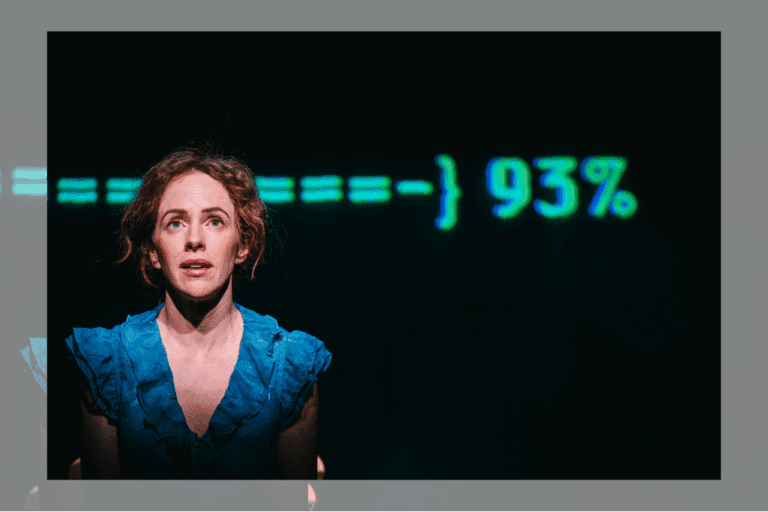 iPhoto caption: Fiona Mongillo in 'Reproduktion.' Photo by Ann Baggley.
REVIEW: Here For Now’s well-acted Reproduktion attempts to tackle too much
Amy Rutherford’s world premiere script is ambitious and the material it covers is complex — but the narrative feels disjointed.
 iPhoto caption: Kristen Thomson in 'Fulfillment Centre.' Photo by Elana Emer.
REVIEW: Coal Mine’s Fulfillment Centre asks how we end up alone, together
The production understands the play’s themes, yet feels limited by a script that delivers a package it never fully opens.

REVIEW: Prodigal at Howland Company/Crow’s Theatre
Prodigal will definitely make you laugh, possibly make you cry, and, hopefully, make you think a little bit as well.
 iPhoto caption: Amaka Umeh as the titular prince in Stratford Festival's 2022 production of Hamlet. Original Photo by David Hou. Image courtesy of Stratford Festival.
Stratford at School: The Festival Introduces Curated Educational Streaming Service
STRATFEST@HOME is a digital subscription service that allows patrons to stream the entire catalogue of Stratford Festival On Film recordings.
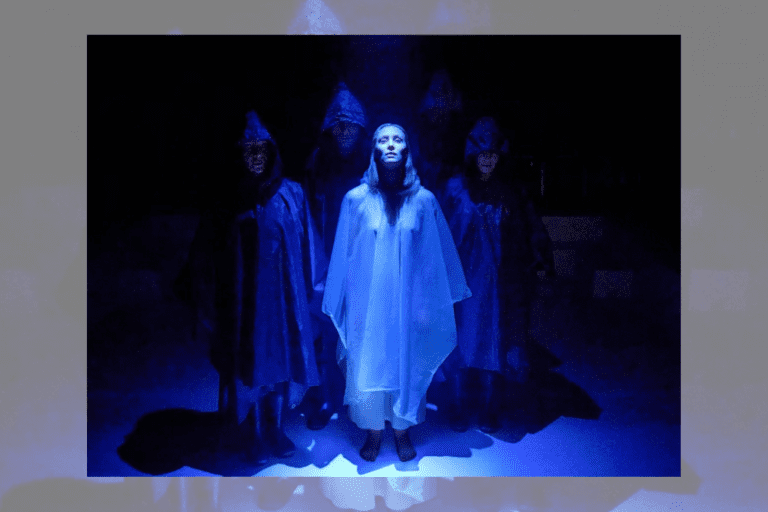 iPhoto caption: Photo by Tim Leyes
REVIEW: Yerma at Coal Mine Theatre
Coal Mine Theatre has made a memorable return to the stage, confidently christening their new home with the Canadian premiere of Simon Stone’s Yerma.
Comments