
REVIEW: Shorelines at TACTICS (Ottawa)
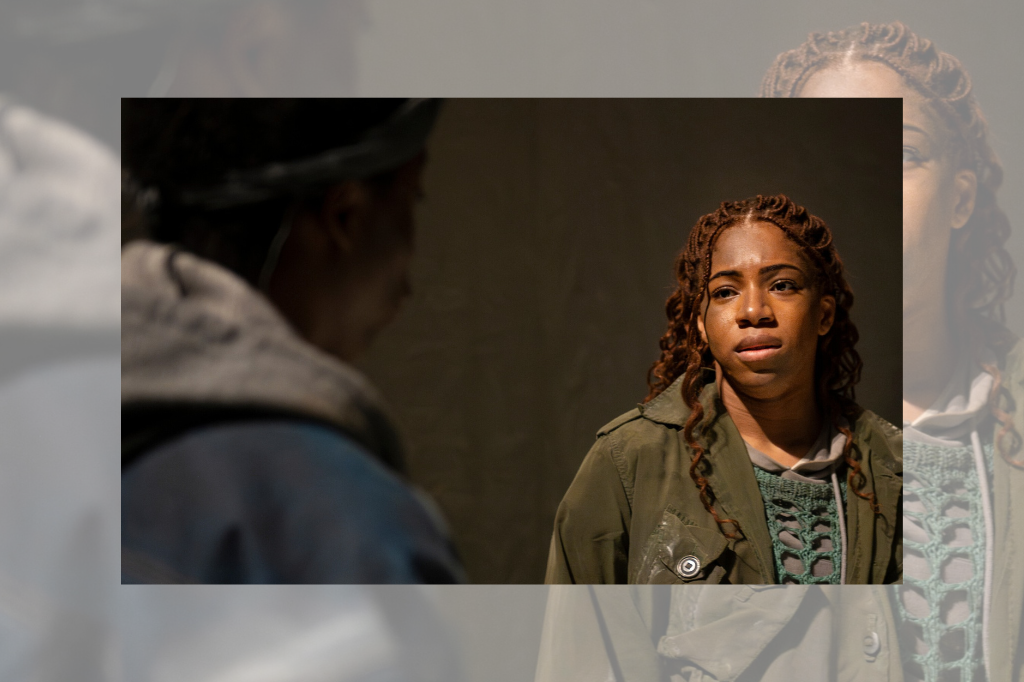
In her new play Shorelines, playwright Mishka Lavigne imagines a decrepit world suffering from the worst effects of the climate crisis. On its own, the show, playing at LabO in Ottawa, is effective, but it becomes increasingly powerful in its remarkable similarity to our own.
In this world, sea levels are rising, slowly, crawling over the carcases of cities long past on the shorelines of North America. The humid, heavy air that surrounds the edges of the continent render the interior dry, hot, and uncomfortable for even those who can afford to escape the ever-growing sea. Necessities taken once for granted, things like oxygen and water, are commodified, and human lives are measured in worth against other human lives. Shorelines showcases a world in which we never learned from our mistakes.
Shorelines situates this large-scale dystopian reality in the story of a set of twins, Alix (Vanessa Onukagha), and Evan (Letréal Farquharson), saddled with the weight of their father’s disappearance and the newfound sole responsibility for the care of their grandmother (Jacqui du Toit). Decay, erosion, and degradation are tangible in this world. Not only is their city decaying beneath their very feet: their grandmother, once a journalist warning about the worst possible effects of the climate crisis, is losing herself as well, a problem worsened by the family’s lack of water and effective medical care. Diminishing resources, for both their people and their land, have rendered this community desperate, stagnant, and suffering. Rather than water, the residents of this city by the shoreline must drink a saline compound to quench their thirst, though the salt keeps them desperately thirsty. As the water levels continue to rise, the government must step in as the city finds itself in danger. When a government official (Cara Pantalone) goes missing, the twins are confronted with a dilemma — to save themselves or risk everything to save their community.
This troubling world as represented in the play is evocative, effective, and sobering. It is made all the more so as the play unfolds, and more and more parallels are drawn between the dilapidated reality we see being presented on stage and our world today. The grandmother in her youth attended the 2015 Paris Climate Conference, we are told, and we are reminded that this world is our own, and that these consequences we see onstage are our future if nothing changes. Additionally, the play’s emphasis on class disparity, assimilation, and poverty conveys the ways the climate crisis has worsened cross-class relations in our own time. The second half of the play, thrilling, tragic, and riddled with a sense of profound anxiety, conjures parallels to the mishandling of the aftermath of Hurricane Katrina, as well as other examples of the intersection of marginalization and the climate crisis.
Lavigne has masterfully instilled these thematic elements into her script, which comes to life with the help of the artistic team behind Shorelines. Director Nicholas Leno has situated the audience on three sides of the stage, surrounding the performance almost entirely. This thrust staging is unbelievably effective; it makes the audience feel as though they are truly a part of the world being presented on stage, a feeling that contributes to the production’s themes. Additionally, this staging makes the performers seem surrounded, contributing to the atmosphere of claustrophobia latent within their situation. This feeling is aided greatly by Leno’s staging of the play.
The set of Shorelines is an old abandoned pool, the ladder to which lies high above the stage, eliciting a feeling of claustrophobia in the performers and even the audience, as the pool extends beyond the barriers of the stage and traps us all inside. Just as the characters are stagnated, so too is the audience. Scenographer Brian Smith has been able to expertly translate the thematic elements of the production into the set design. These aesthetics are coherent and cohesive with the lighting of the production, designed by Tristan-Oliver Breiding. The stage is lit with damp, heavy blues and greens, imparting a feeling of submerged desperation, as though the city at the shoreline is freckled with the sea closing in around it. All the technical aspects of Shorelines come together to create a deep sense of connectedness.
The performances are also evocative and effective. Cara Pantalone brings a sense of crestfallen, nostalgic regret to Portia, and her performance is comprised of equal parts rhadamanthine rigidity and child-like vulnerability that are compelling. Jacqui du Toit’s performance as Gran is powerful, and she believably tethers the grandmother’s traits of intelligence and degeneration heartbreakingly well. Farquharson and Onukagha are the perfect brother-sister pairing. They bounce off each other well, and the balance between bickering annoyance and genuine care and love is masterful. Both bring a sense of youth and innocence that is vetted through a tragic sense of necessitated adulthood, that adds to the sadness of their situation.
Lavigne’s Shorelines is a compelling and tragic story about our future, our faults, and our failures. It is also a story of our connectedness, and of the small-scale communities that make life worthwhile. Lavigne leaves a word for the audience in the program of the show with a sentiment that reflects the soul of Shorelines: “We are at a crossroad. The only way we’ll make it is together.”
Shorelines runs until May 13 at TACTICS in Ottawa. Tickets are available here.
Intermission reviews are independent and unrelated to Intermission’s partnered content. Learn more about Intermission’s partnership model here.

Victoria Johnston
Victoria Johnston is a graduate of Humanities and English at Carleton University, completing her studies in philosophy, history, and English. She is based in Ottawa. She spends much of her free time doting on her partner, and more importantly, their adorable gerbil, Cheese.
LEARN MORE
‘One Size Fits One’: In Conversation with Ottawa Fringe Coordinators about Accessibility
“Fringe is this beautiful annual reunion of theatre, arts, and performing arts people... we're a community and we support each other.”
Comments