
For the creators of Why Not Theatre’s Mahabharata, nothing is more contemporary than an ancient epic
 iPhoto caption: Miriam Fernandes as the Storyteller, with Anaka Maharaj-Sandhu as Arjuna and Neil D'Souza as Krishna in Why Not Theatre’s Mahabharata (Shaw Festival, 2023). Photo by David Cooper. Set design by Lorenzo Savoini, costume design by Gillian Gallow, lighting design by Kevin Lamotte, projection design by Hana S. Kim.
It took a creative team of almost 60 people to bring Why Not Theatre’s two-part, five-and-a-half-hour adaptation of the Mahabharata to life, but there’s one co-conspirator you won’t find listed in the program: time.
“I’ve been [telling] the company to embrace time as a collaborator,” said the production’s director Ravi Jain in an interview. Jain co-leads Why Not Theatre with Miriam Fernandes; together, the pair adapted Mahabharata for the stage. Written in Sanskrit and almost 4000 years old, the titular source material is the longest major epic poem ever penned and foundational to many South Asian cultures.
Since its premiere at the Shaw Festival in 2023, Why Not’s adaptation has toured to the Barbican in England and the Perth Festival in Australia. This April, Canadian Stage will present Mahabharata at Toronto’s Bluma Appel Theatre. Depending on the day, audiences can choose to experience each part on its own, or as one long experience, with a separately ticketed community meal in between. Hosted by two storytellers, the meal is a chance to savour some authentic Indian food — along with the themes and meanings of the main event’s ancient story.
It’s that very antiquity that poses an almost philosophical challenge to the show’s performers. “There’s the time that we’re in now, and there’s the ancient time of the story that’s actually tied to [something] more cosmological,” said Jain. For the company, there’s an “imagination that’s required to hold that space, [and] a humility.”
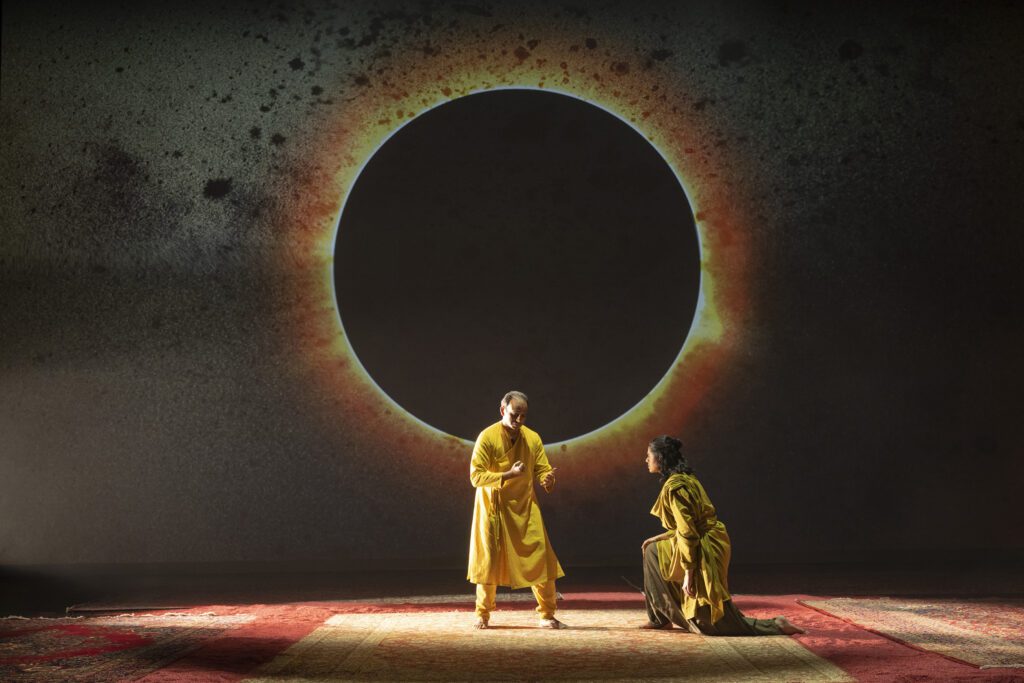
Since its compilation, the Mahabharata has been reinterpreted in countless forms, including English director Peter Brook’s nine-hour 1985 staging, as well as an iconic comic book series by publisher Amar Chitra Katha. It took eight years for Why Not’s adaptation to assume its current shape.
Fernandes joined the project in 2018, when she became co-leader of Why Not. Beyond co-writing the adaptation, Fernandes is also the show’s associate director and appears onstage in the role of the Storyteller, who guides the audience through Mahabharata’s concentric narratives.
“I’ve never had this experience as a performer… where it really feels like the experience of meeting the audience and telling the story keeps changing,” Fernandes reflected in the same interview. She noted how evolving global events have made different aspects of the show’s story sing — and sear.
Mahabharata “centralizes around a family,” she explained. “Two groups of cousins are warring over the throne to this kingdom, and who’s the rightful king, and who should own this land. They eventually end up going to war — a massive [conflict] that kills a billion people.”
During the 2023 Barbican run, “the day that we closed the show was October 7, which is when the whole world in the Middle East exploded again,” Fernandes said. “The show is really about cycles of revenge and genocide. We human beings keep getting into these cycles of hate and revenge and greed and ambition. We somehow never learn the lessons from this ancient wisdom.”
Jain agreed. “There’s a whole thread in the storytelling around the planet and ecocide,” he said. During the tour to Perth, “that was [an element] that the Australians really picked up on, because [of] their relationship to forest fires.” He also acknowledged the perspectives of “the South Asian community that’s seeing the story. There have been so many layers that [it’s] been really exciting to see unfold.”
Contributing additional layers are the international cast of performers — a total of 17 actors (including understudies) and six band members — hailing from across the South Asian diaspora. Jain described how each artist has brought their own unique skill set to the piece.
“We have Kathakali dancing and Odissi dancing in the show because there are performers with those particular trainings,” he said. “We have North and South Indian classical music because of the band composition. Most people were born somewhere [other than India but] have a relationship to [the country], like Miriam and [me]… There are some who know [the original Mahabharata] very well, but the majority didn’t until now. So that came with a lot of curiosity, a lot of responsibility, and a lot of fear that we all had to pass through, in order to find an authentic way for us to tell it.”
Why Not’s innovative telling juxtaposes the ancient art forms mentioned above with other forms both old and new — from Baroque opera to live video feeds.
The piece “starts away from you, and over time, it becomes very personal and very recognizable,” Jain said. “To go from more ancient forms to film acting and live camera feeds is a way of connecting the audience to that same journey: from being distanced to [realizing the story] is actually closer to you than you think.”
For Fernandes, “the forms of the story also help us deal with the problem of time.” She described how Mahabharata begins like “street theatre, people jumping in and out of a circle.” This simplicity of form means that “for the first half hour of the show, we [can] go back and forth in history a lot. Then… we start to sink in and meet characters and live with them for a while… Scenes start to emerge, technology starts to emerge, props start to emerge to help us land in this scene.”
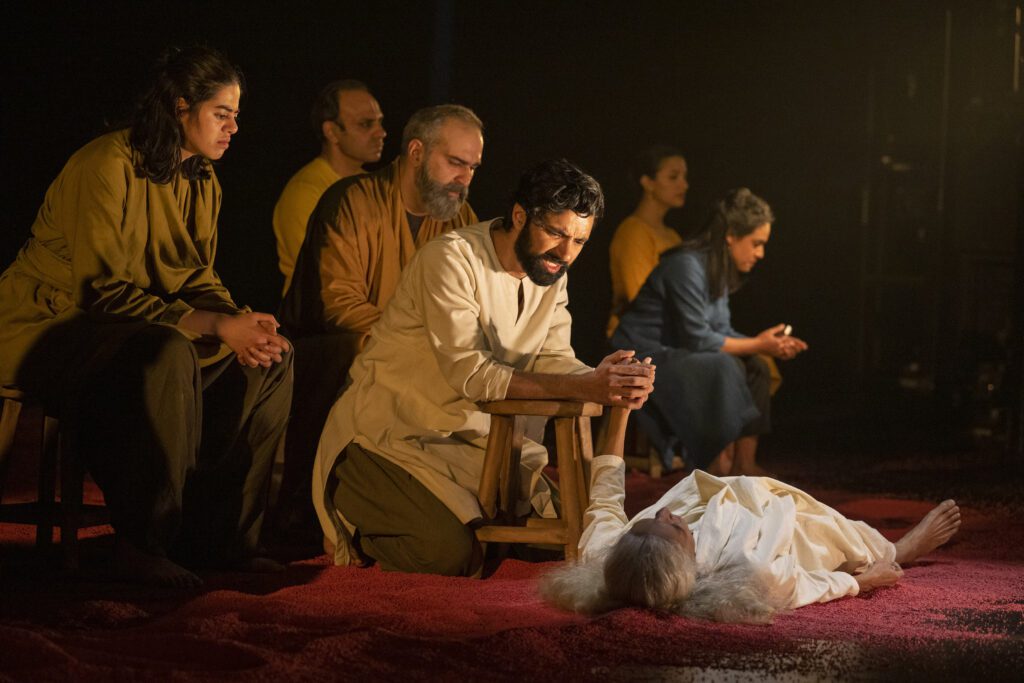
The problem of time is also central to how Jain and Fernandes think about Why Not’s international artistic mission.
“Always, we’re in some kind of intercultural, international conversation,” said Jain. “We’re playing with cultures, playing with languages, playing with forms of storytelling. Our differences are the things we have in common.” In prioritizing touring, he continued, the company is “sending these messages in a bottle so that people find them years from now, in order to speak to people that don’t yet exist, in a time that doesn’t exist.”
That’s the future — but Jain made a point of savouring the company’s present success. Mahabharata “is a really rare project in Canadian theatre… in terms of its collaborations, in terms of its size and scale, [and] in terms of the people making it,” he said.
“It’s a big moment, and we’re really proud of that.”
Part One of Mahabharata opens at the Bluma Appel Theatre on April 8, and runs until April 26. Part Two opens April 11 and runs until April 27. Tickets are available here.

Nathaniel Hanula-James
Nathaniel Hanula-James is a multidisciplinary theatre artist who has worked across Canada as a dramaturg, playwright, performer, and administrator.
LEARN MORE iPhoto caption: Portrait of Eric Woolfe. Photo by Dahlia Katz.
Eric Woolfe’s inventive horror theatre is a monster mash of artistic influences
For the past 26 years, Eldritch Theatre’s director of the uncanny has given ghoulies, ghosties, and long-legged beasties of all kinds a spot in the limelight, in productions that serve up puppets, magic, and a crumbling castle’s-worth of uncanny influences, including schlock-horror B-movies, Shakespeare at his bloodiest, and the fiction of H.P. Lovecraft.
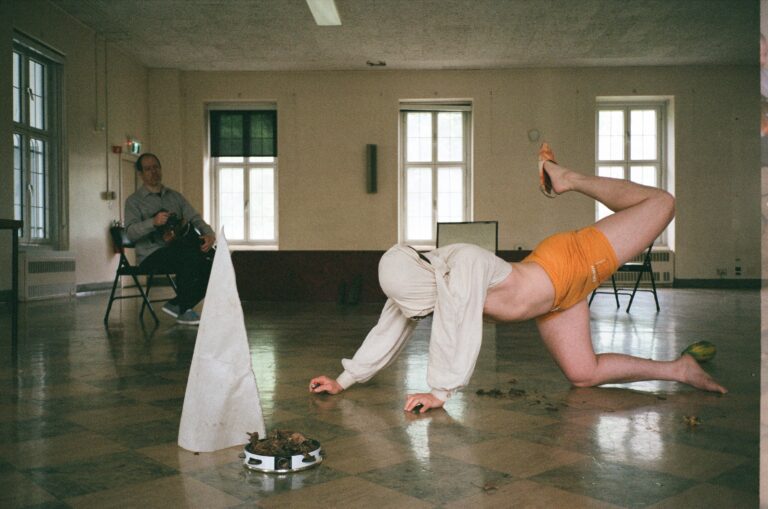 iPhoto caption: Nate Yaffe in 'Rot Hat.' Photo by Kinga Michalska.
This year’s SummerWorks Performance Festival strives to make accessibility intrinsic
The curated festival’s 36th edition features a range of works by Disabled and neurodivergent artists where the medium is very much the message.
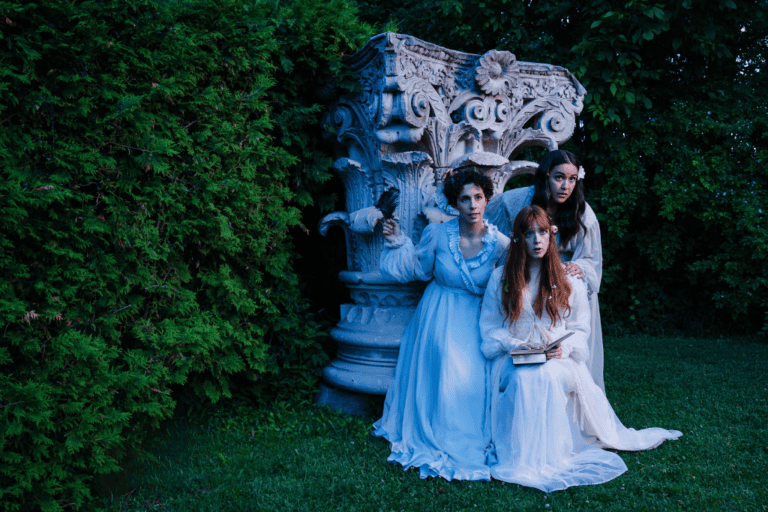 iPhoto caption: Laura Del Papa, Hilary Scott, and Lara Lucia in 'Brontë: The World Without.' Photo by Raph Nogal.
GFT’s Brontë: The World Without is a window into the ordinary lives of literary icons
Directed by Helen Juvonen in Guild Park and Gardens’ Greek Amphitheatre, The World Without follows sisters Emily, Charlotte, and Anne Brontë — the authors of Wuthering Heights, Jane Eyre, and The Tenant of Wildfell Hall, respectively.
 iPhoto caption: Photos of Shalon T. Webber-Heffernan, Paul Couillard, and James Knott courtesy of 7a*11d.
The organizers of the 7a*11d festival want you to know that performance art is still ‘punk as hell’
"There’s something about being live, with a sweaty, stinking, gross, dirty body, that’s just — you’re in it," says collective member Shalon T. Webber-Heffernan. "There’s some kind of alchemy going on that’s addictive to me. I think 7a*11d is sort of the dealer, if you will! It’s keeping us all hooked onto this weird obsession."
 iPhoto caption: Peter Wylde for Intermission Magazine. Photo by Dahlia Katz.
In memory of Peter Wylde, the time-travelling acting teacher
What follows is an edited and condensed collage, loosely organized by theme, that only scratches the surface of Wylde’s life and impact.
 iPhoto caption: Dance Macabre cast. In photo: Keira Marie Forde (front). Back: [L to R] Uche Ama, King Cosmos, Theresa Gomes and Thomas Fournier. Photo by Tiku Romello Fisher (TRF Media).
At the 2026 Toronto Fringe, Caribbean artists stage collisions of identity, power, and desire
In separate video conversations, the lead artists behind Danse Macabre, Ex-Change of Words, and Momme Domme spoke about approaching themes of Blackness, diaspora, power, and desire.
Comments