
Cette fois, en français: Returning Home to Solstice d’hiver
As in-person Canadian theatre slowly re-opens, Intermission’s Editors will be sharing personal reflections on the realities of being back in the theatre. These are not criticisms or reviews. These are not blog posts. They are history.
A crisp Sunday killed in the aisles of Dollarama. An ID dropped in the Yonge/Eglinton muck. Pinched rain boots. Slush.
Conquer the above. Appear at 26 Berkeley Street. First live performance of 2022. Nerves. Glittery stomach, eager and poised.
Incorrect COVID-19 vaccine certificate. Phone calls to provincial hotlines who don’t answer on Sundays. No QR code in sight. No entry to theatre.
Cry. Go home. Call mother and boyfriend and co-editor.
Cry.
My second attempt at seeing Solstice d’hiver at Théâtre français de Toronto goes much better — after three calls to different Ontario public health agencies, I finally have the QR code required to enter Canadian Stage. It’s now Wednesday, and I’m allowed to see the show.
I’ve been excited about it for months.
While still attending the University of Ottawa, in a theatre department led by TfT powerhouse Joël Beddows, I wrote an undergraduate term paper on this play, this strange and gorgeous offering from German playwright Roland Schimmelpfennig. I found myself enchanted by the play’s stage directions; the fallible passing of time; the characters encased in mystery, deceit, and sorrow. Solstice d’hiver (or Winter Solstice, when first I read it in 2020) lingered with me long after I submitted my term paper and forwarded it to Beddows upon request — I doubted I’d see the play staged in Canada.
How lucky I was to be wrong.
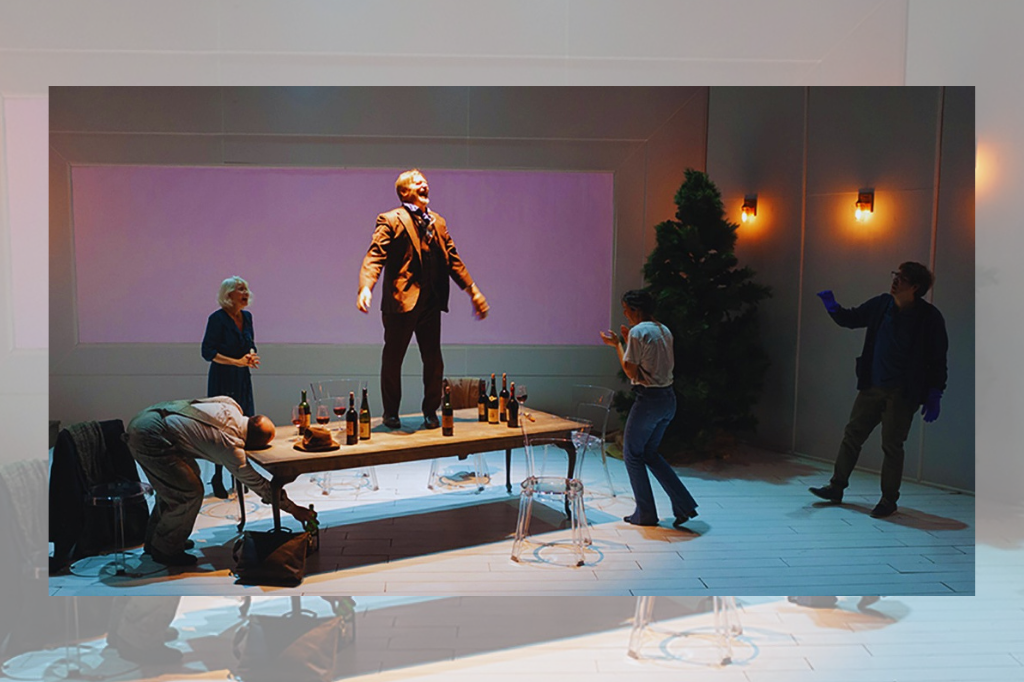
In my first trip to Canadian Stage since moving to Toronto (a first which feels long overdue as I settle into my seat), I get to witness the events of Solstice d’hiver unfold in real time: it’s Christmas Eve, and Albert and Bettina are getting ready for Christmas. Their young daughter abounds with impish chatter, roused by the Yuletide spirit and her own upcoming birthday — she’s represented onstage by only an empty chair. A knock at the door brings stranger Rudolph, who met Bettina’s mother on the train earlier in the day. Red wine abounds; aloof conversations on art and God bubble away; extramarital affairs scorch just beneath the surface of the festivities.
Bettina and Albert’s home seems straight from an IKEA catalogue, all clean edges and abstract paintings — the lighting, in this production, is particularly stunning, deftly oscillating between warmth and harshness as tensions rise to a frightening boil.
It’s the first time since moving to Toronto I’ve thought in French for more than a few moments — my life in Ottawa was a bilingual one, and that’s something I’ve found myself missing since August, the mercis to public transit operators and NAC ushers. Solstice d’hiver scratches the itch for French language as a new Torontonian, and provides surtitles as a useful safety net. I’m surprised how often I find myself glancing towards them — Schimmelpfennig is certainly a different beast in translation, and I’m grateful for the English captions as needed. Tu me manques, théâtre en français, I find myself thinking, revelling in French performance a short subway trip away, and not relegated to Ottawa or Quebec.
Solstice d’hiver, my first live theatre-going experience of 2022, truly does feel like a homecoming; a gasp of air; a pause from pandemic and asinine convoy. The performance feels personal and unfortunately prescient, with themes of anti-Semitism and nihilism gnawing away at a superficially cheerful Christmas Eve. The immediacy of live performance is sudden and wonderful, an illicit treat after the on-and-off lockdowns of the past two years.
In a dark room, a story unfolds, sharp and beautiful.
In a dark room, an acquaintance from my undergraduate life directs a powerhouse play with chilling resonance against Canadian current events: not enough people are here, not enough people are talking about it, not enough people will see it themselves.
In a dark room, we savour strong performances; imaginative projections; playwriting unlike much of the Canadian canon due to its postdramatic tinge.
In a dark room, the audience laughs together, and shifts its weight in uncomfortable chairs, and unwraps candies, and envelopes itself in scarves and coats.
In a dark room, we come back to the theatre — once again, we return home.

Aisling Murphy
Aisling is Intermission's former senior editor and the theatre reporter for the Globe and Mail. She likes British playwright Sarah Kane, most songs by Taylor Swift, and her cats, Fig and June. She was a 2024 fellow at the National Critics Institute in Waterford, CT.
LEARN MORE iPhoto caption: Photo by Aisling Murphy.
In the darkest months of Yukon winter, it’s all about the Sun Room
I’m here for a week in January as a guest of Nakai Theatre, a hub for theatrical experimentation and outside-the-box programming in Canada’s westernmost territory.

Armchairs, tattoos, and an online theatre magazine
When I started at Intermission, my world was limited to the confines of an armchair. Arts journalism was a high it felt dangerously fruitless to chase. The life stretched ahead of me was amorphous and frightening, a chasm filled with hand sanitizer and immigration concerns. It was worth crying over a spilled kombucha and scrubbing at the stain.
 iPhoto caption: Liz Appel headshot courtesy of Liz Appel.
Five questions with Wights playwright Liz Appel
Intermission spoke with Appel over email for a brief Q&A about Wights, now playing at Crow’s Theatre until February 9.

Call for applications: Publishing and editorial assistant
Intermission Magazine is seeking a dynamic and collaborative individual to join our team.
 iPhoto caption: What Writing Can Do: The 2025 Musical Theatre Critics Lab
Announcing What Writing Can Do: The 2025 Musical Theatre Critics Lab
What Writing Can Do is timed to coincide with the Grand and Theatre Aquarius’ co-production of Waitress, which will serve as a jumping-off point for discussions throughout the Lab.
 iPhoto caption: A Christmas Story production still by Dahlia Katz.
REVIEW: A Christmas Story feels fresh at Theatre Aquarius
If you want to catch A Christmas Story before it closes, good luck — the show is close to sold out, and with the talent on that stage, it’s not hard to see why.
Comments