
Hot Off the Press: The Virgin Trial
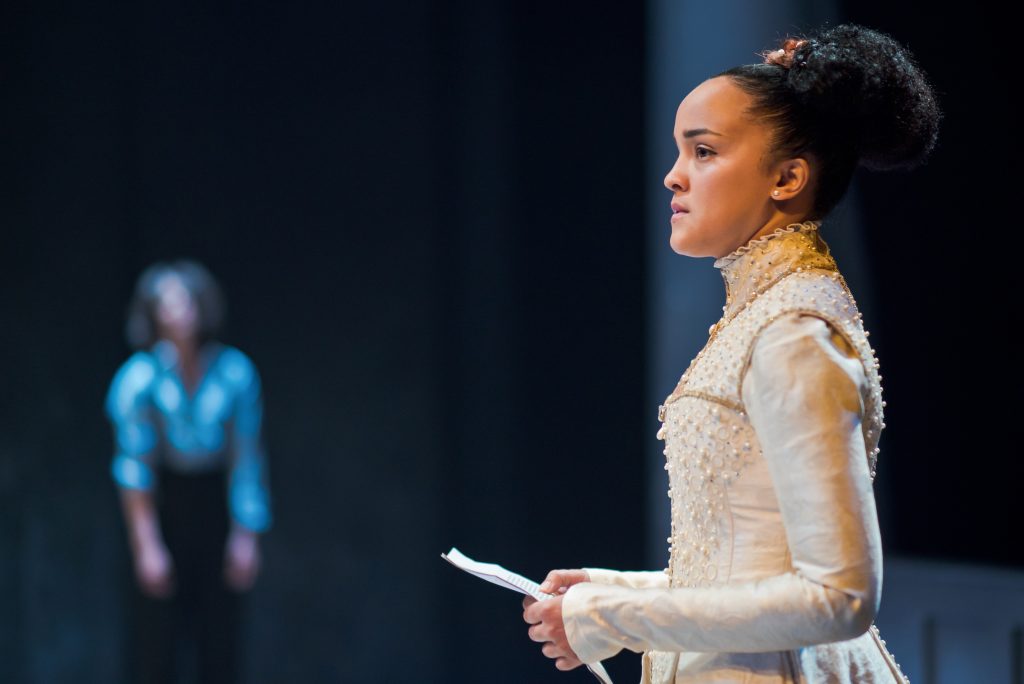 iPhoto caption: Bahia Watson as Bess in The Virgin Trial. Photo by Cylla von Tiedemann
Reading plays is not only for actors who need monologues for auditions or for producers in search of their next show. It’s for theatre lovers who can’t get out to the theatre, or who’ve heard about a play that’s not being presented in their city, or who want to return to a story they loved watching unfold on stage. It’s for anyone who feels like they don’t have the time to read novels, or who skim over the long descriptions in novels to get to the dialogue. Reading plays is for anyone who likes to read.
“I have stories to tell about women,” says Kate Hennig.
This may seem obvious to those who know Hennig’s work as a playwright. Two summers ago, she brought Stratford audiences the story of the smart, confident, and passionate Katherine Parr, the final wife of Henry VIII, in The Last Wife. Parr was the central character of the play, and her two stepdaughters, the snide Mary and the earnest Bess, figured prominently.
But Hennig had no idea when she wrote The Last Wife that she was about to dedicate the next ten years of her life to the Tudor period. When she was ready to hand over the rehearsal draft of The Last Wife, it was suggested by her dramaturgs that she start working on a new project. “I was looking at writing something about the crone,” she says. “And in my research about the crone and witches and stuff like that, I ended up circling back to Mary somehow. And so I went, ‘Oh, my work here isn’t done.’”
She decided to write a play about Bess and one about Mary, and because Bess’s story comes first chronologically, Hennig started there. This summer, that’s the one that Stratford audiences will get to watch unfold.
In The Virgin Trial, fifteen-year-old Bess has been summoned to shed light on her relationship with Katherine Parr’s last husband, Thomas Seymore, who has been charged with high treason for attempting to assassinate the king. The play follows Bess as she “navigates a labyrinth of political and sexual intrigue in the Tudor court that threatens her freedom.” It falls squarely within Hennig’s desire to tell stories about women, not to mention about history and how women’s struggles in the past relate to contemporary issues.
The same actors who played Bess and Mary in The Last Wife—Bahia Watson and Sara Farb—are back for The Virgin Trial. And that’s made Hennig’s writing process a bit easier.
“In those two women particularly, I have relationships with the characters and the world of the play,” explains Hennig, “and then I have a relationship with the actors and the process of work. Both of those things add up to a huge step forward.”
But this play comes with its own challenges, specifically when it comes to form. Hennig knew that the companion plays would each need to be very different in their own right. So while The Last Wife is linear, Hennig has made The Virgin Trial “like a jagged, weird circle.”
She calls this latest play a bit of a mystery thriller. And good mystery thrillers can’t have plot holes, she says. They have to be air-tight. “Basing a plot on history, where the history is not necessarily air-tight, you have to create the air-tightness of it. And so sometimes,” she casually adds, “that’s making shit up.”
As for the final story in the trilogy, about Mary? “I have a long, windy, linear play, and I then I have a sharp, jagged circle play,” says Hennig, about the first two stories in the series. “I can’t use either of those for the third.”
And not only is Hennig trying to figure out what the new form will be for Mary’s story, but the actual character is proving herself to be difficult. “The next [play] is cursing me,” laughs Hennig. “Mary is this cranky bitch who’s hiding in the wall, who doesn’t want to come out. So that’s my challenge right now. To pull Mary out of the wall and see what she looks like.”

About the Play
Fifteen-year-old Bess has no idea when she heads to London to see her uncle Ted that she is about to find herself at the heart of a scandal involving sexual impropriety; her stepfather, Thom; and an attempted overthrow of the government. What does all this have to do with her? How adroitly can Bess manoeuvre through a series of interviews to avoid being swept up in the peril that might ensue? And will she be able to spin the facts to create a myth based on her own innocence?
In this gripping follow-up to The Last Wife, Kate Hennig continues her Tudor Queens Trilogy by cleverly exploring victim shaming, sexual consent, and the extraordinary ability of girls becoming women as she reimagines the scandalous and little-known story of Elizabeth the First before she was Queen.
About the Playwright
Kate Hennig is a diverse, multi-award-winning theatre artist: a playwright, performer, teacher, and Associate Artistic Director of the Shaw Festival. Kate’s first play, The Last Wife, which premiered at the Stratford Festival in 2015, was met with rave reviews and has had five further productions with another four productions scheduled. Kate is currently writing Father’s Daughter, the third play in the Tudor queens series. Born in England and raised in Alberta, she lives and writes in Stratford, Ontario.

The Virgin Trial opens June 27 at the Stratford Festival and runs until September 23.
For information about the show, click here
For information about the published play, click here
May Antaki May is the co-founder and former co-editor-in-chief of Intermission. She edits everything from memoirs to cookbooks, loves maple syrup and boy bands, and is a pretty good first baseman.

Casting Announcement: The Wolves
The Howland Company has announced the cast for their fall production of The Wolves.

Nomination Announcements: 39th Annual Dora Mavor Moore Awards
The nominees for the 39th Dora Mavor Moore Awards have been announced!
10 Reasons Two Actors Wouldn’t Survive the 1600s
Actors Ghazal Azarbad and Paolo Santalucia each give five reasons they wouldn’t have survived the 1600s.

Teenagers from This Year’s Paprika Festival on What They Want to See More of on Toronto Stages
Six young artists involved in the Paprika Festival tell us what kind of theatre they want to see more of.
Based On and Inspired By: How Artists Work from Real Material
A playwright, an actor, a designer, and two theatre creators/performers talk about what it’s like working on a piece of theatre based, in some way, in reality.
 iPhoto caption: A scene from Love and Information. Photo by Dahlia Katz.
What’s a Random Thing You Know a Lot About?
"At the dawn of Thatcherism, a coterie of sexually liberated exhibitionists transformed punk into glorious camp decadence (and I’m sad I missed out)."
Comments