
REVIEW: Buddies and Obsidian’s Bootycandy is a biting carnival of laughter
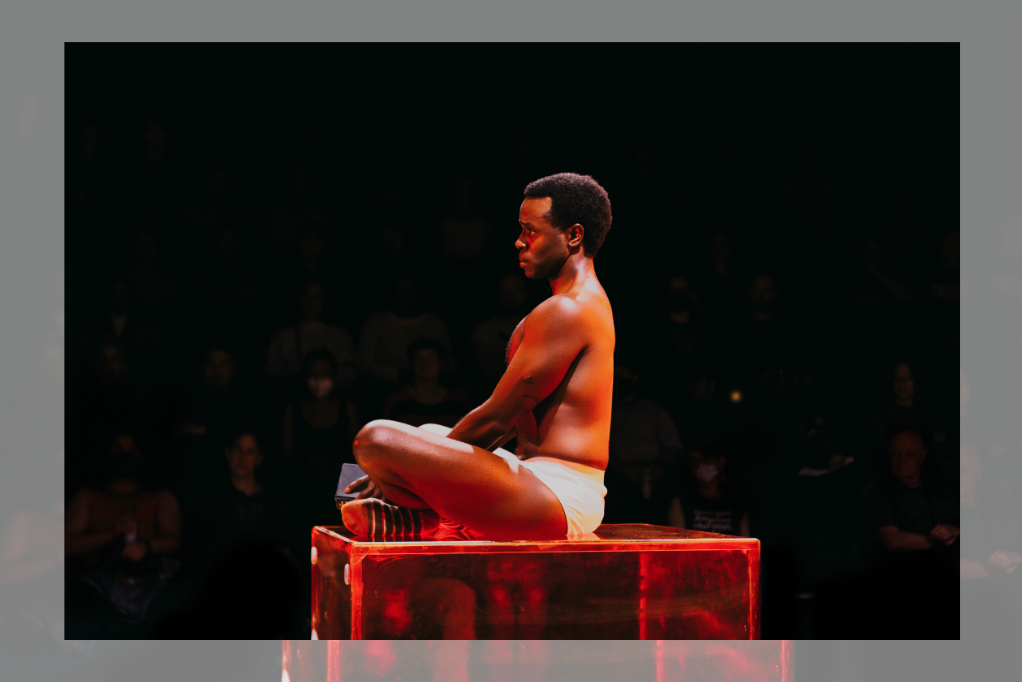 iPhoto caption: Kyle Brown in 'Bootycandy.' Photo by Roya DelSol.
Spoiler alert: Bootycandy‘s dramatic structure is based around a series of vignettes.Therefore, this review discusses each one in detail — including those that arrive late in the play’s runtime.
The interesting case where the difficulty of creating an artwork is reflected in the difficulty of consuming said artwork holds all too true for Robert O’Hara’s Bootycandy. This hilariously morbid co-production from Obsidian Theatre and Buddies in Bad Times is a tricky one to make sense of as a whole and a difficult one to parse in parts — to the delight of this reviewer.
Directed by Jay Northcott and ferociously performed by an ensemble cast of five led by Kyle Brown, Bootycandy is a series of dramatic vignettes featuring an array of characters who are — for the most part — Black and caught in some crisis of queerness. Brown plays the central character, Sutter: a curious child, then a vulnerable schoolboy, and finally an adult playwright living, loving, and making art in the wake of a sexual trauma experienced in his youth.
The other characters all figure into offering a full picture of Sutter’s life: a cross-dressing Reverend (Christopher Allen); Sutter’s mother (a powerhouse Meghan Swaby), sister (Helen Belay), and grandmother; a timid stepfather; a doomed lover in his sister’s husband (Dan Mousseau); and so on.
Due to the play’s fragmented form, with each actor playing multiple characters sometimes simultaneously, it may take a second to make sense of what Bootycandy is trying to do. Once the show bares the fangs beneath its giddy smile, you may be struck down by the sheer force of the creative will and imagination on display. O’Hara’s script is so exceptionally funny that the audience at the Black Out Night I attended quite literally started hooting and hollering.
Set design (Nick Blais), lighting (Darren Shaen), and costumes (Arianna Moodie) assist this, isolating each fragment of Bootycandy’s dramatic tapestry while also cohering this fragmented drama through similar motifs. All the action happens across an abstract plastic-orange rectilinear structure, the reverend’s ovoid balcony pulpit, and the floor; a further fracturing that evokes a fever dream or the splintered recollection of one mind. Moodie’s comically era-specific costumes add to both the form and the humour of the play, while Shaen’s brooding, harshly white, and poignantly orange lighting choices and David Ariza’s quippy sound design collaborate to open Bootycandy’s ambiguities and crassness to more serious contemplation.
With this humour, Bootycandy, like Jeremy O. Harris’ Slave Play, lures its audience into its dark centre with the promise of sweetness, only to disarm viewers and hold them hostage to an upsettingly uncomfortable conundrum. In this dark centre, Bootycandy sheds its skin and shines as a play about a Black boy’s sexual trauma and how it configures his inner and social lives, as well as his artistic praxis well into his adult years.
Is sexual trauma something to laugh about? Are there limits to satire? Bootycandy pushes these questions to the edge, challenging the satirical craft through both its thematic complexity and its many moving parts. A play like this might easily offend, and sometimes its satire borders on empty spectacle. This features in sections that drag too long, like a bit about baby back ribs, and moments of confusing accent work early in the play, that may resonate with caricatures of Black life rather than theatrical representations or meaningful commentary. But under Northcott’s sharp eye, the cast’s performances steadily emphasize the everyday, mundane ironies and racial currents that constitute Black life. In catty conversations between friends, family squabbles, Sutter’s interactions with his grandmother, in love, sex and assault, Bootycandy anchors itself in real sociality.
Through this, Bootycandy justifies Sutter’s intense fixation on an autofictional reversal of his own sexual trauma, staging the rape of a white man by two Black men in a play he is workshopping as a reversal of his own rape by a white man as a teenager. As the playwright’s playwright, O’Hara turns this ordeal into a big joke, another comic reversal in a flurry of quips and puns, ironies, transgressions, and carnivalesque reversals of hierarchy. By the end of Bootycandy’s two-hour runtime, both Sutter and O’Hara have delivered something substantial, whether or not they did it with decorum. The audience on Black Out Night applauded what may be a personal dramatic excavation with a standing ovation, and this reviewer joined in.
O’Hara and Northcott make use of the slippery nature of satire to speak a slippery truth. As Black people living in a world constituted by antiblackness, we are born from traumatic histories and suffer traumas of our own. In lieu of the utopian ideal of healing, Bootycandy posits that since we are constituted by these unpleasant histories, we ought to mine pleasure from them despite being subject to them. This pleasure may exist as making audiences laugh at the social conditions of homophobia, racism, and rape while implicating them in, and making them reflect upon, their own enjoyment. But after laughing for two hours straight, to the point of a bellyache and flowing tears, it is worth asking what room is left for anger. Where does anger go after such an obscene carnival of laughter? How may anger give us pleasure too?
Bootycandy runs at Buddies in Bad Times Theatre until October 17. More information is available here.
Intermission reviews are independent and unrelated to Intermission’s partnered content. Learn more about Intermission’s partnership model here.
Divine Angubua
Jonathan Divine Angubua is a freelance arts and culture critic living in Toronto. Divine holds a Bachelor of Arts degree with concentrations in Political Science, History, and Creative Writing from the University of Toronto. He enjoys any interesting art and is always looking for great book recommendations. As a writer and lover of theatre, he is most inspired by the strangest things.
LEARN MORE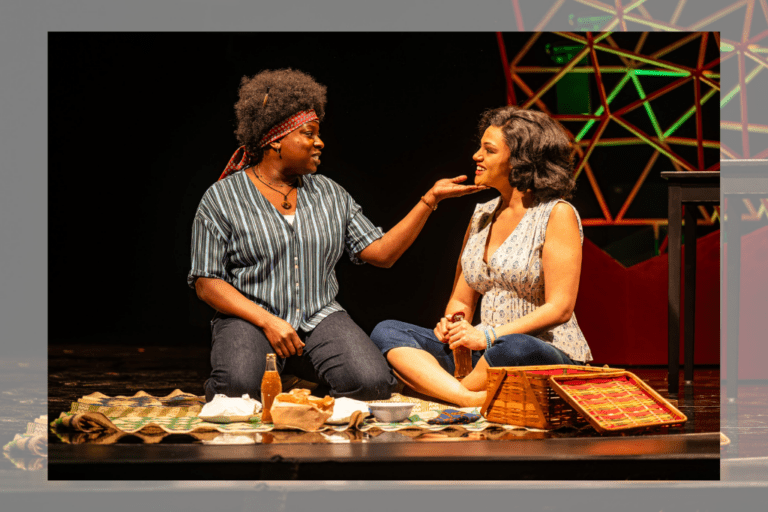 iPhoto caption: Members of the company of 'How to Catch Creation.' Photo by Dahlia Katz.
REVIEW: Soulpepper’s How to Catch Creation has plenty to offer a Canadian audience
From its Black feminist ethics to its ideas about making art and living a good life, How to Catch Creation stands out most of all as a bold intellectual and affective challenge.
 iPhoto caption: Sophia Walker in 'Clyde's' at Canadian Stage.
REVIEW: At Canadian Stage, Clyde’s reflects on the value of negativity
Clyde’s is particularly interesting because of the risks Lynn Nottage takes with both its form and structure. With five characters on stage for 90 minutes, Nottage writes the play to be as compact and pressurized as possible.
 iPhoto caption: Vanessa Sears as Juliet, Julia McLellan as Anne, Matt Raffy as May, and Sarah Nairne as Angelique in '& Juliet.' Photo by Dahlia Katz.
REVIEW: Mirvish’s & Juliet sparkles on the surface despite narrative stumbles
The technical elements of & Juliet are rightfully excessive, fabulous, and gauche, solidifying the camp grounding upon which I came to appreciate the show as a whole.
 iPhoto caption: Sophia Walker and Gord Rand in 'Slave Play.' Photo by Dahlia Katz.
REVIEW: Slave Play sparks debate — so we reviewed it twice
To mark the Canadian premiere of this influential satire, Intermission is honouring the play’s divisive reputation by presenting a pair of reviews written independently of one another.
Comments