
REVIEW: Red Snow Collective’s Carried by the River is still finding its flow
 iPhoto caption: Photo by Dahlia Katz.
Al Green once crooned, “Take me to the river, drop me in the water.” Well, let’s dive in, shall we?
Playing in the Tarragon Theatre Extraspace, Carried by the River 流源夢 explores identity, grief, and intergenerational trauma through the metaphor of a river and a recurring red string of fate. Directed and choreographed by William Yong 楊漢源, written by Diana Tso 曹楓, and featuring music by Alice Ping Yee Ho 何冰頤, the production delivers visually striking images and impressive choreography but struggles to find emotional depth and cohesion.
The play follows 19-year-old Kai (Honey Pham), a queer Asian woman raised in Canada, as she copes with the death of her adoptive mother Rose (Shiong-En Chan), who keeps Kai’s adoption a secret until she’s on her deathbed. Kai travels to China in search of her biological mother and to uncover more about her past. Along the way, she meets three women whose lives intertwine with hers and encounters spirit animals that offer guidance.
A spiritual medium named Lao Lao (Brenda Kamino), grandmother of Kai’s new friend Ting Ting (Michelle Wang), helps Kai navigate grief and questions of belonging. The red string, a symbol of connection and destiny, physically and metaphorically ties the characters together as they move between memory and reality, exploring cultural displacement and the search for identity.
The opening scene, a haunting exchange between Kai and Rose, sets a powerful tone. Lighting designer Andre du Toit’s interplay of light and shadow stands out as one of the production’s strongest elements, vividly capturing the tension between memory and reality.
A highlight of the production is a beautiful piece of choreography where Kai, Rose, Lao Lao, Ting Ting, and Ting Ting’s mother Mei Shan (Tai Wei Foo 符岱微) are physically connected by the red string. As they pull and follow the string across the stage, their movements mirror the tension and tenderness of their interconnected fates. This captivating sequence encapsulates the play’s themes of intergenerational connection and the search for identity, beautifully illustrating how fate binds the characters together.
At the heart of the production is Lao Lao, played with warmth and humour by Kamino. Interestingly enough, it’s Lao Lao’s connection to the spirit world that provides stability. Her ability to speak to spirits grounds the story, balancing its more chaotic emotional beats. This connection becomes somewhat of an anchor for Kai, offering continuity and reassurance amid the turbulence of her grief and self-discovery. In a narrative shaped by loss and uncertainty, Lao Lao’s calm communion with the unseen reflects a deeper truth: healing and understanding can emerge not only from tangible answers, but from spiritual and ancestral ties.
Tso’s script often tells more than it shows, however, relying on expository dialogue that disrupts the natural flow of the story. The exploration of grief, which could serve as the central force of the play, feels muted. By the end of the show, Kai has lost two significant people in her life, yet the impact of these losses remains underdeveloped. Time that could have been spent developing the bond between Kai and Rose is spent on excessive exposition. A factory scene with Mei Shan stands out as one of the more impactful beats, but it feels isolated, not integrated into the broader narrative.
Scenic and costume designer Ting-Huan 挺歡 Christine Urquhart’s stage design is brilliant, with its edges and waves evoking mountains and a river. Urquhart creates striking animal representations like the Tiger and Bear, but the Monkey’s red outfit and spoon-seller role are puzzling, possibly referencing the golden snub-nosed monkey, though it’s unclear. Similarly, the Deer would be hard to identify without context.
Still, one of the more touching moments comes from that Deer (embodied by Chan), who tells Kai, “You don’t need to leave heavy tracks on the floor for you to have been there.” This gentle reminder that presence and impact aren’t always measured by visibility aligns with the play’s core message about identity and belonging.
The show concludes abruptly, leaving me waiting for a catharsis that never came. While the red string motif is compelling, it remains thematically underdeveloped. The string’s connections between characters suggest deeper understanding, but by the end, the metaphor feels unresolved, and the emotional threads of the story are left loose, preventing any true sense of closure or release. Perhaps that is intentional.
Despite its challenges, Carried by the River is a visually stunning exploration of identity, belonging, and the search for meaning. Like a river’s current, it sometimes loses direction — beautiful to watch, but not always carrying you where you wish to go.
Carried by the River runs at Tarragon Theatre until March 23. Tickets are available here.
Intermission reviews are independent and unrelated to Intermission’s partnered content. Learn more about Intermission’s partnership model here.
Krystal Abrigo
Krystal is Intermission's Publishing and Editorial Coordinator. A Scarborough-based writer of Philippine and Egyptian descent who enjoys reading bell hooks, Audre Lorde, and James Baldwin. At any given moment, you can probably find her at a concert, or on a long walk somewhere in Toronto (or elsewhere).
LEARN MORE iPhoto caption: Eva O'Connor in 'Chicken.' Photo by Hildegard Ryan.
This year’s Bealtaine Theatre Festival features a Ulysses adaptation and a solo show about a chicken
The 2026 edition will unfold at the Corleck, a new waterfront performance venue set to officially open in November. Bealtaine audiences will be among the first to experience the space.
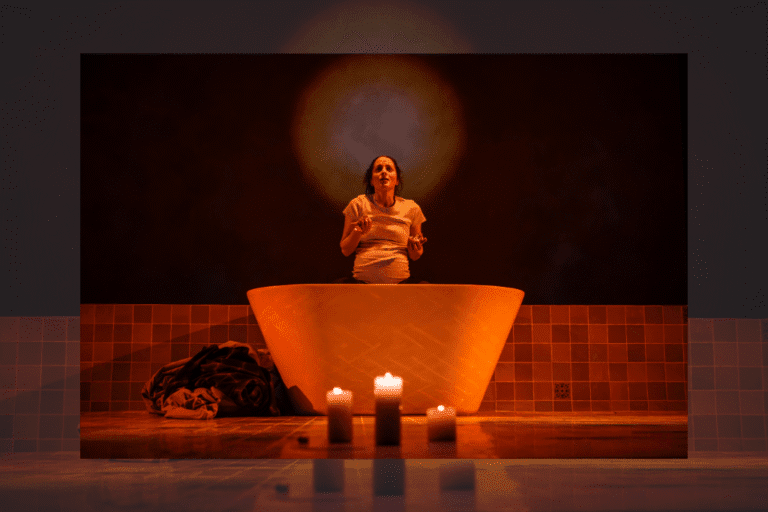 iPhoto caption: Coleen Shirin MacPherson in 'Searching for Aimai.' Photo by Seanna Kennedy.
Playwright-performer Coleen Shirin MacPherson refers to herself as “colonized upon arrival,” born in Canada yet shaped by migrations and erasures that predate her birth. “I don’t have an ancient song or a lullaby that connects us across generations,” she tells her child. That absence — of song, language, and unbroken tradition — propels the Cahoots Theatre production.
 iPhoto caption: A headshot of David Leyshon. Photo provided by Lighthouse Festival Theatre.
David Leyshon named interim artistic producer at Lighthouse Festival
He joins the company as it prepares its 2026 programming, continuing its mandate of producing comedy-driven Canadian theatre in Port Dover and Port Colborne.
 iPhoto caption: Kateryna Larina in Paradisum. Photo by Bálint Hirling.
TO Live to present Recirquel’s Paradisum in Toronto
Next week, a circus-dance hybrid will swing into the Bluma Appel Theatre as part of TO Live’s 2025-26 season.
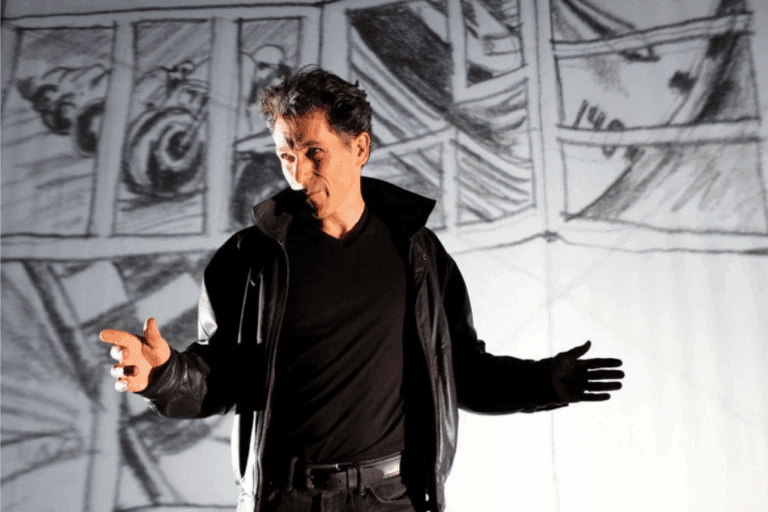 iPhoto caption: Rick Miller in 'Boom X.' Photo by Craig Francis.
In Boom X, Rick Miller uses theatre to trace how Generation X came of age amid major shifts in media, politics, and daily life from the 1970s through the mid-1990s.
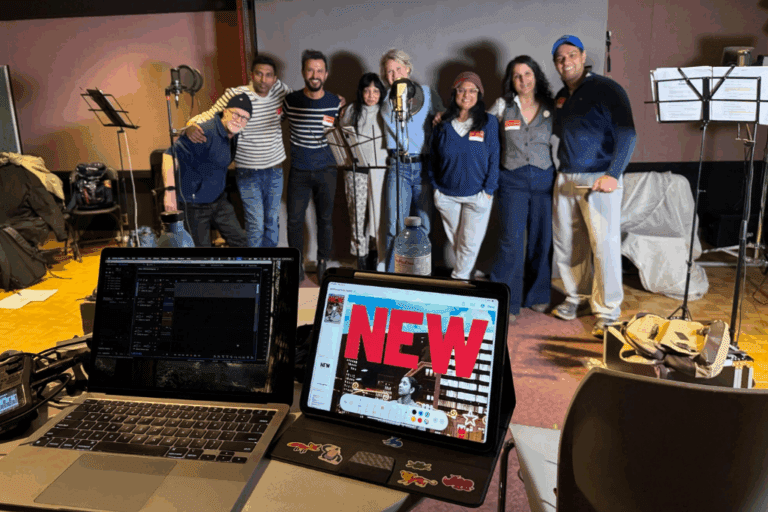
CBC’s PlayME debuts 2026 season, starting with Kim’s Convenience
PlayME has featured work by more than 30 Governor General’s Award winners and nominees, making some of the country’s most celebrated plays accessible to listeners nationwide.
Comments