
REVIEW: At The Theatre Centre, Searching for Aimai renders inheritance visible without offering resolution
 iPhoto caption: Coleen Shirin MacPherson in 'Searching for Aimai.' Photo by Seanna Kennedy.
What does it mean to inherit absence?
In Cahoots Theatre’s Searching for Aimai, playwright-performer Coleen Shirin MacPherson frames that question through her own pregnancy. A second-generation Canadian of Parsi and Irish descent, she confesses: “I have felt rootless for a long time.” The one-hour solo show becomes an attempt to locate something solid — an origin story, an ancestral voice, a cultural anchor — she might offer her unborn daughter.
MacPherson refers to herself as “colonized upon arrival,” born in Canada yet shaped by migrations and erasures that predate her birth. “I don’t have an ancient song or a lullaby that connects us across generations,” she tells her child. That absence — of song, language, and unbroken tradition — propels the piece.
The search begins with a name: Aimai, her great-grandmother, translated as “mother of all mothers.” Its weight is intimate yet unreachable. Speaking it aloud, MacPherson reaches toward continuity while confronting the distance from her ancestors.
The production stages this search entirely in a bathroom. Shannon Lea Doyle’s design is stark: tiled walls, toilet, bathtub, mirror, and sink, sharpening the intimacy of MacPherson’s address while containing the vast history she traverses. A lone pomegranate, introduced as a prop separate from the set, anchors the room with symbolic weight.
That history is largely Parsi. MacPherson traces the community’s migration to Gujarat between the eighth and 10th centuries to preserve Zoroastrianism, an ancient faith originating in Persia, and situates herself within a diaspora often classified as endangered. She also confronts her own positionality: blue-eyed, and frequently read as simply white. She articulates the paradox of being “too white to be Parsi, too brown to be white,” describing “passing” as both protection and betrayal. “I yearn to have an unpronounceable name,” she says, the irony cleanly cutting.
References to a grandmother and an ancestral fishing village gesture toward her Irish heritage, but it remains comparatively unexplored. Given that most perceive MacPherson as white, the imbalance is striking. The production’s gravitational pull toward Persian identity feels purposeful: it is the lineage she must argue for and reclaim. Still, the relative silence around her Irish side narrows what might have been a fuller interrogation of life within this hyphen.
I register this tension differently. I am mixed race: my mother is Filipino and my father was white Egyptian, but I am visibly racialized. Where MacPherson grapples with invisibility, I have contended with the hypervisibility of being Filipino. I understand the ache of in-between-ness even as our relationships to external perception diverge.
Raha Javanfar, an established lighting designer and musician, makes her directing debut here and brings a parallel diasporic lens. In her program note, she reflects on raising two mixed-race daughters — one read as Persian, the other as white — and on the widening distance between her children and an Iran she knows only through stories. Though the Parsi migration narrative differs, both artists circle the same ache: how to build a bridge backward for children who stand further from the point of departure.
Design drives the production’s tonal agility. Laura Warren’s projections send tangled roots across the bathtub, a visual reminder of lineage pressing against the room’s limits. Lilian Adom’s lighting isolates MacPherson in clinical white before saturating the space in pomegranate reds, at times carving her into stark shadow that fractures and doubles her presence.
Janice Jo Lee’s sound design delineates a similar divide. Irish lineage is marked by a solitary sustained flute tone, while Parsi references incorporate breath, percussion, and chant-like resonance. A toilet slams at a pointed reference to Canada’s 1952 closed-door immigration policy.
Yet I felt a tension between the production’s careful composition and the disorder it seeks to evoke. The bathroom, tight runtime, and sculpted imagery impose a visual coherence on an experience that is anything but orderly. Rootlessness rarely resolves into symmetry.
Perhaps that tension is the point. Searching for Aimai does not cross the threshold it evokes; it dwells there, giving shape to longing without pretending to cure it. Whether that shape feels expansive enough may depend on the viewer. But its central question — what we owe our children when our own stories feel fractured — lingers.
Searching for Aimai runs at The Theatre Centre until March 1. Tickets are available here.
Intermission reviews are independent and unrelated to Intermission’s partnered content. Learn more about Intermission’s partnership model here.
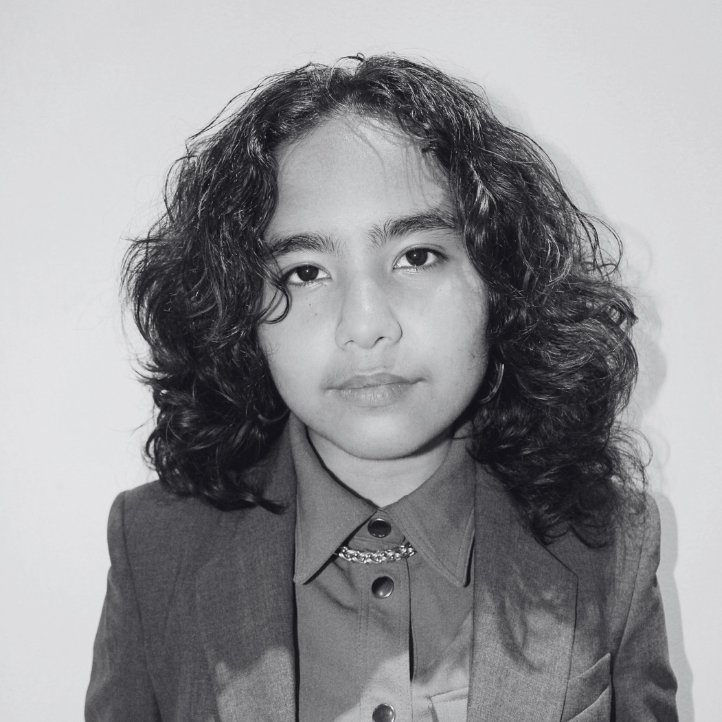
Krystal Abrigo
Krystal is Intermission's Publishing and Editorial Coordinator. At any given moment, you can probably find her at a concert, or on a long walk somewhere in Toronto (or elsewhere).
LEARN MORE iPhoto caption: Carolyn Fe in 'Aye Caesar.' Photo by Mathieu Taillardas.
REVIEW: Carolyn Fe’s Aye Caesar asks what it means to be seen
The phrase is, in my view, a quintuple entendre — and, like the play itself, its meanings become clearer the longer you sit with them.
 iPhoto caption: Lissete VC in 'Deer Woman.' Photo by Andy Moro.
Q&A: At RUTAS Festival, Tara Beagan’s Mujer Venado / Deer Woman makes its Spanish-language premiere
The translation connects the play’s existing themes to the experiences of missing and murdered Indigenous women across the Americas.
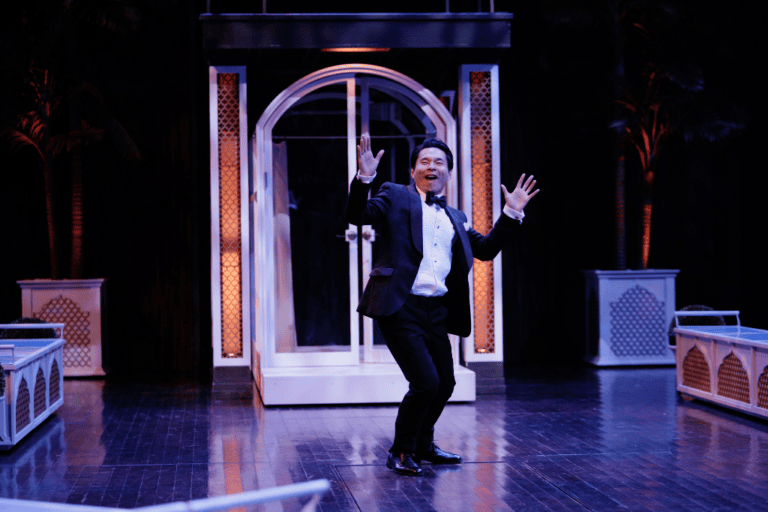 iPhoto caption: Michael Man as Dr. Wilson Wong in 'The Tao of the World.' Stratford Festival 2026. Photo by David Hou.
Meet Michael Man, the versatile actor playing Gollum at the Stratford Festival
Dr. Wong and Gollum are just two of the three roles Man is playing in his second consecutive season at Stratford. He also appears in a smaller role as Robin Starveling, one of the mechanicals, in A Midsummer Night’s Dream, giving him the opportunity to move between wildly different theatrical worlds over the course of a single season.
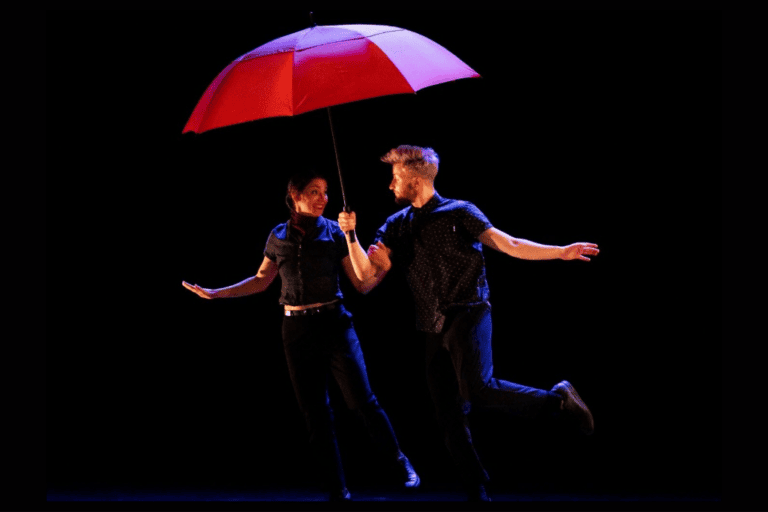 iPhoto caption: Compagnie de Fakto's 'C'est la vida.' Photo by Julie Cherki.
Alliance Française Toronto unveils 2026-27 season at Spadina Theatre
International theatre and dance will play at the downtown venue alongside live music, free cinema, exhibitions, and more.
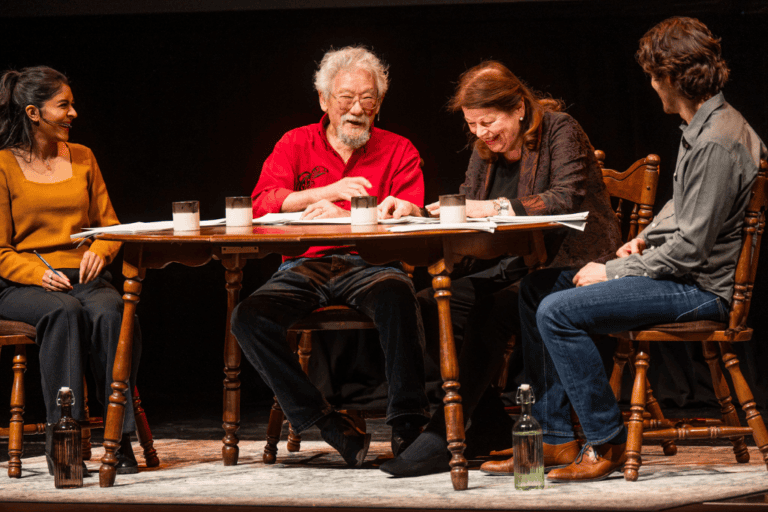 iPhoto caption: Sturla Alvsvaag, Tara Cullis, Michelle Mohammed, and David Suzuki in 'What You Won't Do For Love.' Photo by Dahlia Katz.
David Suzuki and Lester Trips to headline Factory Theatre’s fall season
In addition to its lineup of full productions, Factory will host work-in-progress presentations of Provisions and Ghost River Theatre and Macromatter's Soft Squishy Things in its Studio Theatre during the SummerWorks Performance Festival, running from August 6 to 16.
 iPhoto caption: Toronto Fringe promo photo by Robbie Harper.
REVIEWS: Toronto Fringe Festival 2026
This collection of Toronto Fringe Festival capsule reviews will be updated throughout the festival with writing from 10 different critics.
Comments