
REVIEWS: Toronto Fringe Festival 2026
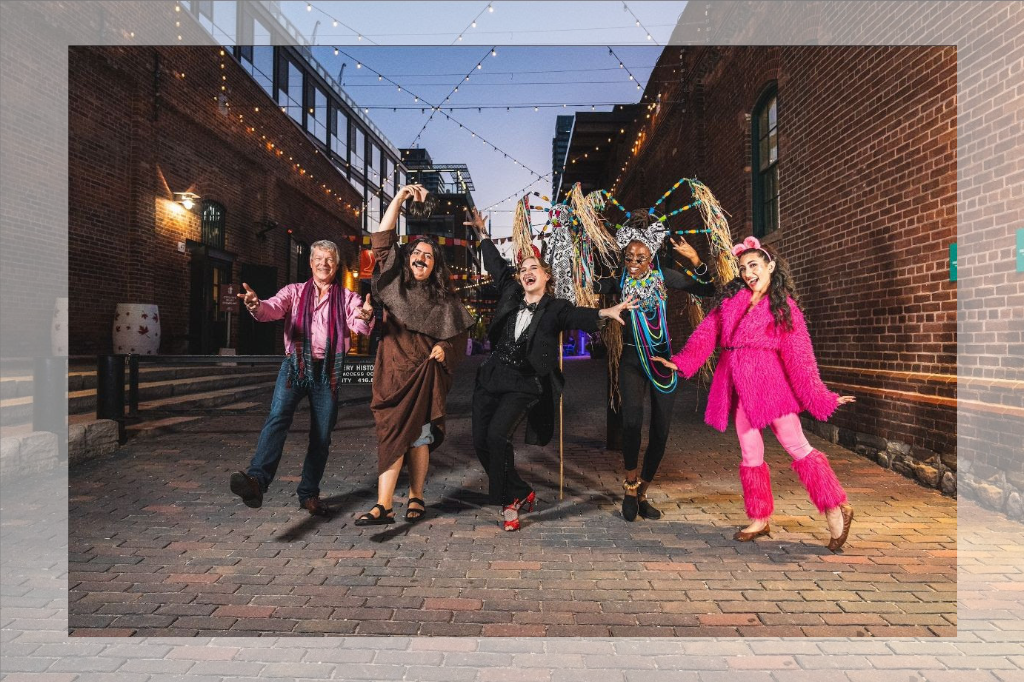 iPhoto caption: Toronto Fringe promo photo by Robbie Harper.
The Toronto Fringe Festival and an Ontario-based performing arts magazine walk into an arcade.
As they settle in for a round of Street Fighter II, the Fringe asks: “Are you gonna do a giant rolling file of reviews like you did the last couple of years? The 2026 festival runs from June 30 to July 12 and features a total of 123 shows, mostly selected by lottery. There’s 27 venues, including new additions Sweet Action Theatre and Young People’s Theatre. And the Fringe hub is back at Soulpepper Theatre in the Distillery District.”
“Well yes,” replies the magazine as it furiously mashes its controller. “We’re thinking 10 critics, reviewing a total of around 60 shows.”
“Game on!” exclaims the Fringe, before ending the duel with a Hundred Hand Slap.
This year, Intermission will publish Fringe capsule reviews from contributors Krystal Abrigo, Melissa Avalos, Ferron Delcy, Liam Donovan, Sania Hameed, Sulaiman Hashim Khan, Gus Lederman, Ilana Lucas, Shivani Nathoo, and Columbia Roy.
Reviews will be published below as they come in. For ease of navigation, new entries will be added to the top of the post. If you’re looking for a review of a specific show, we recommend using your device’s “find on page” function.
Nostos (Soulpepper Theatre’s Michael Young Theatre)
by Liam Donovan
This rich and challenging dark comedy from Nowadays Theatre Company packs an incredible amount into its 75-minute runtime.
Beeta (Tina Bararian), an Iranian refugee woman, runs a dog-sitting business in Toronto while teaching digital dance classes for women back home. As she hangs out with her sister Atousa (Parya Heravi), two dogs (Mahsa Ershadifar and Aida Keikhaii) hold a lively private conversation, while an A.I. android (Niloufar Davari) serves as Beeta’s personal assistant, providing encyclopedic factoids and domestic labour.
Writer-director Mohammad Yaghoubi’s play begins amid the January 2026 uprisings in Iran, when security forces killed thousands of protestors. The sisters and the dogs both debate the political and ethical implications of this event, pulling in references from sources spanning the philosophies of Adorno and Iranian social media activists. The dialogue grows even more heated after a time jump to the aftermath of Ali Khamenei’s killing in February.
Sequences featuring Farsi-language radio broadcasts signpost Nostos as partially intended for an Iranian audience. As someone less familiar with the debates around the uprising, I had to work hard to keep with the conversation — but many of the show’s most powerful elements operate on a physical level. Ershadifar and Keikhaii embody their dogs with inexhaustible energy and a playful lack of restraint, while Bararian performs lyrical dance interludes that give visceral shape to her character’s steadfast ideals.
I hope and expect that this confident production will return to Toronto — perhaps with a slightly expanded runtime — and I look forward to revisiting it then.
Above the Hospital (Soulpepper Theatre’s Weyni Mengesha Theatre)
by Sulaiman Hashim Khan
Writer-director Beau Han Bridge has set out to write a contemporary drawing-room play. Rather than high-society Victorians running in and out of a parlour, we follow a group of sad young artists above a vet clinic in Vancouver getting ready for a Death Cab for Cutie concert.
The run-down apartment belongs to Lauren (Cydney Watson), a film-school dropout considering a career change, and her partner Cameron (Hasson Babar), an egotistical guitarist who believes he’s got an album that’ll change the world — once he finally sits down to record it.
As the evening progresses, they’re joined by Mikey (Ritisha Jhamb), an infantile queer-incel illustrator; Abby (Eman Ayaz), an actress; Bo (Kenneth Seto Tynan), referred to as a “pansexual trust-fund baby”; and Natasha (Raffa Virago), who’s unhoused. While Bridge conjures up this menagerie of conceptually diverse characters, the similarities in their dialogue and behaviour dilute them.
The play’s central contemplation is the practicality of a successful career as an artist. Unfortunately, I don’t think Bridge brings a new perspective to this topic.
Above the Hospital struggles with dialogue. There are plenty of unnaturally written lines, oblique pop-culture references, poop jokes, and intertexts like Obsession (2026) that don’t make much sense. Bridge may be trying to mirror natural conversation, but he doesn’t do so with the deliberation that it demands. The script also suffers from over-exposition: characters awkwardly spell out their thoughts and motivations.
While Above the Hospital is interesting in its homage to classic drama, it could do with being more earnest.
Little One (Puppy Sphere)
by Gus Lederman
I unintentionally saved the best show for my last 2026 Fringe review.
Little One tells the chilling story of two Ottawa siblings, Aaron (Wayne Burns) and Claire (Izzi Nagel), figuring out how to be a family through the ripples of unspeakable trauma. This show by renowned playwright Hannah Moscovitch originally premiered at SummerWorks Performance Festival in 2011.
Moscovitch is unyielding in unpacking the impacts of childhood abuse and the complexities of loving someone who replicates the harm they’ve experienced. Director Alice Fox Lundy stages the disturbing scenes to accentuate the haunting text without being overly graphic.
Lundy makes the most of the Puppy Sphere venue, from the foyer to the large windows that overlook Queen Street.
Burns and Nagel’s performances are phenomenal — I couldn’t pull my eyes away. They boldly monologue directly to the audience in close proximity and the effect is hypnotic. Nagel’s performance is ferocious and her physicality at different stages of Claire’s life is evocative and precise.
Chin Palipane’s lighting design ushers the audience through time, distinguishing past and present with warm pinks and cool whites. His subtle and ambient sound design leaves space for the hard-hitting lines to resound in the room.
The show is sold out, understandably. It’s worth trying to rush, but I imagine there’ll be chances to see a remount in the near future.
Little One will stay with me, especially in my childcare work. Love may not heal all wounds entirely, and yet, sometimes it’s all we have to give.
who? hú 狐 (Tarragon Theatre Mainspace)
by Columbia Roy
If you’re hungry enough to hunt an animal, they’re hungry enough to hunt you.
At the end of the world, two survivors (Jing Cui and Muhammad Akbar Lashari) are living in a cave, when a fox spirit (Antong Xu) follows them home. 狐狸精 (fox spirits) are creatures from Chinese mythology that assume human forms, usually using trickery to harvest energy from people. What follows is a whirlwind of dream sequences and quippy back-and-forths exploring conflict between humankind and the (super)natural world.
Ambitiously chaotic and filled with intrigue, Antong Xu’s who? hú 狐 is a trip to the apocalypse that may leave you with more questions than answers.
In building suspense, it’s hard to toe the line of providing enough exposition without spoonfeeding audiences, and here I think the show could afford adding more context to this world. While there’s a few anchor points in the narrative — like the fox’s monologue about how he got here — they’re too far between for the chaos to feel purposeful.
That said, sometimes the deliberate lack of context is bitingly funny. Whenever Lashari’s character leaves the cave he dons whiteface and a bright blonde colonial wig; having only seen him outside, the fox initially transforms into a white person, with his own pale makeup and fuck-ass blonde bob. The use of whiteface is both the set up for a joke and specific commentary on the growing role of white nationalism in our bleakly imagined futures.
who? hú 狐 swings big and commits to the bit, and despite its structural challenges, I haven’t stopped thinking about it.
Hang in There! (Soulpepper Theatre’s Weyni Mengesha Theatre)
by Sulaiman Hashim Khan
Warning: This production discusses suicide and self-harm.
A wrestler grapples with his feelings of self-determination in this show written by and starring Michael Madore.
After having spent his whole career following a script, retired professional wrestler John “The Hangman” Henry decides to take control of his life and apply for the government’s new assisted dying program — even though he is ostensibly in perfect health. The play sees him discussing his decision with his agent Sam (Darius Zee), his friend/body double Silas (Abdul-Shakur Alawi), and his partner Wanda (Jaden Jackson). These conversations are interspliced with three rounds of interviews with a government program auditor (Rachelle Mazzilli). It’s a timely topic, as the Government of Canada continues to expand the country’s MAID program.
Madore keeps up the emotional punches throughout the show, especially with Mazzilli, who does an excellent job of playing the foil as the two verbally spar during John’s mental fitness interviews. I also enjoyed Zee’s sleazy, detached portrayal of the talent agent.
The production does have weaknesses. Scenes between Madore and Jackson did not fully work for me; some of her line readings sounded like isolated soundbites, taking away emotional weight from their exchanges. And while Alawi’s stage fighting is competent, a lot of Madore’s physical blows don’t land convincingly. At times, lighting choices lead to cast members not in the current scene being visible (sometimes as shadows) behind the curtains, waiting for their chance to enter the ring, which I found distracting.
Hang in There is not a perfect production, but its unique narrative has great form.
2-MAN NO-SHOW: Balls Out! (Sweet Action Theatre)
by Liam Donovan
“Write that down… it’s like this every night,” called out Isaac Kessler to the small group of critics among the sold-out crowd at Balls Out! on Sunday, July 5 — the joke being that this offering from veteran clown-improv duo 2-MAN NO-SHOW in fact changes wildly from performance to performance.
Ken Hall distributes a pair of squishy balls to every audience member. After introductions, Kessler and Hall leap into a caricatural Irish jig, and from there the production’s content is almost entirely up to the crowd: whenever a spectator throws one of their balls, red lights flash and the performers stop. That audience member can then request anything they’d like — whether that’s a change of the previous action (dance more hip-hop; pretend you’re in a cartoon) or a new idea (plan a heist; reveal your fellow actor’s personal secrets).
If this show is boring, it’s your fault.
Sunday’s performance was grand. Gordon Neill serves as an onstage musician, improvising synthesizer- and guitar-based grooves. My favourite audience instruction was for him to switch places with Kessler. Suddenly, 2-MAN NO-SHOW’s carefully honed rapid-fire dynamic had to contend with an unforeseen understudy! Thankfully, Neill is an experienced clown, so he filled in wonderfully — until another ball-thrower reversed the command. (Don’t ask me about Kessler’s piano playing.)
The show is rated PG, and Kessler’s six-year-old nephew sat next to me. He seemed to have lots of fun, which only emphasized the show’s childlike appeal. Throw shit to get what you want: a sterling moral!
Gratitude (Soulpepper Theatre’s RBC Finance Studio)
by Ilana Lucas
In a world run on social currency, gratitude is power. Oren Safdie’s 2018 play Gratitude, a frank psychosexual drama set in the boys’ locker room of a Montreal private high school, gets a sharp, powerful production that reminds us both of the agency teens have in causing harm to each other and the lack of agency they have over much of the rest of their lives. Directed by Safdie and Fatima Lopez, the show’s unflinching portrayal of teen sexuality and cruelty is sometimes deliberately hard to watch, but it’s also hard to look away.
15-year-old Dariya (Iman Ramadan) is clever, calculating, and not afraid to use sex to get what she wants. Her sights are set on athlete Ben (Isaac Wolf Silvers), who’s taken but needs her help to pass his classes. He’d rather pass her offers of sexual favours on to his friends, while she’s not above using blackmail to get to his body.
Rose Belhumeur’s graffiti-covered set and preppy school uniforms provide simple, clear visual signifiers, and the directors vividly portray the simulated sex acts without nudity. A talented young cast makes scenes crackle with tension, with Quinlan Welch’s caring but misguided suitor Josh providing refreshing moments of kindness.
A subplot about Dariya’s judgmental cultural community gives her character dimension but feels slightly rushed, and the play occasionally dips into melodrama — but that’s teenagers for you. With its gritty realism and dark humour, Gratitude may not be to everyone’s taste, but I was grateful I saw it.
Dead Lucky (Soulpepper Theatre’s Michael Young Theatre)
by Columbia Roy
Dead Lucky is a showstopping, heartwarming, conversation about aging for all ages.
A real life father-daughter duo, playwright Greg Sadler and director Cassidy Sadler tap into the lingering anxiety of a near-death experience. At a cardiologist appointment post-emergency stent surgery, Andrew (Julius Chapple) forms an unlikely rapport with fellow patient Wendy (Christine Moynihan) while waiting for test results.
Told through a mix of flashback vignettes, direct address to the audience, and actual character interaction, Dead Lucky is a compelling, well-crafted expression of complex grief.
The word to describe this production is crisp — its pacing and transitions are tight, the flow of blocking feels natural while using the entire stage, and the performances are all-around strong. Both Chapple and Moynihan shine in their characterizations. Chapple’s commanding presence draws attention to every little detail of his frustration and fear; he deftly navigates shifts in time without missing a beat. Moynihan’s Wendy is bubbly and full of joy, bringing much warmth to the clinical waiting room set. Their interaction grounds the show in a deeply human desire for connection that, pardon the turn of phrase, tugs at the heartstrings.
The supporting cast (Louis Adams, Yolande Williams, and Eric Cinnsealach) move in and out as different characters smoothly, keeping the pace punchy and injecting comedy into some otherwise heavy narratives.
Dead Lucky strikes a delicate balance of humour and intimacy as it confronts a question we all face at some point — what will it look like when my body starts to give out on me?
Ooga Chaka (Soulpepper Theatre’s Michael Young Theatre)
by Ilana Lucas
At the beginning of Ooga Chaka, a comedy about prehistoric people who progress from venerating cave paintings to originating the art of theatre, there’s a thrill of discovery. Like a scene from a primitive Blue Man Group, the revelation of percussion instruments causes a stir: When we make a loud noise, or decorate a wall, we leave a legacy.
Bungu (Ben Yoganathan) and Kiki (Rachel Cucheron) walk upright out of the shadow of sleazy cave art huckster Rock (a delightfully slimy Nicholas Eddie) to start the world’s first theatre company. They’re assisted by Rock’s servile underling Horp (Kole Durnford, entertainingly cringing and flailing), who finds his own voice.
Directed by 郝邦宇 Steven Hao and performed by a talented cast with snappy comic timing, Ooga Chaka is at its best when leaning into jokes about beleaguered hunter-gatherers and mammoth egos fuelled by actual mammoth meat. While Ethan Zuchkan’s script falls short of truly incisive satire, the ensemble’s chemistry and the show’s physical comedy and prop gags provide plenty of amusement. (Its program QR codes, pasted on rocks, are probably the Fringe’s most creative.)
After an initial burst of brilliance, the show loses steam in the middle, becoming a more superficial parody that relies on reference humour rather than using the specificity of its setting to the fullest. But its message about the power of friendship is sweet, and when its narrative threads come together at the end, it’s hard not to be won over by the manic heights of lunacy.
A Moment For Frayed Nerves (Theatre Passe Muraille Mainspace)
by Ilana Lucas
Feeling overwhelmed by our doom-scrolling, anxiety-ridden present? Take part in a hallucinatory, metaphorical meal that promises its courses will get you in touch with the tangible aspects of daily life and your goals for the future. Oh, and there’s a singing potato. This musical by Kevin Wong is wacky, weird, and wonderful, and simply needs to clarify its protagonist before it’s ready for a larger run.
Two mental sommeliers (Claire Haig-Halsall and Nathanial Cadougan) and an exacting chef (Helena Shields-Ballantyne) helm Wong’s fantasia of the inner workings of a brain too fried to properly recognize life’s simple pleasures. Each course attempts to rewire a neural pathway before going awry as darkness encroaches on the perfectly prepared regimen. It’s never completely explained why the potato in the picture, charmingly portrayed by EJ Candelaria, is such an outcast carbo-pariah, but his song showcases Wong’s clever, unexpected lyrics (who knew there were so many almost-rhymes for potato?).
Sharply choreographed dances (by Alyssa Pires, who co-directs with Rielle Braid), sometimes sexy and sometimes silly, creatively portray the mindscape, and the cast’s vocal blend is top notch.
With all the offbeat quirk on display, settling the musical’s perspective would go a long way toward giving the audience a clear arc to connect with. A supposed protagonist (Delia Clark-Bautista) in an opening number disappears until the climax, making it unclear whether the show is supposed to be her journey or ours. Including her throughout the show would ground an already engaging work.
Andrew Silverwood: Love Thy Neighbour (VideoCabaret)
by Melissa Avalos
To attend Andrew Silverwood: Love Thy Neighbour, I had to walk down a sketchy alley in the middle of the night by myself. I entered VideoCabaret while the front-of-house supervisor was halfway through her “Tip the Fringe” speech, and Silverwood was there, right beside her in his priest outfit, making jokes with the handful of people there for his show. When I sat down in the Deanne Taylor Theatre, I quickly realised that, due to the bright lights and the seats being set in-the-round, Silverwood would be able to see each of our faces.
When a comedian can clearly see if you’re laughing during a stand-up show, it’s mortifying. Luckily, after Silverwood came out on stage and gave communion by way of Listerine BreathStrips, I knew that I didn’t need to worry about looking bored.
Silverwood jokes about Italians and strip clubs. He takes shots at people in the audience. He’s charismatic, quick on his feet, and easy to like. Some jokes are crude and some could be considered offensive, but as he goes on, he slowly reveals more and more about his personal life. Near the end, he shares that he attended his brother’s wedding in occupied Palestine.
What follows is his plea for the bombings to stop, and for us to reach out an olive branch to one another. Although I was originally worried about the intimacy of the show, I was touched by the closeness he cultivated. Silverwood is not only a talented comedian, but a very bold human being.
Danse Macabre (Tarragon Theatre Mainspace)
by Ilana Lucas
Writer-director Rhoma Spencer’s Danse Macabre, winner of the 2026 Fringe New Play Contest, is a sprawling, ambitious work. Both history lesson and social justice debate, it interweaves present-day tensions at a Toronto Mas camp (a central workshop for the production of Carnival costumes) with details about the transatlantic slave trade and the history of Carnival as a time of celebration and resistance. Full of exciting material, this work could become something special with significant, judicious tightening.
The play hinges on the argument between young artist Tantrum (Shelby Mwambu) and costume sponsor Marc (Thomas Fournier), a white man who wants to march as the central figure. Empowered by the Black Lives Matter movement, Tantrum feels Marc’s request is offensive. Caught in the middle is the team’s designer Cisco (Uche Ama), who claims that her costumes celebrate her Trini heritage, but not politics.
Spencer’s sharp, incisive historical sketches, such as one where the characters don masks to reenact the division of Africa for ownership by European nations, support this debate well. In the present, however, the important discussion quickly becomes circular, and though its constant repetition raises the tension, there’s otherwise little variation in the clashes, which overshadow supposed main character Cisco’s journey.
Candace Dixon’s gorgeous costuming is full of ribbons and movement, but sound design choices (Derek Thorne) work against the actors, with silence emphasizing lengthy transitions and background workshop buzz muffling dialogue. As the run continues, ideally the cast will settle more comfortably into the dialogue, but King Cosmos’ sardonic Magic is already a highlight.
Catching a Cheese Pervert: A Priscilla Patton Mystery (Soulpepper Theatre’s RBC Finance Studio)
by Sulaiman Hashim Khan
Holey cheesus!
Priscilla Patton (Arleigh Curran) is an anti-vegan influencer obsessed with unmasking the Cheese Pervert, who’s been terrorizing unsuspecting women in a rural Ontario town by flashing them. Instead of exposing himself completely, though, he covers his modesty in cheese.
Writer-director duo Kayla Kurin and Krista Rowe’s narrative is surprisingly based on a true story. I unfortunately arrived a few minutes late but I feel I got the full gist of this lighthearted show. Cheese Pervert is full of fun little references to Canadian culture and politics, like when Pricilla’s situationship proposes a session of “CBC Gem and chill.” The strong groundedness of the setting allows Kurin to fluently poke fun at the protectionist Canadian dairy industry.
If you’re not aware, it’s very difficult to import milk into Canada, and due to supply management rules, the volume of domestic dairy production is under quota — making milk a very stable industry. Like the victims of the cheese pervert, we have no choice but to be exposed to Canadian cheese, milk, and butter. There are a few moments in the show that begin to interrogate these politics, but we don’t get too long to think about it before another joke gives the audience a chance to do their best Laughing Cow impression.
José Andrés Bordas is quite the standout. Playing too many roles to count, he handles every other character in the show — including Priscilla’s father, the owner of Patton Dairy, and multiple puppeted characters.
So: come along and watch dairy darling Priscilla Patton pursue the profligate perpetrator at this perfectly palatable play.
Artificially Intelligent 2.0 (Alumnae Theatre Mainspace)
by Melissa Avalos
Being an artist is hard, and comedian Anesti Danelis is burnt out: why not outsource the creative work to an LLM?
In Artificially Intelligent 2.0, a re-vamped version of his 2024 Toronto Fringe show, Danelis provides information to ChatGPT (which the show represents through a sassy, disembodied voice) in order to generate a comedy show about himself. He tells personal stories through a mix of stand-up and musical comedy, joking about different aspects of his life, including his bisexuality, his relationship status, and his Greek family.
Despite its fictional premise, the script isn’t actually written by AI, but Danelis does use generative AI as a live tool for certain sketches. While I can appreciate the discussions Danelis will prompt with the show’s concept, I wish there was a clearer explanation on why tools like ChatGPT could be harmful, and why artists are wary of their usage. After my performance, I overheard a group of friends, who were staunchly pro-AI, chatting about how they liked the show but were unsure why Danelis led a “fuck AI chant” when, to them, the show’s existence was an acceptance of the inevitability of the technology. I, too, was left confused on what Artificial Intelligence 2.0 was trying to accomplish.
Danelis is charming, witty, and very funny — he is easily one of the most endearing people I’ve seen on stage. Even without a strong message, Artificial Intelligence 2.0 is a tight, well-produced, and entertaining Fringe show.
Every Fringe Show You’ve Ever Seen All at Once (Alumnae Theatre Mainspace)
by Sulaiman Hashim Khan
“Being an actor is the most useless job in the world!”
This idea and its variants are the refrain in this sketch revue featuring actor-comedians Matt McCready, Meredith Mullen, Edward Choi, Talia Rockland, Colin Sharpe, and Tyra Banda.
Alongside meta-humour about actors and the performing arts, the sketches in Every Fringe Show You’ve Ever Seen All at Once satirize relatable concerns of the everyday person. These include: what you should wear when attending a 2010s costume party as a 40-year-old divorcé, the myriad ways you can reinvent yourself when purchasing a fake ID, the hit TV show Bones, or even what to do when a giant anthropomorphic two-dimensional phallus ejaculates on you when you’re investigating a murder in which all the circumstances line up with the board game Clue.
As for the title, I’m not sure if it’s entirely appropriate. While there are plenty of jokes about acting and theatre at large, there are fewer about Fringe itself, although the opening sketch circles the festival’s lottery process and there are references to last year’s Fringe darling David Lynch’s Seinfeld (in which Sharpe directed Choi). For me, this framing detracts somewhat from what is otherwise an excellent revue featuring some very funny people making fun of their chosen medium of art.
Also, I never, ever, ever, ever want to see that horrifying Smeagol costume ever again.
State of Balance (Atlantic Avenue Athletic Club)
by Shivani Nathoo
State of Balance isn’t one of those gyms. There are no loud speakers, dimly lit rooms, or influencers. But it can save your life — at least, it saved Ryan’s.
In Steve Switzman’s play of the same name, running at the Atlantic Avenue Athletic Club in the Junction, 60-year-old Ryan (played by Switzman) finds himself running a community open house for the gym he frequents when its owner gets stuck in traffic. During the hour-long meeting that unfolds in real time, he demonstrates an exercise circuit while explaining why he chose State of Balance.
As he shares stories about his childhood, broken dreams, and addictions, Ryan steps in and out of flashbacks, using costume changes, voices, and body language to transform into different characters — be they other people or his former self. At the end of each story, he places the accessories and costumes on a human-like punching bag, externalizing the burden of his memories.
Jake Davis’ lighting design is surprising given the found venue, utilizing overhead fluorescent lights and coloured spotlights to move through the flashbacks.
As open house attendees, the audience sits on chairs and exercise benches, with Switzman speaking directly to the crowd from a makeshift stage, occasionally manoeuvring around the gym to retrieve equipment. The intimate setting makes it incredibly moving to watch Ryan navigate grief and sadness as he finds his way back to hope.
Olivia O, The Musical (Factory Theatre Mainspace)
by Shivani Nathoo
Olivia O, this year’s Adams Prize for Musical Theatre winner, follows a 14-year-old girl who gets separated from her mother when crossing the border into the United States from Mexico. As American immigration officers deport her mother and send Olivia to an abusive foster home, the girl’s aunt rallies the local El Paso community to find her niece.
Written by Diane Currie Sam and Jessica Carmona, with an American and Canadian creative team including director Jennica Carmona, the Fringe production marks the musical’s Canadian debut.
The show is very American, covering topics such as ICE and the 2017 zero tolerance policy. It also explores the broad human toll that racism, prejudice, and an unjust system can have on people searching for a better life, a reality for immigrants everywhere.
Olivia O features both Spanish and English, with much of the story told through song. Gil Yaron and Angela Ortiz’s music takes full advantage of the 14-member cast; layered harmonies and vocal lines capture the busynesses of the immigrants’ lives. But the performers are unmic’ed and sometimes hard to hear, which makes it difficult to follow the narrative.
Valeria Aceves shines as Olivia, with her childhood innocence and naivety driving home the inhumanity of the Trump administration’s policies.
In a time when anti-immigration sentiment is on the rise globally and rights are at risk, Olivia O reminds audiences of the power that everyday people have to push back on injustice.
A Comedy Show at the End of the World (Factory Theatre Studio)
by Melissa Avalos
Between the mutant raids and the radioactive raccoons, how is a man supposed to find the time to change the world with his comedy?
Before the apocalypse, comedian Johnny (creator Jon Blair) used to be famous. Now he performs near a barrel fire in New Garbagetown trying to earn his share of rations. The apocalyptic event, which is only referred to as “the bad day,” erased any semblance of his old life as an edgy comedy writer. Throughout the show, Johnny reveals that each member of his previous troupe has left comedy to do other, meaningless jobs (like being a doctor) while he remains doing his sketch comedy for audiences who only attend for the chance to win a can of beans.
I had a fun time pretending to be part of a post-apocalyptic audience, reminiscing about the “before times” when Warlord Bone-Ripper didn’t run Pain Canyon (formerly Riverdale). With a mix of sketches that all lead back to the collapse of society, Blair fills the theatre with an energy and spark that’s hard to achieve.
What makes this show special are the tender moments where Blair gets vulnerable about the purpose of comedy. Do all of us need to change the world? Or is it enough to create small moments of laughter with our friends and family in order to feel safer in this chaotic world?
The First Vampire (Soulpepper Theatre’s Michael Young Theatre)
by Sania Hameed
How did the modern notion of the aristocratic vampire come to be?
In this two-hander from Monster Theatre, playwright-director Ryan Gladstone playfully interprets the relationship between Lord Byron (Madeleine Humeny) and Dr. John Polidori (Rebecca Wass) while also staging scenes from The Vampyre, the first vampire novel — written by Polidori, but misattributed to Byron. This narrative framework invites the audience to compare the two authors with the book’s central figures: Lord Ruthven, who is inspired by Byron, and Aubrey, who functions as a stand-in for Polidori.
On paper, it makes sense. In practice, the conceit never quite captivates. The parallels between Byron/Polidori and Ruthven/Aubrey are there, but the back-and-forth between history and fiction can feel muddled, dulling the impact of the interweaving narrative.
The performers do their best, convincingly inhabiting their characters and playing off each other. Wass anchors Polidori with a grounded exasperation, while Humeny acts as a foil, channeling a self-centred cluelessness that makes Byron come off as more comic than cruel. Nita Bowerman’s costume design helps reinforce the tone: period-appropriate with a tinge of campiness. And moments of shadow puppetry help to mix things up and keep the production visually interesting.
Overall, the result is mildly engaging rather than enthralling: a well-performed, informative, and amusing historical retelling of Gothic literary history.
Night Journey (Arts and Letters Club, The Great Hall)
by Ferron Delcy
Designed in 1909, Toronto’s Arts and Letters Club emblem features a Viking ship, symbolizing “creative and intellectual exploration.” As Night Journey uses The Odyssey to grapple with the future of humanist education, this nautical crest looms over the stage.
Canada’s arts institutions have a complicated history. The ALC, for instance, was founded as a men’s club; its membership today, while inclusive of women, remains predominantly white. Written by club members Gregory Light and Martin Jones, Night Journey claims to portray a subversive approach to arts education. Disappointingly, it misses an opportunity to investigate how study of canonical literature can be knotted with colonial ideologies.
The play follows a group of mature students studying Homer’s epic. Each student finds growth and healing through their participation in the class: these heartfelt performances are the highlight of the show. But Night Journey also includes a central plot line in which right-wing podcaster Carla (Renée Stein) targets the class, complaining that it’s useless to study texts like The Odyssey because they’re old.
This fundamentally misunderstands online anti-woke culture. White supremacism (which the play suggests is Carla’s platform) wants to protect those cultural objects it deems foundational to Western civilization, at least in theory. Conservative influencer Matt Walsh, for instance, has posted diatribes against academics who apply a critical race lens to Shakespeare; this is the kind of necessary, progressive scholarship currently under attack. Seemingly oblivious to such context, the well-intentioned Night Journey sails past openings for meaningful commentary on the pressing issues facing academia.
SHOWSTOPPER (Soulpepper Theatre’s RBC Finance Studio)
by Ferron Delcy
Clown makeup glowing in a blacklight, Anjun Jia searches his invisible purse for a powder puff and pulls out two middle fingers.
SHOWSTOPPER seethes with righteous rage tempered by self-deprecating humour, as Jia skewers the film and television industry for its abuse and exploitation of marginalized artists. This one-person performance also interrogates those egomaniacal desires only show business can satiate, following the character Aster’s longing for attention and power to a scorched-earth conclusion.
In one scene, Aster performs at a Vancouver open-mic night, waving Valerie Solanas’ Scum Manifesto while he entreats the audience to put down their phones and listen. Behind him, a projected montage of cats wearing hats competes for our attention. The scene ends with Aster miming stealing a laptop from someone working on their screenplay and drop-kicking it. A cartoonish crash plays.
Jia also portrays one-sided conversations with Heated Rivalry producer Justin Stockman, Stephen Colbert (I think?), and Aster as Aster’s therapist. Speaking into a handheld mic, his delivery feels subtle and intimate, counterbalancing the play’s disorienting energy.
It’s unclear to me how autobiographical this project is: in his playwright’s note, Jia describes in frank terms the experience of bigoted abuse that led to its creation. As his experimental work claws at assumptions of what a play should be or do, his vulnerability and charisma remain a grounding force.
All in all, I suspect that Jia, or rather his SHOWSTOPPER persona, doesn’t give a f*** what I think of his show, and I love that for him.
Finding Jamie (VideoCabaret)
by Sania Hameed
At the start of Finding Jamie, Zac Williams suggests the play could be a coming-of-age tale, a mystery, or a love story. In the end, it packs in all three — and yet doesn’t feel like quite enough.
Williams’ one-man show moves between two timelines: in the present, schoolteacher James searches for middle-school kid Jamie, who goes missing on a field trip to the zoo due to some light crush-related drama; in the past, a younger James — who went by Jamie at the time — navigates a budding relationship with new classmate Avery.
Both Jamies navigate their queerness in different social contexts, and briefly speak to the pressures and safety of hiding behind straight stereotypes. Williams paints touching moments, like when past-James says goodnight to Avery, or feels the anguish of his best friend moving away.
The parallel structure holds promise, and is a nod to the dual meaning in the title. But the show’s neatness is also its biggest limitation.
The minimal staging — one stool in the round — leaves a lot resting on Williams’ writing and performance, and too often the material feels overly rehearsed and predictable. Emotional beats like a reveal about the gym teacher are arranged so tidily that they feel more contrived than satisfying.
It’s disappointing, because Williams struck a great balance of sweetness and sincerity in Jack Goes to Therapy at last year’s Fringe. In comparison, Finding Jamie feels flatter and more saccharine, leaving an odd and artificial aftertaste.
2% of Condoms (Soulpepper Theatre’s Weyni Mengesha Theatre)
by Krystal Abrigo
Some people channel their abandonment issues into therapy. Nicole and Claire have turned theirs into sketch comedy.
Co-creators Nikki Bon and Claire Cavalheiro’s 2% of Condoms follows two lifelong best friends whose parallel upbringings — both were the result of unplanned pregnancies, both raised without fathers — have quietly dictated every adult relationship they’ve built. Claire becomes a chronic people-pleaser, moulding herself to fit her husband’s expectations lest he leave. Nicole, meanwhile, learns to equate love with performance, convinced she has to be endlessly entertaining to keep anyone around. Their shared baggage gives the show an emotional throughline, even as it ricochets between increasingly ridiculous outlandish premises.
Under Scott Anthony Cavalheiro’s brilliant direction, the duo barrels through an impressive number of laugh-out-loud sketches, from a pitch-perfect parody of ’90s teen magazines to a wartime metaphor that literalizes the trenches of your 20s. My favourite bit of the night comes courtesy of a mock medical procedure that promises to transform Nicole into a drum — the only way, she reasons, to finally connect with her drummer father. Every sketch ultimately leads back to the same unresolved hurt, making the comedy feel cumulative rather than episodic.
What lingers after the laughs is the friendship at the show’s centre. Claire and Nicole spend decades twisting themselves into impossible shapes for partners and parents who cannot meet them where they are. Yet, despite their flaws and disappointments, and even through moments when they let each other down, they continue to choose one another.
The Astros (Soulpepper Theatre’s Michael Young Theatre)
by Sania Hameed
It’s the final game of the high-school boys’ hockey championship, and tensions are high.
Brianna Russell’s The Astros drops us into the locker room of the Ascension Astros. They’re determined to beat their rivals, the Carbonear Cardinals — particularly after one team member had an altercation with the Cardinals captain the night before.
Russell has built a rich character drama full of small-town desperation, class friction, and toxic hockey culture, with enough detail to suggest a much larger world beyond the rink (sharpened by Evee Dailisan’s effective costume design and Chris Thompson’s simple but strategic set). With six Astros onstage, Catie Thorne’s direction keeps the ensemble’s energy distinct, giving each player a clear personality and rhythm. While the entire cast offers strong performances, Emma Cuzzocrea steals the show as Scott and is devastating to watch.
The casting of (primarily) women and gender-diverse performers for a boys’ hockey team is one of the show’s most compelling choices, a reminder that locker-room masculinity can be its own kind of performance. I did wonder about other casting choices: why cast the rival team captain as a man, and what — if anything — is being said about race in this small-town Canadian context? There could be more to unpack in this thoughtfully crafted piece.
In its current state, this Metamorphosis Theatre Company and Sheep’s Clothing Theatre co-production feels more like a compelling proof of concept than a final form. There’s a real possibility for this show to skate beyond Fringe — I hope it gets called up to a bigger league.
110% Wizard (Native Earth’s Aki Studio)
by Sania Hameed
Fringe mainstay Keith Brown has quite a few tricks up his sleeve.
From classic playing card feats to more inventive routines, this magic show offers enough variety to reward anyone willing to suspend disbelief. Two tricks that left an impression on me included a phone-a-friend stunt and a soda can act on camera that drew oohs and aahs from the audience. But it’s hard to say much more without spoiling the element of surprise (which is half the fun of magic).
Brown brings more to the stage than sleight of hand: he’s a skilled raconteur, and the storytelling that he threads through the performance is a genuine treat. Between tricks, he shares humorous anecdotes about his recent job as a magician on a cruise ship, and gets the audience riled up about the incompetence of American Airlines.
Then there’s Brown’s approachable charm. He’s immediately likeable, and that warmth encourages the audience to lean even further into his illusions. He works the room beautifully, which adds a new flavour to each performance: on the night I attended, an audience member with a perfect duck quack and a seven-year-old whose onstage responses baffled Brown were particularly entertaining additions to the overall experience.
But his true power may be his ability to turn back the clock, transporting adults back to a place of childlike wonder.
Will and the Amazingly Obsessive Theatrical Vinyl Collection (Jamii Hub)
by Krystal Abrigo
Will Parry from Barrie wears his heart — and his sprawling musical theatre vinyl collection — on his sleeve in this unapologetic theatre-kid confessional. Directed by Dean Deffett and framed as a slumber party, the solo show traces Parry’s life from discovering Annie in childhood to navigating queerness, gender identity, and adulthood. Along the way, stage manager Iris Asserlind keeps the pace with well-timed soundboard cues while Parry punctuates each chapter by belting beloved musical theatre numbers.
Parry’s enthusiasm can occasionally veer into cringe territory, but that’s also what makes the show so endearing. His anecdotes about borrowing stacks of CDs from the library, obsessing over obscure cast recordings, and forcing prospective partners to watch Sweet Charity before getting serious should feel familiar to anyone who’s ever fallen headfirst into the art of musical theatre fandom.
Potential audiences should note that the show contains mature content, including discussions of sexual coercion and suicidal thoughts. As the material grows darker, Parry deftly juxtaposes musical theatre standards with difficult personal experiences, finding especially effective resonance in Oklahoma!‘s “I Can’t Say No.” Deffett treats these moments with remarkable care.
The production is less assured, however, in how it navigates its shifting tones. The transitions between devastating vulnerability and exuberant theatrical celebration — particularly an extended disco-inspired sequence near the end — can feel jarring, even though the emotional throughline remains compelling.
All in, Will and the Amazingly Obsessive Theatrical Vinyl Collection is a deeply personal love letter to musical theatre: earnest, awkward, and all the more affecting for it.
Ex-Change of Words (Soulpepper Theatre’s Weyni Mengesha Theatre)
by Krystal Abrigo
Danny Sylvan’s Ex-Change of Words reunites Derrick (Sylvan), a Black university graduate, with Curtis (Ryan Kelly), his white ex-boyfriend, who’s in his 40s. A year after the end of their three-year relationship, Curtis is still grieving the death of his fiancé, while Derrick is beginning to reexamine their relationship through the lens of conversations with his therapist. Under Pasha McKenley’s deft direction, their reunion over glasses of wine gradually unpacks questions of race, age, power dynamics, and emotional vulnerability.
Sylvan’s dialogue is exceptional. Every joke, callback, interruption, and unfinished thought feels earned, communicating the rapport of two people who know each other inside and out. Derrick’s playful charm and perceptiveness contrast sharply with Curtis’ guarded reserve, making both their affection and frustrations feel credible.
Kelly delivers a devastating performance as a man who has spent years avoiding vulnerability until avoidance is no longer possible, while Sylvan brings a grounded mix of wit and restraint as Derrick begins challenging the patterns that once defined their relationship.
I found much of Derrick and Curtis’ dynamic painfully familiar — not just the ease of old rhythms returning, but the way grief, love, resentment, and care can coexist long after a breakup. I left the production thinking about my own relationships: the people I’ve loved and lost, as well as the ones who somehow occupy both spaces at once.
Ex-Change of Words trusts its audience to sit with contradiction, and is one of the most emotionally truthful plays I’ve seen in some time. I’d happily see it again.
Gerry’s Imaginarium (Young People’s Theatre Studio)
by Gus Lederman
Asking kids about their dream jobs? Boo, capitalist! Teaching kids to find whimsy in a boring 9-5? Better.
Gerry’s Imaginarium is a show by the four performer-creators of The Neighbourhood Follies collective, recommended for ages four to 12.
Gerry, an uninspired architect (Ajeuro Abala) on a tight deadline, attempts to build a theatre for musical duo The Troubadours (Tessa Rusgnak and Matthew “Zach” Zacharias). All Gerry has are drab grey blocks and a puzzling blueprint. The Troubadours underscore his process with peppy tunes and encouraging words — but they need the audience’s help, as well as a dancing sprite named Lottie (Alie Rutty), to make it come together.
Director Micaela Morey ensures a hearty helping of physical comedy, particularly from Gerry, who’s a non-speaking character. Rusgnak is the main speaker/vocalist, addressing the audience and narrating. Zacharias’ casual deadpan comedy and Rusgnak’s bubbly expression make for a fun dynamic.
In classic children’s show fashion, there are multiple opportunities for kids (and adults) in the audience to participate. You’re encouraged to come onstage and learn a dance, but are given alternative ways to participate from your seat.
I was hoping for Gerry to feature and interact with the audience more. We don’t really get to see the journey of him overcoming his struggles. In that sense, the participation aspect can feel separate from the narrative’s end result — but the kids didn’t seem to mind.
Rutty’s jazzy choreography is delightful, and Rusgnak and Zacharias’ original songs are super catchy; I left the theatre humming the tunes.
Little Astronaut (Native Earth’s Aki Studio)
by Shivani Nathoo
Listening to the opening number of Little Astronaut, I felt my past pouring back to me.
Isobel Arseneau’s debut musical follows two young women (Arseneau and Bianca Hopkins) struggling to belong in their first year of engineering school, an experience I know too well as a female engineer. As they face challenges from overbooked schedules, challenging coursework, and classmates’ sexism, they slowly learn that to get through it all they have to trust themselves and each other.
Little Astronaut feels more like a full-scale indie production than a Fringe show, with a 13-piece orchestra, 12-person cast, and a set and backdrop that occupy the remaining space on the small Aki Studio stage.
The music and orchestrations by Arseneau, Nicholas Biancolin, and Justin Wai are beautiful and moving, with intricate harmonies that fill the entire room, taking full advantage of the cast and orchestra’s size.
Hopkins and Arseneau shine as the leads, bringing raw emotions to their solos.
Lincoln Macdonald’s set and Reid Sox-Harris’s lighting transform the stage from classroom to night sky and back again, with the use of boxes with foldable arm desks, and a backdrop with hidden LEDs.
Perhaps most impressive is that the majority of the cast, crew, and creative team are engineering students and recent graduates who cut their teeth in engineering-student-led productions at the University of Toronto, and are now making their Fringe debuts.
Little Astronaut affirms that this group of artists belong both in engineering school and on the Fringe stage.
Minimum (Factory Theatre Mainspace)
by Krystal Abrigo
Minimum asks a simple question with increasingly complicated consequences: What would happen if Ontario’s newly elected premier were forced to live on minimum wage? Written by Victoria Sullivan and directed by TJ Cheslea, the political comedy uses this premise to examine performative politics, public perception, and the frequent disconnect between elected officials and everyday Ontarians.
Brandon James Sim delivers an energetic performance as Premier Simon Devereaux, balancing outsized ego with moments of genuine panic as his carefully managed image unravels. Christa-Marie Waugh is a steady, engaging presence as Grace, his ambitious political aide, while playwright Sullivan brings a sharper, more caustic edge to Helen, Simon’s domineering estranged wife, whose presence repeatedly unsettles his sense of control.
Sullivan’s script is filled with clever, observant humour drawn from social media, partisan optics, and the rising cost of living. The strongest comedy comes from specificity: GO Train commutes, a Hamilton apartment search landing pointedly on Barton Street, and Simon budgeting with the Flipp app as his finances collapse. A recurring joke of Simon swapping expensive alcohol for Listerine drew some of the biggest laughs, while other pointed jabs at Doug Ford-style politics — from spa funding controversies to dollar-beer promises — root the satire even more firmly in Ontario.
Although Sullivan’s script is packed with clever humour, the production plays it with surprising sincerity. The dry delivery softens some punchlines, but the wit remains rewarding.
Evie & Alfie: A Very British Love Story (Soulpepper Theatre’s Michael Young Theatre)
by Shivani Nathoo
Evie & Alfie: A Very British Love Story opens with Evie (co-playwright Alex Dallas) and Alfie (co-playwright Jimmy Hogg) sitting on two chairs in silence — Alfie reading the paper, Evie doing a crossword. They seem like a typical older English couple, until you learn that Evie rode a motor bike in her heyday, and Alfie does the hoovering (much to the dismay of other men in the neighbourhood).
Through a series of flashbacks, the pair tell their life story, from their first meeting in a busy British pub to their current life as pensioners.
This comedy doesn’t shy away from the challenges of getting older. In one particularly moving scene, Evie goes on an impassioned rant about the reality of aging as a woman, and becoming invisible once you’re no longer considered desirable.
The play features British references including the blue plaques that mark historical sites, the TV show Countdown, and various phrases and slang words, but these shoutouts are always explained so that audience members get the joke regardless of their background.
The lighting is simple but effective, using cooler lighting for the flashbacks, and warmer lighting for the present. The actors also sport a pair of glasses as their present selves, and remove them for the flashbacks.
Evie & Alfie is witty, touching, and funny. After success at both the Montreal and Edmonton fringes, I expect it will do well in Toronto too, with Anglophiles and non-Anglophiles alike.
The Remainders (Soulpepper Theatre’s Kevin & Roger Garland Cabaret)
by Columbia Roy
Have you ever considered the existence of librarian nepo-babies?
Set inside a branch of the Toronto Public Library, The Remainders (dir. Christine Cortes) explores how we decide whose stories get to take up space. When self-published author Renee (Nicole Fairbairn) slips her memoir into the stacks, she clashes with by-the-book third-gen librarian Natalie (Aurora McClennan): Their squabble over literary merit attracts attention from other patrons, and the group slowly starts to unravel each other’s stories.
They all have a reason to love, or need, the library — people-watching, resume-building workshops, or just somewhere to have a nap: each character represents a section of the TPL’s patronage. Playwright Rebecca Becket Grace takes an ambitious swing exploring seven character arcs within a 55-minute show, sometimes muddying their individual development. It feels like she wants to give each character a profound storyline, fitting with the discussion of representation in narratives, but ties things up too quickly and perfectly. In a rewrite, the script could hone in on a few characters specifically, or extend the length and explore each with more depth.
What captured me most about the show was watching each actor’s distinct characterization choices, and the enjoyment they got out of building off each other’s energies, all finding ways to impart humour into their presence.
The show puts its money where its mouth is, with a portion of ticket sales going to support the Toronto Public Library Foundation that helps keep library services and programs available for all.
Potato Potato Saves The World (?) [Soulpepper Theatre’s Kevin & Roger Garland Cabaret]
by Melissa Avalos
When all of the world’s comedians are captured by an invading alien race, how does one troupe stop the destruction of the planet? With sketch comedy, of course.
On the heels of their Audience Choice Award-winning show at SketchFest 2026, Potato Potato is back to serve you some of their most popular sketches and parody songs alongside a couple of new hits. The premise is simple: after failing the Canada’s Got Talent screen test, the five comedians (Daniel Bagg, Callan Forrester, Ashlyn Kusch, Erika Rogstad, and Lizzie Song) are abducted and must win their Space Court case in a trial by comedy or else the invaders from the planet Otnorot will suck up all the water on Earth and destroy the world. Easy-peasy, right?
I enjoyed Potato Potato’s political music stylings at SketchFest this year, and therefore some of these sketches were familiar to me — but I still found myself laughing. In order to prove humanity’s worth, the group performs scenes about everything human: sex, relationships, technology, and Doug Ford. Though the team finds their comedy hilarious, they ask themselves: will this be enough to win over the intergalactic space court?
If you haven’t seen Potato Potato on stage before, you might get a little lost with all the in-jokes and self-references the cast makes to their previous performances. But, if you’ve enjoyed their work before, you’ll definitely enjoy this latest production.
Lifeguard (Native Earth’s Aki Studio)
by Columbia Roy
Kathryn Haggis’ part-time job has taken over her life.
Lifeguard, written by Haggis and directed by Tracey Erin Smith, is a 50-minute autobiographical exposition of how Haggis came to devote 40 years to a career most people associate with horny 20-year-olds. Spanning her aquatic childhood and her involvement in the arts, the solo show details the traumatic losses and strong sense of community that keep her practicing as a “water doctor.”
Fundamentally, Lifeguard is a story about how life and death often happen to you the very same way: quickly and silently.
The show starts off quite engagingly: Haggis explains that lifeguarding is about committed observation and being unafraid to cause disruption. She is boisterously self-assured and clearly no stranger to commanding a room, and there are moments in the performance she rules.
As the production continues, however, she seems to lose her footing in an unclear narrative structure. Because the show jumps around in time it’s hard to track its build beyond a collection of stories. She uses snippets of ‘80s hits to transition between segments and punctuate emotional moments, but their frequency and brevity chop up the narrative and feel disjointed. Coupled with an early emotional peak and underdeveloped ending, I felt there was not enough of a throughline to clarify the show’s raison d’être.
To Haggis, lifeguarding is clearly a way of living; she embodies this by scanning the audience constantly, and I appreciate her effort to make every audience member feel seen and included in her show.
By Popular Demand (Native Earth’s Minogitoon Workspace Giizis Studio)
by Melissa Avalos
The Roaring ‘20s are back, and with it — a Great Depression! Wait… that can’t be right.
With a mix of music, sketch, and character-acting, this solo comedy show by Janelle McGuinness showcases a comedian at her finest. McGuinness’ writing is sharp, relevant, trans-inclusive, and more anti-capitalist than your average comedy show. Under Carly Heffernan’s experienced direction, By Popular Demand reminds me of what I love about the Fringe: women being unapologetically funny, wild, and unhinged.
The sketches’ subjects range from budget airline tickets to evil restaurant waitlists, all tied together by McGuinness, who dawns a ‘20s transatlantic accent and slowly spirals into a depression caused by the terrors of the world we live in. The future is scary! Fascism is on the horizon! And, worst of all, the TTC shuttle buses never come!
Despite her adamant reluctance to crowdwork, McGuinness’ improvisational abilities makes this show easy to engage with when she asks for help from the audience. My favourite bit is a fun Mad-Libs sketch, in which McGuinness takes suggestions and then reads aloud the story the audience creates. Like most of the bits in the show, the Mad-Libs go off the rails in the best way possible.
Though it’s at Fringe for now, I certainly hope this show fulfills its title and comes back by popular demand.
Seasons of Souls (Factory Theatre Mainspace)
by Ferron Delcy
Ding ding ding! Three dancers move with concentrated power. Arms taut as bowstrings, they gear up for the shot, then zip their hands forward. Pounding music, punctured by a boxing bell. They dip. They rise. Whether they’re winning or losing, they’re in love with the fight.
In Seasons of Souls, Sydney Keir’s breathtaking choreography presents the body as an emotional conduit. This non-narrative contemporary dance show alternates between solos, duets, and ensemble acts featuring the full Keir Collective (Adrienne Taylor, Amélie Clément, Doraianna Filippo, Jasmin Souter, Marlee Young, Sato Shiwa, and Sierra Makarchuk).
I found the group work the most captivating. Each dancer moved with an unmistakable receptivity to their partners, creating intimate proximities and fraught distances. In one duet, two dancers stayed low, tumbling across each other. In another piece, the full company travelled the width and depth of the stage with contagious buoyancy.
Keir purports to explore time with her show. As a non-dancer, I’m not sure I would register this focus without the program’s guidance. Granted, sound cues of alarms ringing and clocks ticking gesture to the concept. A devastating solo set to Joni Mitchell’s “Both Sides Now,” performed in seconds-delayed tandem with the projected graphic of a dancer (designed by Grace Sun), felt like a tribute to aging. More often, however, I was content to lay aside any interpretive key.
At the show’s close, the packed theatre gave a standing ovation. “That was pure joy,” someone commented behind me, as we poured into the humid night.
First Kiss (Native Earth’s Aki Studio)
by Melissa Avalos
Step aside Sixteen Candles, there’s a new classic coming-of-age story at the Fringe.
In this teen movie parody-musical mix, performer Josette Jorge, writer-composer Nathalie Younglai, and director-choreographer Damon Bradley Jang tackle the ups and downs of high school in the ‘80s. Jorge plays Fiona, an awkward 15-year-old who dreams that her first kiss will be just like in a John Hughes movie. Jorge also plays Fiona’s mom, Fiona’s best friend Marcia, and just about everyone else in the show. Though this is a one-woman musical, the stage never feels empty thanks to the live band, made up of Joe Bowden (drums), Kierscey Rand Regozo (keyboard), Rachelle Younglai (violin), Jiwon Bang (cello), and Younglai (harp).
I love how this is intrinsically a Filipino story. Fiona obsessively watches rom-coms and while imagining herself in the main role, she can’t ignore the fact that she looks more like the comedic relief characters than any of the leads. On top of this, her mother puts immense pressure on her to succeed, since she gave up her life in the Philippines for Fiona to live in Canada. And there are a good amount of Filipino references that will make my fellow pinoys laugh.
Prolific with ‘80s references that even a Zoomer like me can follow, this production is full of fun, excitement, and heart. First Kiss pokes fun at common movie tropes, and asks the audience to rethink how these stories shape our expectations of what life can be.
Orbit (Factory Theatre Studio)
by Sulaiman Hashim Khan
The capsule review format cannot do this play justice.
Written and directed by Sarini Kumarasinghe, Orbit follows Roe (Ivy Miller), a young woman abandoned aboard an interplanetary public transit shuttle operated by StarSpeed. She’s on a tight timeline to return her work equipment to her boss. After cursing and yelling at automated helpline bots, she’s finally connected with a human call-centre agent (Will King) on the other side of the solar system.
As the agent tries to get Roe out of her rut, they share thoughts about city life, relationships, and their jobs, building a strong bond over the show’s hour-long runtime. Their conversation turns to the economic and social motivations of precariat classes made up of immigrants and rural-urban migrants in major cities.
Kumarasinghe creates what is a prima-facie dystopia in Orbit. She begins the play by luring in the audience with the relatability of transit frustration — StarSpeed could just as easily be the TTC — and the infuriating dance we must do to be able to speak to a person when calling customer service lines. The conceit of the future dystopia is made more effective with the awful realization that the conditions are too relatable. This dystopia isn’t “what if,” it’s what is.
The narrative and world-building subtly hint at the causes of inflation, a weak job market, and enshittification — but the focus remains the character’s feelings, centring the human consequences.
Orbit is a well-written, well-crafted, and well-acted play that I hope finds a life beyond Fringe.
Many Happy Returns (Society Clubhouse)
by Gus Lederman
Outside on College Street, crowds celebrate Portugal’s win against Croatia. Inside the Society Clubhouse, the year is 1926 and the World Cup doesn’t even exist yet!
Many Happy Returns is an immersive Prohibition-era quest designed for forging new friendships.
There’s a 30-minute cocktail reception to meet your fellow time travellers before you embark on the hour-plus adventure together. With the cosy boho vibe of the venue, and given the Time Captain’s (Julie Cohn) laidback welcome at the door, it feels fairly easy to approach people (having a drink from the bar doesn’t hurt either).
The Time Captain clearly explains the mission: it’s a New Year’s party, and you must mingle and gain the trust of four characters (who make themselves known with grand entrances). Once you do, they’ll gradually hand over the 10 artifacts pictured on a board. When the clock strikes midnight, you travel back 10 minutes and continue the mission using what you’ve learned. You have five time jumps to collect the artifacts and complete the mission.
The actors are skilled improvisers and quickly adapt to whatever the roughly 40-person audience does — as long as it’s respectful. It can be difficult at times to get a word in with a character, since everything happens simultaneously.
The show is completely sold out, but it’s worth a shot at rushing it. If you’re lucky enough to attend more than once, you can experience new storylines each time… I guess you could say there’s potential for Many Happy Returns?
Springtime (CineCycle)
by Liam Donovan
Oh, this two-hander gets bleak. Protagonists May (playwright Katie Lawrence) and June (Kendra Cordick) are a pair of young women living unhappily in a small crate; during the show’s climax, projection designer Kira Bhandar Ma flashes videos of worms wriggling through dirt.
But I didn’t find director Shailyn Pierre-Dixon’s production suffocating. Thanks to Lawrence and Cordick’s detailed performances, sensitivity persists.
Staged in a narrow thrust at the grungy CineCycle (now with air conditioning), the show mostly unfolds within the tight confines of a rectangular prism’s softwood frame, which set designer Greg Lawrence raises a few feet off the floor.
The script’s early minutes shovel on the exposition: May and June are enemies of an unnamed state, and an ugly bald man is guarding them for money in the basement of his barn. Around 3 a.m. each night, they get to pee outside. They haven’t seen the sun in months. May is the only one who speaks to the man (voiced by Josh Palmer); their developing relationship fuels Springtime’s conflict.
June is forceful. She flexes her ability to pinpoint people’s weak points, asserting her desires both physically and verbally. May, however, lets things ruminate, often brooding on feelings for weeks before letting them blow. Both Lawrence and Cordick offer richly embodied performances that gallop toward emotionally wrenching territory with courage.
Tense and enrapturing, Springtime is most effective on a visceral level — as I stepped onto Spadina after the show, the outside world felt strikingly foreign.
God Save the Sodomites (Native Earth’s Minogitoon Workspace Giizis Studio)
by Sania Hameed
God Save the Sodomites is one of the “gooddest” Fringe shows I’ve seen.
After missing out on seeing The Ensemble at Fringe last year, I was determined to catch the next show by the talented 2025 George Brown graduates behind Old Soles Theatre Collective. The premise is gleefully irreverent: angels Barbiel (co-playwright Aliyah Bourgeault) and Af (co-playwright Emmett Logue) descend to Earth to check in on Abraham’s nepo nephew Lot (Kaleb Piper), and determine whether Sodom (and Gomorrah) might be spared from smiting.
Walking in, a Gregorian rendition of “Wonderwall” by Oasis sets immaculate vibes for what’s to come. A small paper questionnaire rests on each seat, inviting audience members to confess the “gooddest” and “baddest” things they’ve done, and answer a question about a lost glove. It’s a simple set-up with huge payoff, and once (the fictional) St. Peter’s book is out of the bag, the show rises to new heights of hilarity.
One of the production’s strengths is just how successfully they’ve harnessed the unpredictability of audience participation to comedic effect, while sparing shyer audience members any pressure to actually interact. Bourgeault and Logue riff with remarkable quickness and their natural chemistry is the comic engine of the show. Director Jack Davidson ensures Piper’s exquisitely irritating Lot unites the audience in collective disdain.
With cheeky wordplay, playful costume design, excellent sound details, and an improvisational spark that makes each performance unique, God Save the Sodomites is fresh, fun, and tempting enough to see again.
The Tortoise, The Hare, and The Truth (Sweet Action Theatre)
by Melissa Avalos
We all know the story of the Tortoise and the Hare, but do any of us know what really happened?
…No?
Well, these comedians don’t know either. In The Tortoise, The Hare, and The Truth, Sweet Action Theatre steals a script from a ninth-grade drama class and presents the supposedly true version of the classic tale as an absurd combination of melodrama, improv, and lots and lots of animal jokes. Vinay Sagar plays the Tortoise and Joshua Bonnici the Hare, with Gordon Neill, Selly Kim, Victoria Watson Sepejak, and Goldy Yason rounding out the ensemble.
The comedy relies on this group of professionals acting amateurish, reminiscent of the Saturday Night Live sketch “High School Theatre Show.” During the show, the cast intentionally makes awkward missteps, forgets lines, and stumbles around on stage — and I laughed out loud every time. The team’s comedic timing alongside Isaac Kessler’s direction reassured me that, even though they were making obvious mistakes, I was in good hands for the next hour.
I have a personal aversion to audience participation, but every task offered to the crowd was quick, engaging, and sometimes hilarious. I heavily enjoyed seeing audience members attempt to play catch with the Tortoise.
If you think you’ll enjoy the overly sentimental dialogue of 13-year-olds being performed by grown adults wearing dollar-store animal costumes, this show is for you.
The Improper Identity (Native Earth’s Minogitoon Workspace Giizis Studio)
by Columbia Roy
Why is it Big MAC if it’s MICK-Donalds?
Written and directed by Miho Suzuki, this show follows Japanese immigrant Ai (Suzuki) in her quest for a job. From picky dialect coaches to experimental mind-reading technology, it navigates the frustrating realities of having an accent and pokes fun at the pressure to assimilate.
The performers (Suzuki, Mladen Obradović, and Kent Penaranda) take what could be a touching — though fairly cut and dry — narrative and instead embrace making the most ridiculous choices possible. My personal highlight was a vignette dedicated to tongue choreography. Dressed in a fleshy pink pair of puffy one-legged overalls, stone-faced Suzuki demonstrates the precise glossal movements needed to pronounce English “properly.” She wriggles, holds a perfect leg extension, and damn near does a flip while Obradović struggles to keep up.
Clocking in at only 55 minutes, The Improper Identity has plenty of punchy, engaging action. However, the pace could be tightened in the show’s more heartfelt scenes to carry through the energy of its wacky side. But even less polished moments are offset by the trio’s magnetic charm, always bringing me back to them. They establish themselves as confident, capable performers who strike a great balance between sincerity and not taking themselves too seriously. They commit to every aspect of the show, including finding moments to throw each other under the bus just for the fun of it.
Overall, this show is sweet, absurd, and full of joy, and the easy rapport between the performers shines through at every turn.
Echoes of You (Soulpepper Theatre’s Weyni Mengesha Theatre)
by Gus Lederman
“Fall in love again and again / fall in love again and again…” A remix of the Charli XCX song booms through the theatre. The dancers’ hands flit in a dizzying whirlwind. It’s sharp, intense, and impassioned.
Echoes of You is a 55-minute contemporary dance piece exploring the impact we leave behind in our relationships. Facing a series of unfortunate technical difficulties at the show I attended causing a 25-minute delay, the stage management team moved on with professionalism and high spirits. The cast’s astounding skills and performance made it worth the inconvenience.
Choreographer Dawson Lloyd charges every movement with intensity and intention. He performs in a few numbers, but often opts to spotlight the other dancers instead.
Tyler Horvath Thompson stands out with a moving solo that made me misty-eyed. His abilities are awe-inspiring, but it’s the conviction in his bodily expression that stirred something in me.
The seven-person cast dances with breathtaking control, making it look effortless. They’re completely engaged in the movement, from their faces to their fingertips. They lift and throw each other around as if they’re weightless.
A preshow voiceover and lengthy synopsis in the program run the risk of overexplaining the show’s premise. The themes of emotional resonance and contentious relationships are clear enough through the performance alone — and could be conveyed in a shorter run time.
Whether or not you’re a fan of dance, you’ll likely be blown away by this company’s skills; the images still echo in my mind.
Three Descending Notes (Geary Avenue Warehouse)
by Gus Lederman
Leave it to Fringe to show me something I’ve never seen onstage before. A dreamlike VFX-heavy musical set on the TTC? A first!
Three Descending Notes stages the gentle and imaginative musical journey of Odelia (Georgia Grant), an elderly woman with dementia, trying to find her way home. Along the way, strangers become fantastical creatures.
Story/book writer Robin North handles Odelia’s character with compassion. Grant’s performance is charming, with gorgeous operatic vocals and a soft demeanour.
Grant is the only actor who performs live onstage, interacting with pre-recorded projections of the other six performers on a scrim. This technique presents both Odelia’s real-life interactions and hallucinations with the same realism, allowing the audience to experience the world through her eyes.
Rachael Cardiello’s entrancing music completes the fantasy. The strongest numbers are near the beginning — particularly, the mermaid quartet.
Nae Phillips’ VFX are impressive, to say the least (see some of their process here). This labour-intensive technological feat is refreshing in the age of fully AI-generated show visuals and fits the artist-centred DIY spirit of Fringe. A singing bear (Jamie Salloum) is absolutely joyous, and reason enough to catch this show.
Similar to North’s other show in this year’s Fringe, Fray, the ending of Three Descending Notes feels a bit premature. Grant gracefully belts the finale with gusto, but the lyrics stay surface-level. I left wanting a second act to delve deeper into the themes of home and self-discovery. Nonetheless, it’s a magical and moving start to this story.
Stupid Cupid (Native Earth’s Aki Studio)
by Ferron Delcy
You think your boss has a god complex? Try working on Mount Olympus. This 55-minute drama by Debora Itimbien mythologizes a brand of burnout familiar to anyone from the corporate world, especially WOC. Iris (Itimbien) has devoted her life to babysitting — I mean personal assisting — Cupid (a standout Jordan D’Amico). She covers for his infidelity, spends nights at her desk meeting deadlines, and even travels to the Underworld to supply drugs for a party he’s throwing. Being in the business of love, as of course Cupid is, seems to further erode professional boundaries, creating a toxic environment in the vein of tech startups and nonprofits.
At its sharpest, Stupid Cupid offers an intersectional lens on the promise of capitalist success and delivers a clear verdict: the game is rigged. A Greek chorus of Graeae (Tega Aror and Mauranda Nunes), whose entrances cue an atmospheric fog machine (set design by Rachel Trask), stir up Iris’ frustrations, leading her to enact brutal revenge. Itimbien has clearly tapped into of-the-moment pressing questions around dignity at work, financial independence, and liberatory rage — in fact, her play has much in common conceptually with Erin Shields’ latest premiere Medusa.
This isn’t quite a polished production. Despite Stupid Cupid’s larger-than-life premise, the cast (many of whom are theatre students) mostly favoured an understated, hypernaturalistic performance style better suited to film. At times, I was unsure whether they were improvising dialogue. Punching up these performances would help the comedy land and prepare audiences for the play’s melodramatic conclusion.
Cult Following (Soulpepper Theatre’s Kevin & Roger Garland Cabaret)
by Ferron Delcy
Food, friendship, sex: Machina (Malak Zeineddine) provides all. Dependent on this AI companion, Eve (Jane Adé) rarely leaves her apartment. She cycles between sleeping and waking at odd hours, ordering overpriced delivery, and fantasizing about joining influencer Miss That Girl (Zeineddine) on a wellness retreat to Hawaii.
Cult Following draws a parallel between two engines of addiction: commodified wellness culture and dystopic technology. Each promises fulfillment but instead disconnects and disorients. As the chatbot cosplays personhood and a Miss That Girl acolyte (Sylvia Adeniyi) preaches total unity, distinctions between self and other blur.
Eve’s dialogue with Machina through the show’s first half cleverly sets up their complex power dynamic. Eve is aware of Machina’s nonhuman status, which gives her license to act unfeelingly, making sharp demands and criticisms. At the same time, she’s emotionally reliant on the chatbot’s flirtations and assurances. Machina’s rotation of voices from sultry to friendly to corporate zest, performed to perfection by Zeineddine, hilariously underscores the eerie customizability of AI companions.
Adé has written and directed a taut and tightly paced script with an ending that’s bonkers in the best way. She and her castmates show promise as early career artists, even if this production doesn’t quite capture the play’s ambitions. Skillful integration of theatrical conventions could help a limited budget go further (Rebecca Sommer’s design distractingly uses an outdoor lounge chair to represent a bed, the main set piece). This satire may short-circuit at times, but it’s nothing a little rewiring won’t fix.
Crucified Woman (College Street United Church)
by Shivani Nathoo
A crucified woman hangs from the ceiling, positioned directly in front of a stained-glass cross. In the drama that follows, locals try to ban a book from their community’s high school, and the author finds herself on a metaphorical cross of her own.
Set in the late 1970s, Crucified Woman explores the interwoven, real-life stories of censorship and outrage around Almuth Lütkenhaus-Lackey’s statue “Crucified Woman” and Canadian author Margaret Laurence (played by Carling Dulder). As Laurence battles bans of her novels across Canada, she finds strength and kinship with the statue and its hosts at Bloor Street United Church.
The lifesize replica of the statue made by Kristyn Watterworth acts as the show’s centrepiece. As the actors describe the artwork and their emotional responses to it, the audience is able to study the statue and develop their own relationship to it.
The ensemble cast, directed by Jeffrey Dale, features seven actors all playing multiple roles, with simple costume changes distinguishing their characters. Igino Lorenzo is a standout, playing Minister Cliff with warmth and steadiness.
The play, written by Dale, is deeply Canadian, and Torontonian. It’s currently playing at College Street United Church, a stone’s throw away from Bloor Street United. With references to the University of Toronto and the 1989 Montreal Massacre, the play feels perfect for a local crowd.
As misogyny, book banning, and wars rage on, this story of resilience and defiance needs to be told more than ever.
Ladies’ Day (VideoCabaret)
by Liam Donovan
A quiet rebellion of 1960s Ontario housewives, punctuated by brat needle drops: it’s a concept that could turn into something overly broad. But playwrights Jesse McQueen and Jack Creaghan execute the idea with blazing precision.
On an ordinary workday, Lorna (McQueen) invites over three women from the neighbourhood: Mae (Blair MacMillan), Vera (Shanda Bezic), and Evie (Jennifer McEwen). They take a break from laundry and casserole-making to drink cans of Labatt beer in front of Lorna’s new pool. It soon becomes a Thursday tradition. The secret spreads, the event balloons, and the husbands — all played by Carson Pinch — get pissed.
From there, Ladies’ Day keeps digging. In one economical poolside scene, the conversation zips from caricatural husband impersonations to emotional confessions and back again. Also the director and sound designer, Creaghan invokes the contemporary stakes undergirding domestic labour, but overall the show seems to assume Toronto Fringe audiences will be on board with its feminist politics and prioritizes embodiment over explication. (One of the show’s only weak points is a handful of fourth-wall breaks underlining jokes too forcefully.)
The ladies get a bounty of chances to dance and sing, such as in a heightened synchronized-swimming sequence atop the sheet of blue fabric that spiritedly takes on the role of pool. It’s cathartic to watch these characters escape their proscribed societal roles by choosing how to occupy a space. Performance as a tool of liberation: Fringe crowds will dig that. I know I did.
Jon Bennett: American’t (Soulpepper Theatre’s Kevin & Roger Garland Cabaret)
by Sania Hameed
This solo storytelling show begins with Miley Cyrus’s “Wrecking Ball” on loop, which feels about right for a show about trying to re-enter America.
American’t follows Australian performer Jon Bennett as the pandemic lockdown derails his tour of the United States, sends him back to the Australian outback, and thwarts his efforts to return to America. Bennett is an engaging, mile-a-minute speaker, though prone to tangents and occasional repetition for emphasis. Still, with a scrappy slideshow and an easy stage presence, he keeps the room fixed on him.
The pacing initially meanders, and the show sits a little unevenly between emotional arcs and comedic detours. Some moments — like the voice notes from a friend’s daughter — bring a touching sweetness, while other jokes go a beat too long, with the humour overshadowing the story’s heart.
American’t is messiest when chasing punchlines, but strongest when it embraces vulnerability. Having toured for more than a decade, Bennett grapples with what home means to him: a country, a person, or the freedom to keep performing? Other existential questions emerge as well: Bennett recalls a pandemic-era poll suggesting artists were considered non-essential, and the show deepens into a question of identity and purpose.
As he describes more harrowing situations — a personal breakdown, a distressing experience at the U.S. border — the anxiety in his voice is palpable, and these moments land with emotional force. But Bennett carefully rebuilds hope and humour, until he pulls the rug out from under the audience, only to send us laughing once again.
Clowns Reading Shakespeare (Young People’s Theatre Studio)
by Krystal Abrigo
A troupe of eager clowns has been tasked with putting together a Shakespeare production — they just haven’t decided which play to stage. Created and directed by Kenzie Dalie and presented by Panoply Theatre Collective as part of Fringe’s KidsFest, Clowns Reading Shakespeare follows the aspiring performers as they audition their way through scenes from Hamlet, Romeo and Juliet, and Macbeth.
Callan Forrester as Hot Dog and Sebastian Biasucci as Pockets are driven by their characters’ rivalry and sharp physical comedy. Their chemistry carries through to an off-kilter Romeo and Juliet death scene, with “Walking on Sunshine” blasting and a juice box standing in for poison.
Forrester, in particular, is a delight: their rendition of “to be or not to be” is performed entirely on an off-key recorder, which they insists they’re playing in iambic pentameter. “If you listen closely,” they tell the audience, “you can hear the rhythm,” before turning to me mid-scene to ask, “Are you laughing? I went to Juilliard.”
The show’s most biting moment comes when Paige Madsen, who plays the clown troupe director, reframes theatre-making not as passion or performance, but as survival within a system of funding, producers, and awards culture.
Clowns Reading Shakespeare never talks down to its young audience. Kids around me eagerly answered questions, volunteered for scenes, and embraced every invitation to participate, making the performance feel like a shared game rather than a lesson.
Such Ado! (Cake Cabaret)
by Krystal Abrigo
Much Ado About Nothing is my favourite Shakespeare play, and this adaptation had me cackling right from the get-go. Such Ado!, written and directed by Emily Elizabeth (with Intermission staff writer Nathaniel Hanula-James serving as dramaturg), reimagines Shakespeare’s comedy around a high school’s all-gender soccer team. It proves to be a solid fit, with a distinctly queer lens that feels fresh. While Elizabeth updates much of the language for a contemporary audience, it retains the wit, theatricality, and tangled misunderstandings that define Shakespeare’s original, and finds inventive new ways to play with this familiar story.
I was thoroughly entertained by Liam Kinahan’s Jonathan. Sulking onstage in a green towel, Kinahan is instantly hilarious. He delivers a predominantly Shakespearean dialogue with complete conviction, making each entrance more amusing than the last.
This adaptation also enriches the play’s emotional stakes through the romance between Hera (Naomi Morales) and Claudia (Keren Edelist). Hera’s relentless drive stems from her mother’s immense academic pressure, while Claudia’s future hinges on her grades and soccer scholarship. The dynamic is earnest and well-acted.
The production never loses sight of the joyous romantic chaos that makes the original so entertaining. Elise Bauman’s magnetic Ben and Frances Loiselle’s vibrant Bea anchor the comedy with crackling chemistry and razor-sharp banter, ensuring the production’s emotional depth never comes at the expense of its humour.
Whether you’re discovering Much Ado About Nothing for the first time or know it by heart, Such Ado! is a delightful reminder of why Shakespeare’s comedy has remained beloved for centuries.
Belly Button (Soulpepper Theatre’s Michael Young Theatre)
by Shivani Nathoo
Belly Button, written by Hemali Sankalya Ratnaweera, explores the loneliness of childhood through the eyes of Q, a South Asian child trying to make sense of their place in an unnamed corner of the world. Directed by Shaharah “Gaz” Gaznabbi, the play uses movement, puppetry, poetry, and prose to explore Q’s emotions, memories, and inner world.
Supporting Q (Shriyanshi Quanoongo) on their journey is a five-person chorus clad in colourful South Asian salwar kameez. The chorus provide levity alongside the show’s serious themes, often bickering with each other over how to help Q. Along the way Q meets famous painter Amrita Sher-Gil (Sandy Aurora Ramdin), who provides the child with a refuge as they heal from their past and find a place of belonging.
The cast’s physical comedy is strong, evoking much laughter from the opening night audience. That said, the play makes several quick tonal shifts from laughs to grief to sadness, and in some cases the comedy overshadows the seriousness of the scenes.
The production quality of the show is fantastic. Ashley Naomi Skye’s sound design is immersive, transporting the audience to markets and Q’s inner world. Sephora N’Kosi’s lighting enhances the emotions on display, as showcased in one scene where Sher-Gil is painting and the rest of the world fades into darkness.
Growing up as an outsider is difficult. But walking out of Belly Button, I felt a lot less alone.
Sinner: A Musical Tragicomedy About Breaking Up With White Jesus (Theatre Passe Muraille Mainspace)
by Columbia Roy
Warning: Loud woman — earplugs provided
From writer-performer Marla Torgerson, Sinner is a musical gospel unabashedly taking up space.
Gliding along the balcony of Theatre Passe Muraille’s Mainspace in red vestments, Torgerson opens the show with an “Operatic Trigger Warning” — introducing heavy themes with a skillful vibrato, a taste of the multi-stylistic musical numbers to come. Moving onto the stage, she assumes the role of church organizer Dr. Sandi, who introduces Torgerson as a presenter at today’s sermon. Torgerson sheds the vestment and returns, as herself, to lead us through her experience growing up in Canada’s Bible belt.
To explain this cultural context, Torgerson outlines three pillars of womanhood vital to social survival: Work selflessly, shut up, and for the love of God be skinny.
From catchy tunes about cellulite to ballads questioning purity culture, Sinner’s music highlights Torgerson’s experience of finding her voice. What begins as a completely solo show explodes into a full-band concert as she refuses to feel less than in her own body. Torgerson’s bright, powerful belt layers with a bluesy guitar and supporting vocals from Forte, a local gay men’s chorus, and it’s hard not to head-bang along.
I question, however, the show’s framing device. Other than the short stint as Dr. Sandi, Torgerson plays herself for the rest of the performance. Despite her wit and engaging imagery, this feels like unfinished business.
When the worst thing a woman can be is selfish, Marla Torgerson’s Sinner is loudly, proudly, for herself and anyone trained to shrink themselves.
Fray (Studio 162)
by Gus Lederman
What binds a family together — tradition? History? In Fray, it’s hundreds of yards of orange string.
Writer-director Robin North weaves a story about a dysfunctional nuclear family in the 1980s: lonely daughter Meg (Maïa Greco), snarky mother Rose (Melanie Pyne), and cynical father Bill (Tim MacLean). Living unhappily under one roof, they argue and chastise one another on exasperating repeat.
The cast is dialed into the story’s world from preshow to bows. Greco is gripping as Meg, finding moments of longing in the mostly combative dialogue. Pyne and MacLean are a convincing miserable married couple and skillfully create tension in both calm and chaos.
Alireza Keymanesh’s forceful choreography with the string is effective as a metaphor for constrictive relationships. Whether they like it or not, the characters are roped into each other’s antics — notably, Rose’s self-obsessed musical flashbacks. If you were to photograph the show at any point, you’d likely capture a compelling tableau.
Based on visuals alone, Fray could be mistaken for a full-on subscription season show at a professional theatre. The debris of a claustrophobic 1980s living room thoughtfully litters Philip Ratcliff’s set.
The show is billed as 60 minutes, but ran closer to 40 at the performance I attended. The story could benefit from using the full hour to flesh out the ending, which falls short in its attempts to escalate the conflict. With more time to develop nuance in the emotional arc, we could see this clever and ambitious show on a larger stage someday.
Whose Lineage Is It Anyway? An Improvised Shakespearean History (Factory Theatre Studio)
by Ferron Delcy
Brent Hirose opens by soliciting a beloved family story from the audience. Tonight: drunk uncle at a wedding. After further prompting, he establishes that the uncle is a happy drunk with a teetotaller brother. “Great!” Hirose says. “We have enough to work with.”
“Do they???” I think.
Whose Lineage Is It Anyway? (great title) bills itself as an improvised history play à la Shakespeare — think King John, Richard III, or Henry V — delivered in iambic pentameter. Somehow, Vancouver-based Spontaneous Shakespeare Company (Hirose, Delaney Gilmour, Evan Brow, Martina Vos, and Zach Wolfman) must concoct an epic story of feuding kingdoms around the brief tale of Uncle Mike’s indiscretions. I’m a little worried.
Then Hirose delivers a stunningly Shakespearean prologue, totally calming my pre-improv jitters.
This show is part technical feat, part improvisational hilarity. Yes, the cast brings the comedy (at the show I attended, a running gag about mixing up names), but they also display a deep understanding of Shakespearean language and narrative structure.
Occasionally, the comedy takes a back seat to world-building. Spectators already familiar with the plays being riffed on may have an easier time maintaining focus during more expository scenes — it’s fun to spot the formulas Shakespeare was working with.
The talented cast ensures such meticulous plotting pays off, fabricating a history play that feels satisfyingly complete at only 60 minutes. Villainous machinations, mistaken identities, and rhyming couplets crossed with hilariously modern interjections: impressive as a written work; astonishing as a freestyle.
CAMP! (Soulpepper Theatre’s Michael Young Theatre)
by Ilana Lucas
If you don’t already have tickets to CAMP!, the new musical by the team behind last year’s Fringe hit Iris (says goodbye), you may have already lost your spot in Camp Clover’s most coveted cabin. While less ambitious than Iris, the show by Ben Kopp (music and lyrics) and Margot Greve (book, additional lyrics, and direction) is a crowd-pleasing comedy with enough depth to have staying power.
August (Jordan Gurbin) and Nova (Kayla Morgan), camp friends since age nine, now rule the roost as senior counselors. Unfortunately, in what should be their last and best summer ever before college, they’re barely speaking, actively sabotaging their cherished memories. An energetic cast playing their fellow counselors, campers, and younger siblings (Cameron Kuwayti and Alicia Gonçalves as August’s brother and Nova’s sister are a fantastic comedy duo) must determine what led to the rift before it ruins everyone’s experience.
What elevates CAMP! beyond a fun summer romp is its willingness to soak in the bittersweet nature of change and regret. Its exploration of the insidious, quiet entropy of situational friendship, painful even in youth, will resonate with anyone who’s seen someone drift away like an unmoored canoe. Gurbin and Morgan create a relationship of credible longevity, scoring palpable hits at each other’s vulnerable spots while making tentative attempts to recapture the magic of years past like a lightning bug in a bottle. The camp, a character in its own right, also feels real and lived-in, with detailed, offbeat traditions celebrated in catchy numbers.
Mary, Mary (Cake Cabaret)
by Ilana Lucas
Mary, mother of Jesus, and Mary Magdalene, his disciple — who were they really, stripped of thousands of years of men’s judgment? Mary, Mary, by Amanda Gauvin Allen and John Thomas gives these pivotal women their own voices.
A victim of timing, the play suffers from coming right after Erin Shields’ Mary, Mary, Mary, Mary at Crow’s Theatre, and unfortunately feels even less essential, both more religious and more didactic than its predecessor’s similarly feminist look at the Marys in Jesus’ life. Despite the playwrights’ attempts to increase the women’s agency, they still feel reactive and secondary, performing the space around Jesus’ story rather than truly filling in the blanks about themselves.
As the stoic “Mother” Mary and the emotional Mary Magdalene, Jennifer Vallance and Rojan Molanian find harmony in presenting a unified, show-framing messenger chorus for Jesus’ ideals, and roiling conflict in determining the best way to either support or subvert the prophecy that ends his life. With the audience in only three rows, the first abutting the stage, microphones are more hindrance than help, adding distance to a story that already feels remote. The minimalist set of white blocks gives the actors plenty of places to go, though directors John Thomas and Angela Barbosa could sometimes find more organic reasons for them to be moving.
One captivating speech where Mary Magdalene decides to cast off some of her sins and keep others hints at the fire the script could contain, were it willing to stretch further beyond its characters’ awe for their saviour.
$20 Dollar Sandwich Ruins Your Childhood (Factory Theatre Studio)
by Melissa Avalos
As a kid, did you have a peculiar hobby? What about a teacher with an odd quirk? A notable neighbourhood rival? If the answer to any of those questions is yes, you’d be a perfect audience member for $20 Dollar Sandwich Ruins Your Childhood.
Comedy troupe $20 Dollar Sandwich (Brennan Asbridge, Antony Hall, Shaun Hunter, and Chase Jeffels), who you might remember from This Show Will Change Your Life at last year’s Fringe, are back with a new production that combines the absurdity of improv with nostalgia for the past. The troupe interviews a member of the audience about their past, and creates scenes based on the participant’s answers.
It’s fascinating to watch four comedians come up with prompts on the spot and bring those ideas to life. Asbridge, Hall, Hunter, and Jeffels have an onstage chemistry that could only come from years of practice. At my show, the audience interview led to an array of hilarious scenes, like a husband with a knitting addiction, a Shark Tank episode about frozen vegetables, and a hitman that isn’t allowed to think about sex. Every show will be completely different than the last — so if you enjoy it the first time, come back again to get your childhood ruined all over again.
Dads (VideoCabaret)
by Liam Donovan
Before Dads, creator-performer Taylor Trowbridge and her brother Dylan Trowbridge, the director, encourage the audience to fill out index cards with one “challenging” trait and one “positive” trait they have in common with their dad.
Although our answers don’t return until the play’s climax, much of Dads is crowdsourced through other means, such as brief voluntary audience interviews.
The Trowbridges’ dad passed away three years ago, and the show doubles as a remembrance. Taylor explains that he was an expressive insurance-salesman-slash-writer, calling on dad-like audience members to shade his story by reading scripted dialogue.
Plus, every night, a different local standup comedian performs a 10-minute set about dads — I saw the excellent Jacob Balshin.
Near the end, Taylor says she hopes we feel more at peace about our father-child relationships, past or present. This would be a lofty, somewhat presumptuous goal for any show, nevermind one with such a dispersed range of theatrical methods; the portrait of the Trowbridges’ dad is affecting, but the fast-paced participative sequences necessarily prioritize breadth over depth.
That said, Taylor’s generous presence and Dylan’s energetic navigation of the in-the-round space imbue the experience a relaxed warmth — at least for me. As Taylor underlines early on, the show would certainly be difficult for those with absent or abusive fathers (if you need a breather, re-entry to the auditorium is allowed).
And since I think Dan Donovan will find this review: Yes, dad, you might like it.
U UP? (Tarragon Theatre Mainspace)
by Sulaiman Hashim Khan
Just like democracy, this comedy values audience participation.
Written by Omar Shamir and directed by Ken Hall, U UP? follows four border agents stationed at the Canada-U.S. Niagara Falls crossing, where Canadian agents Schmidt and Chuchkee (played by Oliver Georgiou and Samantha Lee) work alongside their American counterparts Pepper and Milgram (Saba Akhtar and Siva Pemmasani).
U UP?’s set is clever. A table sits in the middle of the stage, flanked by each nation’s flag with a rope down the middle to signify the 49th parallel. Whenever an agent tries to encroach the frontier, the voice of a disembodied disciplinarian booms from the overhead speakers, warning them to stay back.
The show starts with the cast rattling off quips about Canadian niceness and American gun culture. While it can be entertaining to indulge in national stereotypes, I feel that skipping the clichéd jokes would allow the performance to gain momentum earlier. On opening night, the production was strongest during its improvisational scenes, with Georgiou’s presence really standing out.
Scenes between Lee and Akhtar focus on their trysts on the Maid of the Mist, but their personalities clash more than their nationalities. Still, after an honest conversation prompted by an audience member brought on stage for “secondary questioning,” they are able to actualize their relationship.
Shamir doesn’t say anything new — but he doesn’t need to. As political tensions continue, U UP? reminds us that borders may separate nations, but people will always reach across.
The 2026 Toronto Fringe Festival runs from June 30 to July 12. More information is available here.
Melissa Avalos and Sania Hameed are covering Toronto Fringe as part of Page Turn, a professional development network for emerging arts writers, funded by the Canada Council for the Arts and administered by Neworld Theatre.
Intermission reviews are independent and unrelated to Intermission’s partnered content. Learn more about Intermission’s partnership model here.
Comments