
REVIEW: Theatre Calgary’s Dial M For Murder queers the classic with style and suspense
 iPhoto caption: Shekhar Paleja, Emily Dallas, and Tyrell Crews in 'Dial M For Murder'. Set design by Anton deGroot. Photo by Trudie Lee.
From the get-go, Dial M For Murder gives us, well, everything: a setting (1950s London), a victim (the affluent Margot Wendice), a culprit (her parasitic husband Tony Wendice), a motive (his discovery of Margot’s taboo affair), and a method (sponsoring her murder).
Before you start crying “spoiler,” let me say: this isn’t your mother’s whodunit. Namely, it’s not quite a murder mystery. A partnership between Theatre Calgary and Vancouver’s Arts Club (where it will be running next February), Dial M For Murder spares no time in telling us the “who” and the “why,” as Mr. Wendice’s intentions are arrogantly lucid from the start. The play’s true enigma manifests in whether or not he’ll actually be able to pull it off.
What ensues is plotty and wordy, but so very fun. Running 2 hours and 15 minutes (including an intermission between acts), the production is a veritable blink-and-you’ll-miss-it, with a gripping script and electric performances.
With respect to script, Jeffrey Hatcher’s 2022 reimagining of Frederick Knott’s 1952 play is a knockout not only in dramaturgical acumen, but in political sharpness, too. The cloaked romance that sparks the homicidal scheme at the core of play is no longer between Margot (Emily Dallas) and a Mark, but rather a Maxine (Olivia Hutt). Yes, exactly — the original heterosexual coupling becomes refreshingly queer.
Stakes, and consequently audience investments, are dizzying. What was once the product of tired, heteronormative marital dissatisfaction, becomes a covert operation born of social necessity. It’s danger, it’s excitement, and it’s just the kind of tension required to elevate a watchable plot to a memorable one.
As a queer person, I’m often skeptical of tokenized swapouts that amount to little more than optics. Here, however, director Jillian Keiley’s handling of the text is judicious and far from socially tepid. The relationship between Margot and Maxine is played sensitively and unabashedly, and at no point falls victim to comedic undermining. Keiley refuses to shy away from depictions of onstage intimacy and, thanks to Anastasia St. Amand’s intimacy direction, molds a gravitational dynamic that is touching and sympathetic.
This production’s innovation goes even further than revisionist content; Anton deGroot’s set is a carefully vexing (read: queered) rendition of a 1950s apartment, featuring a turntable floor and an upstage wall that revolve beneath and around the actors throughout the performance.
The shifting is unsettlingly subtle. So much so that, upon a first watch of the production’s invited dress rehearsal, it had me questioning whether it was turning at all. Even during a second viewing, I strived — and often failed — to detect the precise moments the set slipped from stasis into motion. What might read as gimmicky at first glance, I’d call inspired; deGroot’s sophisticated engineering both honours the play’s cinematic roots and evokes a thick air of unease. As we watch the walls and floor slide, we witness the two central female characters negotiate a world that is literally and perpetually working against them.
I realize I’m making this sound rather grim and serious — which it really isn’t. When not unfolding its zig-zagging plot, Dial M For Murder delivers pinpoint pokes and jabs (homicidal and humorous alike) that had the Thursday-night house I sat in for my second viewing laughing just as much as they gasped.
Stylized transitions amp up the melodrama characteristic of the thriller genre: with sound designer and composer Anton Lipovetsky’s bouncy musical stings and lighting designer Itai Erdal’s crisp spotlight work, each scene change is a fun suspension from a packed plot.
The airtight cast adds necessary punch to this text-dense show. Tyrell Crews impresses as the slippery Tony Wendice, who cons the righteous Inspector Hubbard played by an unwavering Shekhar Paleja. Stafford Perry is also particularly snappy in the small-but-mighty role of commissioned murderer Lesgate. Occupying the quintessential victim role, Dallas gracefully navigates Margot’s narrative weight even when the character, as written, dissolves into dated hysterics. Most notable is Hutt, who stuns in her portrayal of murder mystery writer Maxine. Lush with measured wit and transatlantic charm, Hutt’s performance brings gravitas and agency to a patriarchal mid-twentieth-century London.
Staked at the crossroads of theatrical thrills and social incisiveness, Dial M For Murder is the kind of programming I love to see on larger Canadian stages — good theatre, drenched in suspense and sustained by a contemporary ethos.
Dial M For Murder runs at Theatre Calgary until October 26. More information is available here.
Eve Beauchamp wrote this review as part of Page Turn, a professional development network for emerging arts writers, funded by the Canada Council for the Arts and administered by Neworld Theatre.
Intermission reviews are independent and unrelated to Intermission’s partnered content. Learn more about Intermission’s partnership model here.

Eve Beauchamp
Eve Beauchamp (they/them) is an award-winning Calgary-based theatre artist, playwright, and graduate of the BFA in Acting at the University of Ottawa. They are the co-artistic director of Levity Theatre Company and primarily create work that explores queerness, capitalism, and neurodivergence through humour, poetry, and storytelling. Currently, you can find them pursuing their Master of Fine Arts in Drama at the University of Calgary.
LEARN MOREComments
Leave a Comment
 iPhoto caption: Members of the company of 'Narnia.' Photo by Dahlia Katz.
REVIEW: Bad Hats’ Narnia is a joyful, heartwarming escape
The spirit of openness and the joy of discovery rule over this Narnia. Open the wardrobe and see.
 iPhoto caption: Members of the company of 'Robin Hood.' Photo by Dahlia Katz.
REVIEW: Canadian Stage’s Robin Hood panto is anti-capitalist fun for the whole family
Following Ross Petty’s legacy of scene-stealing, Damien Atkins as the evil Prince John is easily the greatest delight of the show.
 iPhoto caption: Lauren Gillis and Alaine Hutton in 'Public Consumption.' Photo by Eden Graham.
REVIEW: Lester Trips’ stylish Public Consumption captures the internet’s profound emptiness
Rather than directly representing online life, Public Consumption speculates — with virtuosity — about how the digital world affects our bodies. And the show's findings are by no means comfortable.
 iPhoto caption: Tony Ofori and Daren A. Herbert in 'Moonlight Schooner.' Photo by Dahlia Katz.
Kanika Ambrose’s Moonlight Schooner is animated and visually stunning, but its individual pieces don’t come together as neatly as I would've expected.
 iPhoto caption: Fiona Mongillo in 'Reproduktion.' Photo by Ann Baggley.
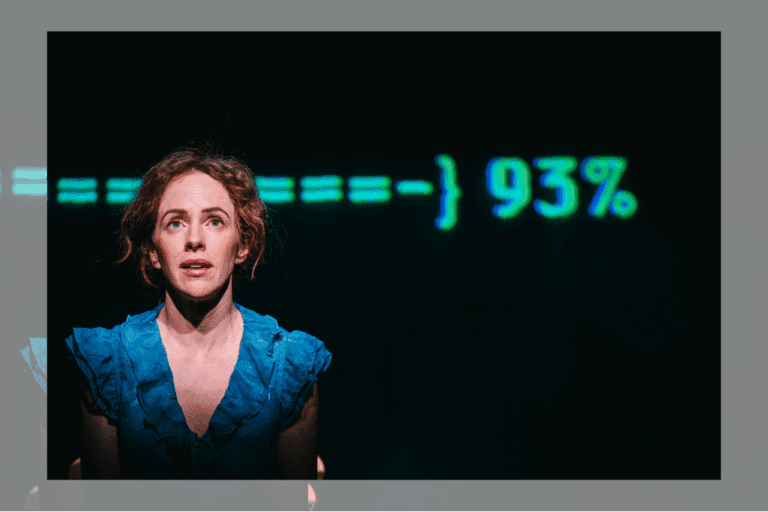
REVIEW: Here For Now’s well-acted Reproduktion attempts to tackle too much
Amy Rutherford’s world premiere script is ambitious and the material it covers is complex — but the narrative feels disjointed.
 iPhoto caption: Kristen Thomson in 'Fulfillment Centre.' Photo by Elana Emer.
REVIEW: Coal Mine’s Fulfillment Centre asks how we end up alone, together
The production understands the play’s themes, yet feels limited by a script that delivers a package it never fully opens.
 iPhoto caption: Elinor Holt and Ellen Close in 'How Patty and Joanne Won High Gold at the Grand Christmas Cup Winter Dance Competition.' Photo by Benjamin Laird.
“We’re living in a world right now where failure is not an option,” says actor Elinor Holt. “And a lot of times people would rather not try anything at all, rather than try something and risk failing at it.”
 iPhoto caption: L to R: Maya Baker, Jameela McNeil, Kelsey Verzotti, Sarah Horsman, and Jessica Jones in 'Legally Blonde.' Photo by Trudie Lee.
In 2022, Verzotti became the first Asian-Canadian to play the titular redhead in Anne of Green Gables at the Charlottetown Festival. Now, she’s set to shatter more expectations as she tackles the lead role in Theatre Calgary’s Legally Blonde.
 iPhoto caption: Photo by Nanc Price.
REVIEW: A Streetcar Named Desire pulls into Theatre Calgary for the first time in over two decades
You’ll find everything you might expect from a take on A Streetcar Named Desire: sensuality, top-notch performances, and all.
 iPhoto caption: Photo by Trudie Lee.
A Christmas Carol makes a triumphant return to Theatre Calgary
“It brings me a lot of joy to know that the generations of Calgarians who saw this show when they were a young person are now, 37 years later, bringing their sons and daughters,” says artistic director Stafford Arima.
 iPhoto caption: Photo by Ben Laird.
REVIEW: Twelve Days brings Christmas joy to lunchtime in Calgary
Watching Twelve Days is reminiscent of opening up the door to a chocolate advent calendar: yes, you know what you’re gonna get, but heck if you don’t enjoy every second of it.
 iPhoto caption: The Lehman Trilogy production still by Trudie Lee.
REVIEW: Canadian theatre has a thing for The Lehman Trilogy. Does it work at Theatre Calgary?
The real drivers of Theatre Calgary’s production are its three performers. And boy, do they ever drive. Each performance pulses with unmatched and unrelenting vivacity, made all the more impressive by the stamina required from the ambitious three-and-a-half-hour runtime.
This sounds intriguing! Wish I could see it.