
REVIEWS: Festival TransAmériques 2026
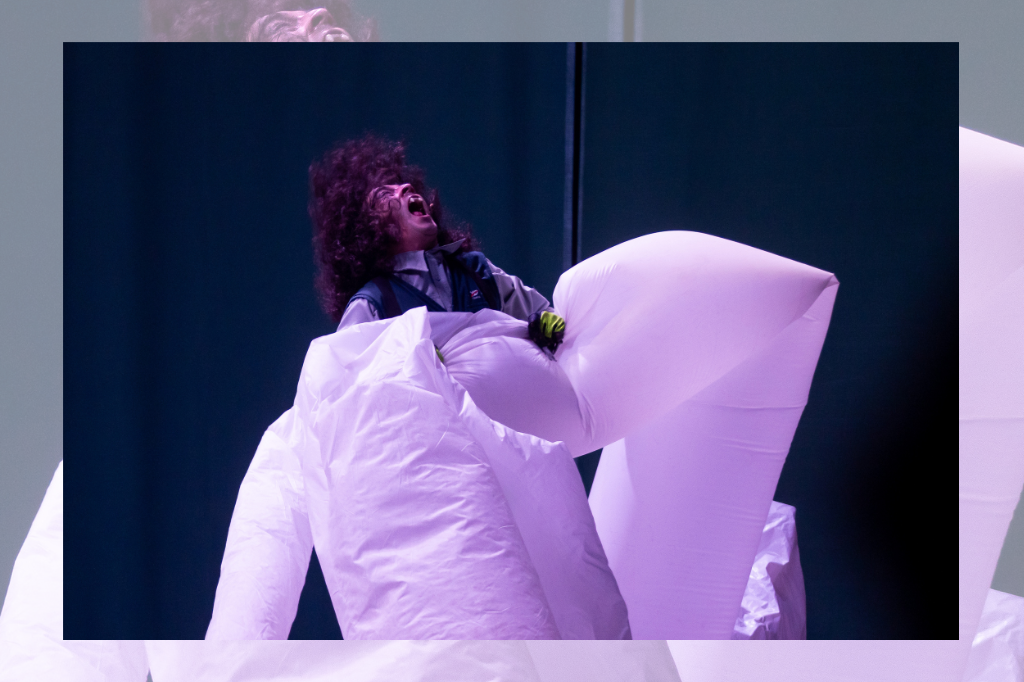 iPhoto caption: 'Vampyr.' Photo by Nicolas Calderon.
The 20th edition of Montreal’s Festival TransAmériques (FTA) does right by its name, featuring a curated lineup of 25 theatre and dance productions with roots mostly in the Americas, from Brazil to Haiti to New York and beyond. (A show from Kyrgyzstan is the main exception.)
The festival’s varied programming, combined with its commitment to surtitling all productions in English and French as needed, makes it one of the most vital contemporary performance festivals on the continent, and a valuable meeting place for the Canadian and Quebecois theatre communities.
This year, Intermission presents its most comprehensive FTA coverage ever, with four critics publishing a total of 16 capsule reviews — responses that will appear below over the course of the two-week festival, with new entries added to the top of the post for ease of navigation.
Bon festival !
Mystic-Métallic (La Chapelle Scènes Contemporaines, June 4 to 8)
by Liam Donovan
I couldn’t initially find my way into this hour-long work of environmental protest dance.
Quebecois creator-performers N. Zoey Gauld, Audrée Juteau, Catherine Lavoie-Marcus burst onto the stage in splotchy ragged white jumpsuits as instrumental heavy metal blares. The trio thrashes wildly, traversing a floor of white mats; sometimes, they snap into defensive positions, like perturbed felines on guard. While a dancer burrowing under a mat resonates with the show’s professed aim — to grapple with the ravages of the mining industry in the rural Quebec region of Abitibi-Témiscamingue — mostly the show felt like undetailed rage. After a while, I assumed the whole production would continue in the same manner, and all but resigned myself to disappointment.
But eventually, softness emerges. The workers pause, then gather in a downstage corner and look back at the abandoned playing space, above which their movements have caused hanging rocks and metal rods to swing (set design by Amélie Laurence Fortin). Karine Gauthier’s lighting dims as the dancers stand side by side: breathing, reflecting. And the atmosphere gets even more tender when the performers start using three of the metal rods as odd, primitive flutes.
I now understand the whole show as a metaphor for the difficulty of escaping extractivist systems: like the opening sequence, sometimes pain continues for so long that it’s impossible to imagine an alternative. (Paging Mark Fisher.)
But everything has an end, and sometimes that end is beautiful.
YOU CANNOT CAN (Piscine du Centre sportif de l’UQAM, June 3 to 7)
by Gus Lederman
In YOU CANNOT CAN, Montreal-based performance artist Dana Michel dwells and dillydallys in and around the humid chamber of the UQAM pool to interrogate her resistance to swimming. To get to the pool, audiences must enter through a gym, which, on opening night, was packed with athletes pumping iron. The strange sensation of being out of place sets the tone for this piece.
Michel lays poolside in a latex leotard, with a curly wig obscuring her face. She languidly stretches, picking a persistent wedgie. The snapping sound of the leotard reverberates around the space. For one hour, Michel sluggishly performs a series of absurd tasks to prepare to swim, such as stirring an industrial stockpot or sitting atop a pile of ice cubes. Slouching and limp, she exerts effort to suit up in various impractical outfits, seemingly procrastinating her entrance into the water. The routine marries the subtleties of contemporary dance with the ridiculousness of clown.
A low hum underscores Michel’s own vocals; she grunts, sings, and hisses breathily. The venue creates a rich sonic experience, amplifying and slightly distorting every noise. It’s an apt container for a bizarre show. But my view from the sidelines was, at times, obscured. If you’re down to dip your toes in, the pool’s edge seems to be the best seat.
In YOU CANNOT CAN, floating becomes an arduous task that Michel must achieve to trust her body’s buoyancy. For me, however, it felt easy trusting Michel to deliver an engrossing performance.
Ces regards amoureux de garçons altérés (Théâtre Prospero, June 4 to 7)
by Liam Donovan
This frenetic bender of a solo show won playwright Éric Noël last year’s Governor General’s Award for French-language drama. But the most immediately striking element of Théâtre Prospero’s remounted 2025 production is director Philippe Cyr’s set design. Black platforms protrude from the intimate theatre’s ceiling and floor, leaving a tight rectangular space with a puddle of lubricant in the centre. It’s too short for a standing adult, so actor Gabriel Szabo crawls, wiggles, and writhes through Noël’s 75-minute whirlwind of meth, sex, and scorned love.
An unnamed man wakes up, beaten, in a Montreal gay sauna. The bruises are new, but the locale isn’t: for months, this is where he’s been spending entire days dealing drugs and having chain sex. Monologuing, he details how a broken-off relationship with a gorgeous man named Manu caused him to start treating pleasure like a competition of endurance.
Ces regards amoureux de garçons altérés — a title invoking the gaze of boys under the influence — is a kind of mini-marathon for both Szabo and the audience. The actor contorts himself into athletically insectoid positions while spitting out drug-fuelled lists of text such as this one detailing a typical session at the sauna (surtitle translation by David Dalgleish): “washroom, shower, hot tub, shower, sauna, hallway, glory hole, sling, washroom, shower, washroom, shower, hallway, from one room to another, from mouth to cock, one ass to another.” It’s a virtuosic performance that embraces ugliness — Szabo flails and yelps, skidding through lube like a figure skater in a constant state of falling — in the name of love.
L’éther (Édifice Wilder — Studio-Théâtre des Grands Ballets, June 3 to 9)
by Liam Donovan
Marie Brassard’s potent new monologued play is dedicated to the dead. Near the 80-minute production’s start, the Quebecois stage and screen veteran says she’s reaching an age where friends pass ever quicker. What follows is an oneiric exploration of the question, “How do we leave?” (or, if you’re not reading surtitles: “Comment partir?”).
Brassard narrates the stories of three interweaving characters: herself, who breaks a wrist while biking to visit a friend in palliative care; that friend Céline, who’s requested medical assistance in dying; and Thanasis, a melancholy Montreal taxi driver. Whenever Brassard speaks as someone other than herself, a vocoder lowers her voice several tones and applies an electronic distortion so otherworldly that it feels natural when the text lifts off from reality and starts imagining other characters’ dreams, where flocks of birds fly circles through clouds of memory.
Also billed as director, Brassard collaborates with video designer Karl Lemieux and onstage composer-musician Alexander MacSween to create a lush, experimental visual-aural dreamscape that for me echoed the soulful associative collages of filmmaker Paul Clipson; long takes out the taxi window evoke Abbas Kiarostami.
At one point, the script underlines the power of living with “elegant lightness,” arguing that humanity’s great superpower is our ability to brush off death’s inevitability with a laugh. This ideal is doubly resonant because in L’éther, Brassard lives up to it completely, guiding the audience through existential territory with disarmingly generous ease.
from rock to rock… aka how magnolia was taken for granite (Usine C, May 31 to June 2)
by Liam Donovan
An exercise in theme and variation undergirds this nimble contemporary dance offering from the New York-born, Switzerland-based choreographer Jeremy Nedd, who performs next to Brandy Butler, Nasheeka Nedsreal, Zen Jefferson, and Jeremy Guyton. Over 75 minutes, the group deconstructs the Milly Rock, a street-dance move created by the American rapper 2 Milly, which Fortnite poached to viral effect.
The dancers take several minutes to build the Milly Rock, starting from a static position and increasing the size of their movements so gradually that the augmentation only becomes evident in retrospect. (The final version combines a two-step with basic arm circles and hands that slice the air around belly-button level.) It felt to me like an embodiment of how dance vocabulary used to travel: as unobtrusively as breathing. Other sequences aim to disorient. Particularly surprising is the abrupt entrance of an anonymous helmeted dancer on a hoverboard. Aboard their useless capitalistic toy, the performer glides an eerily slow circle around the space, body slumped, before disappearing from view.
Bursts of joy mute any latent cynicism. A playfully complex duet that jams on dapping, a sort of multi-step handshake with roots in Black American culture, received ecstatic cheers from the closing night audience. And though much of the score is fairly abstract, uptempo jazz music underscores a cathartic group climax; amid the performers’ relaxed smiles, it’s easy to forget they’re doing an abstracted version of the Milly Rock — until a stray arm scoop reminds you where it all started.
Querelle de Roberval (Théâtre Jean-Duceppe, May 30 to June 2)
by Liam Donovan
At the centre of this Quebecois drama by director-adaptor Olivier Arteau, based on a Kev Lambert novel that riffs on Genet, lurks Querelle (Philippe Thibault-Denis). Caravaggian lighting by Emile Beauchemin beams through the window of a shipping container in the frigid titular Lac Saint-Jean town, where the 30-something Montreal transplant offers a procession of young men — some underage — their first queer sexual experiences. He bends them over as an 18-wheeler, converted by set designer Amélie Trépanier into an organ, booms Bach.
So begins this two-and-a-half hour production, mostly in French with English surtitles, from Quebec City’s Théâtre du Trident. But the cast numbers 12 and Querelle is only part of the story — Arteau’s script is unrelentingly choral, opening up several sides of the months-long local sawmill strike that is the show’s narrative and political fulcrum. We hear the perspectives of Jezebel (Ariel Charest), a lonely employee; other picketers, from skeptics to firebrands; a young ASMRist (Vincent Paquette) or three; an older Innu man (Marco Collin) struggling to preserve his language; and the mill’s cartoonishly villanish boss, Brian (Hubert Lemire).
Arteau’s direction is metamorphic. Different characters relate to the audience in unique ways (Jezebel’s narration is deeply felt, the ASMRists’ purposefully artificial), and sometimes occupy their own visual worlds (at Brian’s house, Eliot Laprise’s video design cuts to a white void). This mosaic of non-realistic theatrical approaches has its dips in effectiveness — including an overlong climactic battle scene narrated at microphones — but I think it succeeds in making the production feel socially engaged; the play’s contemporary labour politics crackle like wildfire.
Vampyr (Maison Théâtre, May 29 to 31)
by Liuba de Armas
Living somewhere between elegy and ecocritical manifesto, Vampyr is a gripping Spanish-language satirical mockumentary about the social and environmental impact of wind farms in Chile.
Director and playwright Manuela Infante deploys language masterfully, crafting entire scenes with a handful of nonverbal sounds, repeating ambiguous phrases (“ya, bueno”), wordplay (e.g. “impacto” as collision and consequence), and echoing motifs in a nod to the chattering of bat swarms.
Designed by Rocio Hernández, the set recalls the verdant artificiality of green screens and greenwashing. The props are few but strategic, privileging manufactured materials like aluminium and plastic sheeting. Modeling labour transparency, the cast carries out set changes in plain sight.
Actors Marcela Salinas and David Gaete shapeshift as vampire bats, night-shift workers, a company spokesperson, and a chiropterologist. When asked at the talkback on May 30 about the choice to have actors interpret multiple roles, Infante explained: “We’re inhabited by multitudes.” The cast strives to sustain tension between animal and human aspects of their performances. This co-inhabiting of entities anchors the work’s ecocritical stance, culminating with the declaration that man is half-dead, half-living, half-land, half-animal, half-human, “y no solo eso” — “and not only that.” This intentionally paradoxical equation is more concerned with articulating the distinct parts than their sum, to trace kinship between human and non-human life. Vampyr is a challenging work that I think will find resonance anywhere life, human or otherwise, is exploited for profit.
Vampyr will be presented at Festival Carrefour in Quebec City on June 3 and 4.
Baldwin and Buckley at Cambridge (Place des Arts — Cinquième Salle, May 28 to 31)
by Megan Hunt
Baldwin and Buckley at Cambridge is a tense recreation of 20th-century history — and reflection on the present — from New York theatre company Elevator Repair Service, that relies on verbatim transcripts of a 1965 debate between the iconic (and iconoclastic) author James Baldwin and the conservative commentator William F. Buckley Jr. Anchored by standout performances from Greig Sarjeant (Baldwin) and Ben Williams (Buckley), the show follows both intellectuals’ arguments about whether the American dream was built through exploitation of its Black population. While both performers depict their characters as articulate and confident, Williams’ performance drips with an infuriating smugness: he’s hard to watch, but impossible to look away from.
John Collins’ straightforward but effective direction centres the inherent weight of the verbatim monologues, and punctuates the historic nature of the debate. That said, the show shines brightest in a standout scene that is, according to program notes, purely imaginative: a conversation between Baldwin and the playwright Lorraine Hansberry (April Matthis), a friend who died just a month prior to the debate. Against a sonic backdrop of overpass traffic and Nina Simone wafting from the radio, we get an intimate peek into the interior life of two of the 20th century’s most significant writers. There’s a moment of fourth-wall-breaking within this scene that recontextualizes the whole show as a meta-conversation Elevator Repair Service is having about its own past as a theatre company. It powerfully blurs the lines between today and 1965, arguing that the gap between these two moments isn’t as wide as we’d like to believe.
Festival TransAmériques runs in Montreal until June 10. More information is available here.
Liuba de Armas and Megan Hunt are covering FTA as part of Page Turn, a professional development network for emerging arts writers, funded by the Canada Council for the Arts and administered by Neworld Theatre.
Intermission reviews are independent and unrelated to Intermission’s partnered content. Learn more about Intermission’s partnership model here.

Liuba de Armas
Liuba de Armas is a working-class arts writer and curator based in Montreal, with roots in Ciudad Nuclear, Cienfuegos, Cuba. She holds a Master's degree in art history from McGill University and has curated exhibitions at Latitude 53, MSVU Art Gallery, Hermes Gallery, and the Khyber Centre for the Arts. She is one of two co-editors of Beyond the Gallery: An Anthology of Visual Encounters (Laberinto Press, 2021) and is a member of Neworld Theatre's Page Turn program (2025-27).
LEARN MORE
Liam Donovan
Liam is Intermission’s senior editor. He lives in Toronto. His Substack newsletter is available at loamdonovan.substack.com.
LEARN MORE
Megan Hunt
Megan Hunt is a Montreal-based writer, editor and dramaturge. Her work has been featured in outlets such as This Magazine, Culture Days and IN Magazine, as well as festivals including the Women's Work Festival in St. John's, Newfoundland. She is one of the writers selected for the first cohort of Page Turn, a program facilitated by Neworld Theatre to support emerging voices in criticism and arts writing.
LEARN MORE
Gus Lederman
Gus Lederman is an emerging playwright and performer. They graduated from OCAD University’s Creative Writing program in May 2025, where they were awarded the Nora E. Vaughan medal for their thesis project, mycomimic. Gus got their start as a theatre critic in the Toronto Fringe's 2024 New Young Reviewers program. They love campy queer movies and (almost) anything with puppets.
LEARN MORE iPhoto caption: Members of the company of 'Robin Hood.' Photo by Dahlia Katz.
REVIEW: Canadian Stage’s Robin Hood panto is anti-capitalist fun for the whole family
Following Ross Petty’s legacy of scene-stealing, Damien Atkins as the evil Prince John is easily the greatest delight of the show.
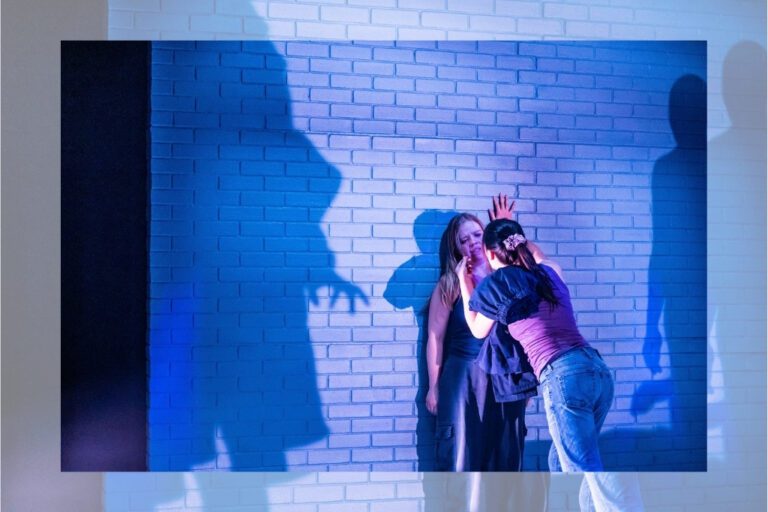 iPhoto caption: Vivien Endicott-Douglas & Liz Der. Photo by Dahlia Katz.
The show is approximately an hour-and-a-half long, but in the world of the story, it all takes place in only 10 minutes. Woolley’s choice to manipulate time in this way is clever and appropriate, allowing the audience to feel the enormity of what someone undergoing a mental health crisis might experience over a few minutes.
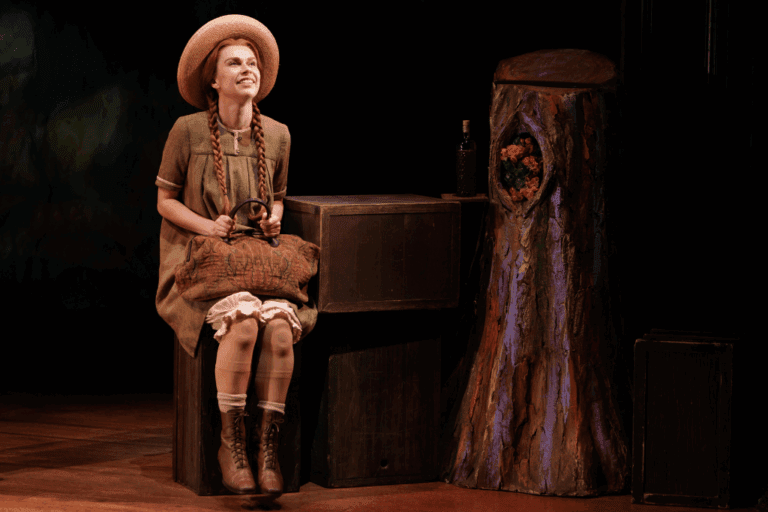 iPhoto caption: Caroline Toal as Anne Shirley in 'Anne of Green Gables.' Photo by David Hou.
“The story is so hopeful and beautiful and funny and silly and moving — and I think that nowadays, it's so nice to be reminded of hope," says Toal.
 iPhoto caption: Photo by Mike McPhaden.
REVIEW: Shakespeare in the Ruff’s Tiff’ny of Athens throws a delightful party in Withrow Park
The text draws on an eclectic mix of sources: other Shakespeare plays, Dolly Parton songs, and automated messages from government service helplines, to name a few.
 iPhoto caption: Andrew Penner and Deborah Hay in 'After the Rain.' Photo by Dahlia Katz.
REVIEW: After the Rain transforms the Tarragon Mainspace into a passionate folk-rock concert
The performers of this world premiere musical got a lot of laughs from the buzzing opening night audience, but make no mistake, they got quite a few audible tears out of us, too.
 iPhoto caption: Photo by Nanc Price.
REVIEW: Mirvish’s Made in Italy dishes a pleasant but lengthy family feast
Made in Italy is a feat of physical comedy, with creator-performer Farren Timoteo seamlessly taking on the distinct voices and mannerisms of about 10 different characters.
Comments