
Stratford Festival review: The Goat or, Who Is Sylvia? A review in five acts
 iPhoto caption: Photo by David Hou.
Prologue
Is it wrong to dub Edward Albee’s Pulitzer-shortlisted play The Goat or, Who Is Sylvia? a tragic love story? Well, probably, since one of its central couples is composed of a goat and a man.
The Stratford Festival’s production of the work, now playing on the thrust stage of the Studio Theatre, poses an ideal opportunity to watch this twisty story unfold. The man, Martin, is a highly successful architect at the height of his career and personal life. His wife, Stevie, oozes extinguished middle-class sophistication, Martin’s partner in quippy battles of wit and sarcasm; after so many years together, they still love each other. And though their queer son Billy is something of an Achilles heel to Martin’s existence, for all intents and purposes, Martin has hit his peak.
Who’s Sylvia, you ask? Oh yeah, the goat with whom Martin has fallen madly in love. When long-time family friend Ross finds out about Martin’s so-called “love affair,” everything comes crashing down in this tragic, but surprisingly comical, downfall of man.
Albee’s tribute to Greek tragedy works quite well, feeling contemporary on the Stratford stage while still paying homage to the genre through its structure and tone. Even the title is a poke to its origins (the original Greek meaning of tragedy being “goat-song”). The play is complete with a thorny family, monologues that mimic the Greeks’ direct address, and nauseating romantic plot lines (while Ancient Greek tradition often featured incestuous plot lines, Albee takes that trope even further).
And now, in my own tribute to the Greek tragedy, I present a review in five acts:
Act I: The Atmosphere
Shawn Kerwin’s set is a white picket fence wet dream. There’s a stately white bookshelf that almost suggests a proscenium with its grandness, along with four pristine matching armchairs set up in a cross position. The action of the play unfurls inside painted white lines that create a box, within which the perfect life of The Goat or, Who Is Sylvia? can exist.
While the living room at first looks perfectly symmetrical, it’s actually slightly off-kilter, thanks to unevenly spaced shelves that cleverly hint at the unpleasant underbelly of the Gray family. Most of Kaileigh Krysztofiak’s lighting errs towards the naturalistic, but the transitions especially are where red and blue tones make The Goat or, Who Is Sylvia? feel reminiscent of A24’s I Saw the TV Glow.
Act II: The Direction
Dean Gabourie’s direction feels human and nuanced, with characters weaving between the living room’s couches as if inside the Minotaur’s labyrinth. The characters exude simultaneous sarcasm and energy — much to my intrigue, it’s not always clear when a character is being serious.The epic proportions of the characters’ emotions are again reminiscent of ancient Greek theatre, though if anything, the production occasionally has a bit too much zeal. From the play’s first scene, the energy rests at an 11, and never falters during the show’s interval-less hour and 49 minutes (itself a feat!). As a result, though, the conclusion doesn’t necessarily feel as cathartic as the play’s genre demands.
Act III: The Acting
The chemistry between Stratford veterans Rick Roberts and Lucy Peacock is jaw-dropping; both deliver impactful performances infused with vulnerability. Peacock in particular offers a raw portrayal of female rage onstage. Anthony Palermo’s performance as Billy struggles to find itself when Palermo shares the stage with the larger-than-life Roberts and Peacock, but Palermo finds their footing by the time Albee’s tragic tale reaches its nauseating end.
Act IV: The Costumes
The colours of Kerwin’s costumes are intentionally striking against the set. While Stevie is dressed in white layers that match the white set, Martin dons darker garb, almost as if standing in opposition to his middle-class dream of a home. Billy, meanwhile, wears bright orange, a colourful sore thumb: He lives outside the rules of this suburban middle-class structure, and challenges his parents’ views and behaviours with his queerness.
Act V: The Language
The star of Albee’s play is the work’s hyper-fixation on semantics. Martin, Stevie, and Billy often debate the language they use, trying to find specificity in how we communicate with one another. Grammar, rules, and language become an important path to understanding the Gray family. The verbal frenzy of Albee’s script is electrifying — there’s a beautiful lyricism to the words, which the characters then use as their weapons.
Exodos
The Goat, or Who Is Sylvia? delivers an off-kilter comedy and disturbing tragedy in a fashion that would make the Ancient Greeks proud. Though the performance at times feels melodramatic due to its consistently high energy, it’s unlikely you’ll see a show quite like this again any time soon.
The Goat or, Who Is Sylvia? runs at the Stratford Festival until September 29. Tickets are available here.
Intermission reviews are independent and unrelated to Intermission’s partnered content. Learn more about Intermission’s partnership model here.

Andrea Perez
Andrea Perez is an interdisciplinary theatre artist who enjoys acting, writing, directing, and producing. She is an undergraduate student at the University of Toronto studying Drama, Classical Civilizations, and Creative Writing, exploring storytelling and people in their many facets. She is a member of the 2023 cohort of the IBPOC Critics Lab, supported by Intermission Magazine and the Stratford Festival.
LEARN MOREComments
Leave a Comment
 iPhoto caption: Photos by Dahlia Katz.
REVIEW: Two site-specific TIFT shows flirt with nonconformity
Screw the proscenium: a house kitchen and a warehouse take front and centre in Talk Is Free Theatre's productions of Cock and For Both Resting and Breeding.
 iPhoto caption: Dead Broke production still by Calvin Petersen.
REVIEW: Comedy-horror hybrid Dead Broke successfully spooks
While the non-horror aspects of the show lean towards the more amateur, the scares are incredibly successful. This show pulls off the theatrical horror with seeming ease: That’s reason enough to check it out for yourself.
 iPhoto caption: Sara Topham in Hedda Gabler at the Stratford Festival. Photo by David Hou.
Gatekeep, gaslight, girlboss: The delight of female rage in theatre
Personally, I support women’s rights and women’s wrongs — especially when it comes to my girl Hedda. And it seems that at least two Ontario directors share my viewpoint, with Hedda Gabler opening twice in the same month at Stratford and at Coal Mine Theatre in Toronto. What makes her story so appealing?
 iPhoto caption: Photo by Dahlia Katz.
REVIEW: The Last Timbit is a surprisingly charming commercial gem
The Last Timbit, a show of snow and sweets, had a limited run at the Elgin Theatre in June and is getting a streaming release on Crave on August 12. I, for one, am more than curious to see how a wider audience will react.
 iPhoto caption: Photo by Emily Anne Corcoran.
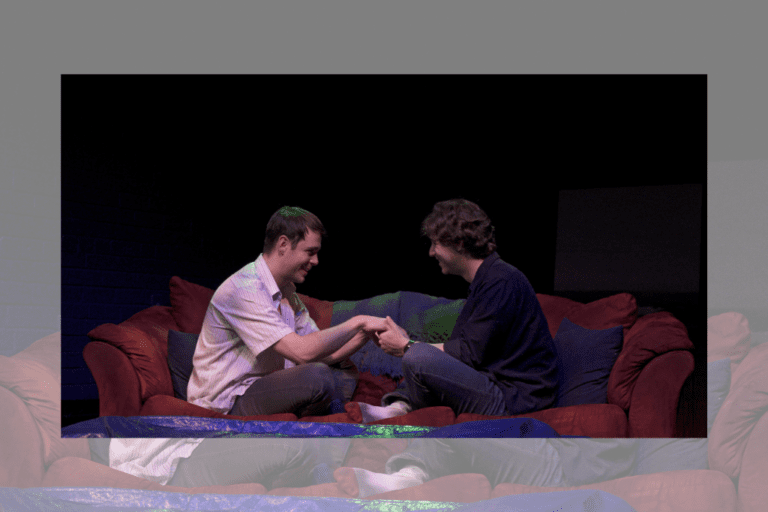
REVIEW: Icarus Theatre’s Fiji combines competing genres
If you enjoy the pitch of a rom-com true-crime mesh, this one's for you. Even if it's not perfect, it's a charming, nimble watch that tugs at the heartstrings.
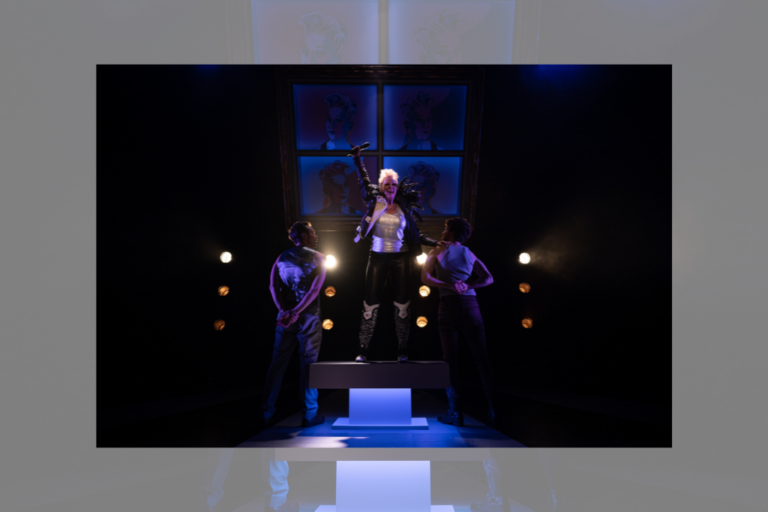
REVIEW: ARC’s Rockabye glows but over-saturates
Rockabye, though a little longer than it should be, raises many timely questions. Should real lives be valued over ideologies or the other way around? Is it ethical to let someone die for a political cause?
Thank you for this review. I was blown away by the performance (and script) two days ago.
As I find it a challenge to sit still for two hours, I was immensely grateful for the consistent energy level of an 11. And as the Greek tragedies and comedies that I once read were not lengthy, (probably some were much shorter than this) I think we can appreciate the unrelenting pace. I think I liked being stunned by the plot but always registering reactions two steps behind. And always at the back of my mind wondering how this tragedy could be at times so funny.
Martin was so convincing in his agony that I walked away heartsick.