
REVIEW: In Tarragon and Native Earth’s Mischief, the jokes aren’t the point
 iPhoto caption: Lisa Nasson and Nicole Joy-Fraser in 'Mischief.' Photo by Jae Yang.
I’m writing this review as part of ON Criticism: The 2025/26 Theatre Critics Lab, a collaboration between Intermission and four Ontario theatres. In recent weeks, that work has included a conversation with Mischief director Mike Payette and associate director Joelle Peters, focused on the Toronto premiere of the production alongside broader questions of reviewing Indigenous storytelling, settler spectatorship, and cultural responsibility. That exchange, and the reflections it prompted afterward, inform how I approach this review, shaping what I notice, what I struggle to read, and the habits and expectations I bring with me as a settler viewer.
Mischief, written by Lisa Nasson, is a co-production between Tarragon Theatre, Native Earth Performing Arts, and Neptune Theatre. Tarragon’s marketing materials describe the show as a “gentle comedy,” a phrase that proves accurate, but undersells the play’s ambitions. It earns its laughs easily and honestly, but the jokes aren’t the point. They invite the audience into more uncomfortable conversations about history, protest, and absence.
Set in and around a Mi’kmaq community near Kjipuktuk (Halifax), the story centres on Brooke (played by Nasson), a Mi’kmaq woman who structures her life around routines she both relies on and resents. She works at her uncle’s store on the rez, winkingly named “Chris’s Convenience,” fielding regular customers and familiar indignities while trying to keep her emotional life carefully contained. When a woman appears in the store’s back room claiming to know Brooke’s missing mother, her fragile equilibrium begins to crack.
Nasson anchors the production with an assured, naturalistic performance that feels lived-in. Her work is sharp without being showy, and her comic timing reflects a great deal of control and precision. She wields humour as both a shield and weapon, using wit to maintain control until her grief insists on acknowledgment.
The supporting cast that fills out Brooke’s world is excellent. Jeremy Proulx’s Uncle Chris provides much of the show’s warmth, his performance balancing charm and weariness without tipping into sentimentality. Trina Moyan’s Tammy, a close friend of Brooke and her uncle, is fiery and impulsive, injecting the play with energy and political urgency. She often articulates a sense of collective responsibility that Brooke resists, especially in conversations surrounding protests against a local statue of the city’s founder, Edward Cornwallis, who issued an infamous scalping proclamation against the Mi’kmaq. Tammy and Brooke’s debates give the play much of its intellectual friction.
Devin MacKinnon appears in two smaller, deliberately abrasive roles: Fisherman Fred and Good Guy. Neither character is meant to be liked. Instead, the writing positions them as lenses through which Brooke encounters different forms of settler entitlement. MacKinnon commits fully, distinguishing the roles through physicality and tone.
The first act moves smoothly, even comfortably — until it doesn’t. A scene involving Fisherman Fred is the turning point. It begins almost like flirtation. The audience laughs along, recognizing the rhythms of a familiar interaction, until Brooke turns him down, and Fred unspools his ignorance and casual racism, sucking the air out of the room. The laughter evaporates. The silence becomes palpable.
MacKinnon’s return as Good Guy dominates much of the second act. Here, the play takes aim at performative allyship and liberal self-congratulation, skewering the desire to be seen as one of the good ones. The result is intentionally cringeworthy, and often funny, but also somewhat narrowing. While the satire is sharp, it comes at the cost of narrative momentum, circling a point the play has already made, even as it continues to provoke laughter and discomfort.
One of Mischief‘s most intriguing elements lies in its incorporation of the otherworldly. Nicole Joy-Fraser plays Emily, a mysterious, liminal figure who appears to Brooke in a space somewhere between memory, ancestors, and imagination. Joy-Fraser brings a playful strangeness to the role, oscillating between humour and gravity. A running joke comparing Emily to Jesus culminates in a physical gag that earned one of opening night’s biggest laughs.
Emily’s presence helps represent Mi’kmaq ways of understanding time, kinship, and relationships with the non-human world (ideas outlined in the audience resource guide provided by the theatre). Rather than insisting on a fixed meaning, the production allows these ideas to remain suggestive. I sometimes found myself reaching for clearer symbolic anchors, an impulse that likely reflects my own training and expectations more than a shortcoming of the work.
Andy Moro’s set and projection design are among the production’s highlights. The set feels both protective and confining, suggesting multiple images at once, from anatomy to architecture. Projections of fish and birds appear throughout the play, mirroring a conversation Emily and Brooke have during their first encounter. The fish represent Indigenous characters, moving through a world structured for their capture, while the birds symbolize settlers, observing from above or preying on those below. These images establish a visual grammar that runs beneath the action, allowing meaning to accumulate through repetition rather than explanation.
Leigh Ann Vardy’s lighting design and Maddie Bautista’s sound design largely keep to the background. When Bautista’s sound does rise to the surface, particularly in a low, ominous rumble near the end of the first act, it lands with precision, signalling a tonal shift without overwhelming the scene.
The emotional heart of Mischief emerges in its treatment of absence. Brooke rarely speaks directly about her mother, who went missing three years before the play begins, but her absence lingers in every moment. Nasson delivers one of the show’s standout moments in a second-act monologue that finally allows her character’s accumulated frustration and grief to bubble over without a punchline to cushion it.
The ongoing crisis of Missing and Murdered Indigenous Women and Girls looms behind the play. Nasson gestures toward this reality without fully unpacking it, a choice that creates a sense of tension. Mischief engages with big ideas like this, as well as intergenerational trauma, protest, reconciliation, and the ways settlers relate (or fail to relate) to Indigenous struggle, but it resists building toward a singular, declarative conclusion. At moments, the play seems to strain against its own gentleness, reaching for something sharper before pulling back.
That unresolved quality may frustrate some viewers. For others, it may feel entirely consistent with the work’s temperament. It is not a parable or polemic — nor does it ever claim to be. The play’s openness sometimes challenged my expectations about narrative payoff and theatrical argument. But the laughter is real, the discomfort is earned, and the performances are compelling.
By the end, Mischief may not fully cohere into a singular statement, but it leaves behind something quieter and more human: the feeling of having spent time inside a community, listening to its jokes, its arguments, and its silences. It is a play full of questions — some answered, many not — and it trusts the audience enough to live with that uncertainty.
Mischief runs at Tarragon Theatre until February 8. More information is available here.
Hunter Weaymouth wrote this review as part of ON Criticism: The 2025/26 Theatre Critics Lab, a collaboration between the Grand Theatre, Talk is Free Theatre, Tarragon Theatre, Theatre Aquarius, and Intermission.
Hunter Weaymouth
Hunter Weaymouth (he/him) is a Hamilton-based playwright, screenwriter, and theatre critic.
LEARN MORE iPhoto caption: Hamilton Fringe 2025. Photo by Dave Pijuan-Nomura
REVIEWS: Hamilton Fringe Festival 2026
From intimate performances and new dramas to musical comedies and experimental collaborations, these shows offer a glimpse into the many strange, funny, moving, and unexpected stories being told across Hamilton this summer.
 iPhoto caption: The company of 'It’s a Good Life If You Don’t Weaken.' Photo by Dahlia Katz.
In Theatre Aquarius’ new Tragically Hip jukebox musical, emotion comes first
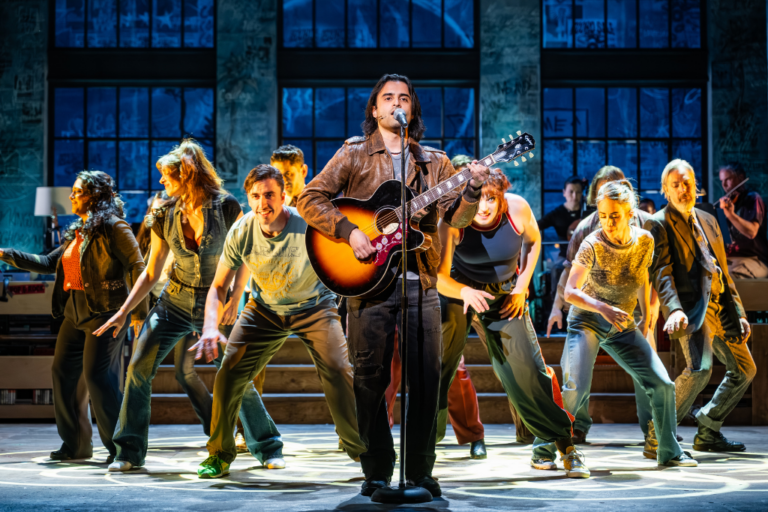
“This show isn’t about the Tragically Hip,” says director Mary Francis Moore. “It’s about Waleed.” Instead of bending the Hip’s music to fit the narrative, the team has looked for thematic threads and moments where the emotional undercurrent of a song aligns with what’s happening on stage, even if the connection isn’t explicit.
Comments