
REVIEW: Pride and Prejudice gets a postmodern makeover at London’s Grand Theatre
 iPhoto caption: Photo by Dahlia Katz.
Jane Austen is such a towering voice in the English canon, with no shortage of adaptations — so how can a production find a new spin on her work?
In the Grand Theatre’s Pride and Prejudice, adapted by Kate Hamill and directed by Rebecca Northan, the answer is to apply an iconoclastic touch to Austen through metatextual elements, physical comedy, and anachronisms. For me, these postmodern flourishes lack coherence, resulting in a production replete with interesting choices, but without an overarching take on Austen.
The story is, well, you know. Lizzy Bennet (Beck Lloyd) has resolved to never marry, but then slowly gets swept up with Fitzwilliam Darcy (Eric Craig), who she at first detests, but learns that she has misjudged. Perhaps the first major adaptational choice is that when the two first see each other there’s a Hollywood-movie-style record scratch while Lionel Richie’s “Hello” blares. The production plays up the love-at-first-sight trope through the Richie intrusion, but there’s still the classic (and comical) arc from witty disgust to romantic overtures.
This moment, among others, proclaims this Pride and Prejudice’s distinctly cinematic sensibility, underlined by the sound design and music (both by Maddie Bautista). Several times over the course of the production, Northan’s direction communicates implied camera movements with dramatic swoosh sound effects, as the scenery and actors all tilt as if we’re now looking from a different point of view — a strange and interesting effect. The costume design by Joanna Yu blends regency fashions with contemporary touches of bright primary colour, suggesting a middle ground between rigid historical accuracy and pop revisionism.
Many of the actors do double-duty and sometimes even cross gender lines: Raechel Fisher plays Ms. De Bourgh as well as Jane, who is helplessly in love with Mr. Bingley (Sarah Wilson). Wilson is hilarious as Bingley, who can only be described as dog-like in his affections. Carmen Grant plays the other major male suitors: the at first dashing Mr. Wickham and the awkward, overly exuberant Mr. Collins. In further cross-gender casting, Andrew Moodie plays Mr. Bennet, the bored-out-of-his-mind patriarch, as well as Charlotte Collins, Elizabeth’s best friend.
A standout in the supporting cast is Lior Maharjan, who plays both the naive (and in this production, frequently drunk) Lydia, and Lady Catherine De Bourgh, nailing Lydia’s youthful energies as well as Lady De Bourgh’s stern, aristocratic authoritarianism. Another is Wilson, who plays both the aforementioned Mr. Bingley as well as the scene-stealing Mary, a character that has a habit of sneaking up on people, resulting in everyone on stage shouting “MARY” in shocked horror. Maharjan and Wilson are strong as a comic duo, with Lydia’s effervescence bouncing perfectly against her cold, grotesque, frequently coughing sister. Mary’s unadorned sharpness against Lydia (as well as everyone else) is a delight: “you locked me in a closet!”
The show’s sexual innuendo mostly lands, with period-accurate flirtations like Lydia’s “can I touch your musket?,” but some of it feels less organic, as when Mrs. Bennet states, rather out-of-character: “balls, balls, balls, I cannot get enough of them.” Other segments failed to land for me because they lean too much on tired jokes — ironic usage of Lionel Richie feels just about as old as Lionel Richie at this point — but even when effective, this shift to broad comedy leads to a production that feels like a Saturday Night Live sketch parodying Austen, instead of a wholly thought-out adaptation.
These embellishments are primarily surface-level, whereas the core story remains relatively unaffected by all the shenanigans. This devotion to following the plot makes it harder to say anything new about the feminist questions that Austen addressed 200 years ago, nor suggest how those questions bear on the present.
This year marks Jane Austen’s 250th birthday, and this has heightened the already-regular torrent of Austen adaptations. Following on from the jukebox musical Pride and Prejudice* (sort of) that played in Toronto two holiday seasons ago (and is coming back in July), we’ve just seen the 20th anniversary re-release of the Keira Knightley Pride and Prejudice film, and there will be another Hamill Austen adaptation, Sense and Sensibility, at the Stratford Festival this summer.
Given the sheer number of takes on Pride and Prejudice, as well as the built-in audience already familiar with the novel, what I wanted were more changes to the narrative. On the level of direction and music, the play evinces an anarchic impulse which then makes its attempt to hit every plot beat from the novel feel dissonant — an uneasy compromise between extremes. That being said, even my Austen-purist heart was won over by the time-tested conclusion. (How could you not be?) In spite of some missed opportunities, Pride and Prejudice ends up a lighthearted recontextualization of its source material, which should appease all but the most stolid Janeites.
Pride and Prejudice runs at the Grand Theatre until May 17. Tickets are available here.
Intermission reviews are independent and unrelated to Intermission’s partnered content. Learn more about Intermission’s partnership model here.

Gwen Caughell
Gwen Caughell (she/her) is a critic, playwright, and short story writer who lives in London, Ontario. She loves any work that is queer, difficult, or strange. Her (ever-changing) favourite writers/critics (at the moment!) are Sarah Schulman, Mary Gaitskill, James McCourt, Paula Vogel, Tony Kushner, Robin Wood, D.A. Miller, and Lauren Berlant.
LEARN MOREComments
Leave a Comment
 iPhoto caption: Members of the company of 'Narnia.' Photo by Dahlia Katz.
REVIEW: Bad Hats’ Narnia is a joyful, heartwarming escape
The spirit of openness and the joy of discovery rule over this Narnia. Open the wardrobe and see.
 iPhoto caption: Members of the company of 'Robin Hood.' Photo by Dahlia Katz.
REVIEW: Canadian Stage’s Robin Hood panto is anti-capitalist fun for the whole family
Following Ross Petty’s legacy of scene-stealing, Damien Atkins as the evil Prince John is easily the greatest delight of the show.
 iPhoto caption: Lauren Gillis and Alaine Hutton in 'Public Consumption.' Photo by Eden Graham.
REVIEW: Lester Trips’ stylish Public Consumption captures the internet’s profound emptiness
Rather than directly representing online life, Public Consumption speculates — with virtuosity — about how the digital world affects our bodies. And the show's findings are by no means comfortable.
 iPhoto caption: Tony Ofori and Daren A. Herbert in 'Moonlight Schooner.' Photo by Dahlia Katz.
Kanika Ambrose’s Moonlight Schooner is animated and visually stunning, but its individual pieces don’t come together as neatly as I would've expected.
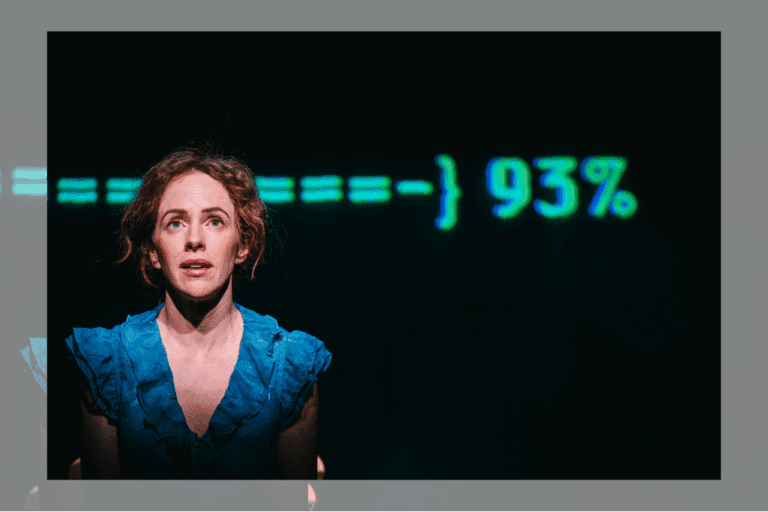 iPhoto caption: Fiona Mongillo in 'Reproduktion.' Photo by Ann Baggley.
REVIEW: Here For Now’s well-acted Reproduktion attempts to tackle too much
Amy Rutherford’s world premiere script is ambitious and the material it covers is complex — but the narrative feels disjointed.
 iPhoto caption: Kristen Thomson in 'Fulfillment Centre.' Photo by Elana Emer.
REVIEW: Coal Mine’s Fulfillment Centre asks how we end up alone, together
The production understands the play’s themes, yet feels limited by a script that delivers a package it never fully opens.
 iPhoto caption: Photo by Dahlia Katz.
REVIEW: How does the American musical Waitress land in today’s Canada? It’s complicated
The Theatre Aquarius and Grand Theatre co-production is fascinating for its attempt to harness the pleasures of the Broadway musical form, while casting an awkward-stepping jaundiced eye at fantasies of American identity.
This was a well written review, I wish I had read it before I went to see the show. I left half way through because I thought the directors take on it was aweful. The actors were good but all reserved, pent up emotion and subtle wit was cometely lacking, it was like watching a pantomime version of Pride and Predudice and was not what I was expecting to watch and not worth the expensive tickets