
REVIEW: All’s Well That Ends Well at the Stratford Festival
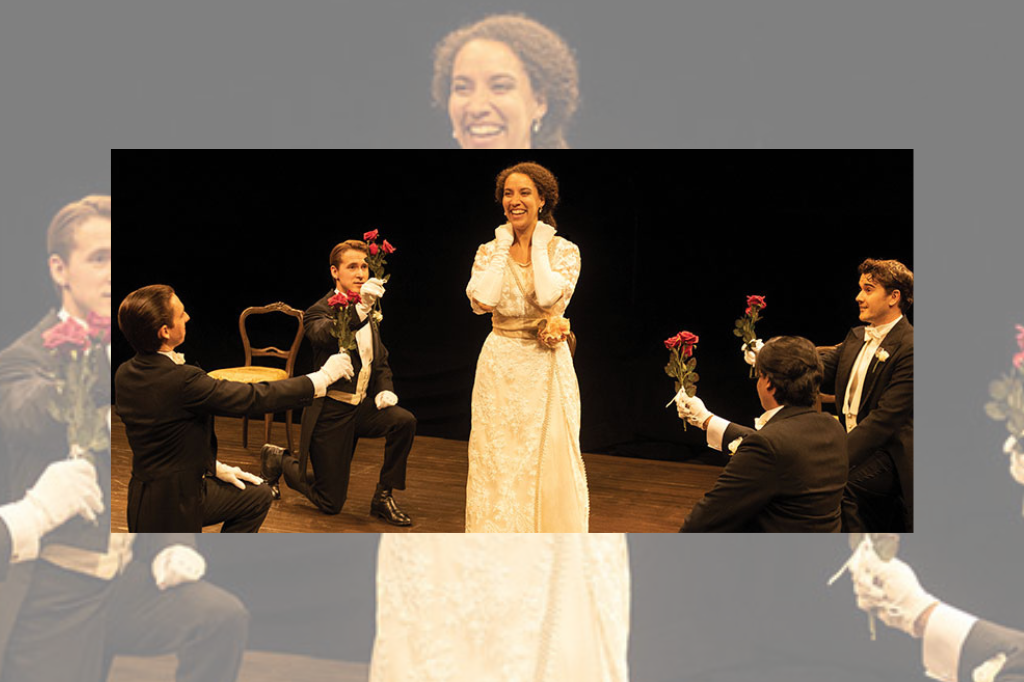
Wow, Shakespeare scholars weren’t kidding when they called it a “problem play,” were they?
The Stratford Festival’s All’s Well That Ends Well is a commendable take on one of Shakespeare’s more frustrating plays, a production which by and large works in spite of a troublesome story. Director Scott Wentworth has moulded the Bard’s tale of fuckboys and fairytale logic into an appealing product, mustering the resources and scope that a Stratford production allows. The Tom Patterson Theatre’s long thrust stage, studded with twelve high-back dining chairs, is ably used here, and the vomitoria (passages under the audience seating, for those who weren’t in my Theatre History II class) make for a number of high-comedy entrances.
Lowly Helen (a charming Jessica B. Hill) has her eyes on Bertram (the bumbling Jordin Hall), a member of the aristocracy who views her as a mere annoyance. Helen concocts a plot to force him to marry her, which involves her coercing the sickly King of France (Ben Carlson) to appoint Bertram as her suitor.
But Bertram’s a calculating bastard, giving Helen conditions she must fill before he will marry her — and in the meantime, he’s off to war, where he becomes infatuated with Diana (the fiery Allison Edwards-Crewe). Helen follows him, initiating a game of cat-and-mouse which ultimately Bertram in the aftermath of his infidelity, bonding Helen and Diana in friendship after having performed the bed trick — a literary device far older than Shakespeare, and one which already feels played-out. All’s Well ends with Bertram professing his love for Helen, given she’s gone to such impressive lengths to win him.
As is perhaps evident, the problem-ness of the play emerges early on. Helen is unopposed to using others as pawns in her advances towards Bertram — she ignores much of the very good advice from the Countess of Rossillion (Seana McKenna) — and the object of her affection is a rudderless rich boy with little mind for how others are affected by his actions. Bertram’s decision to marry Helen is rather abrupt: if they’re to marry, one might anticipate a fairly toxic union. A much more cogent subplot involving Bertram’s disloyal associate Parolles (Rylan Wilkie) brings a needed straightforwardness to the play — the scene in which the soldiers prank him for his foolish actions, spearheaded by a fantastic Irene Poole, is tantalizingly funny and gone too soon. Moments led by André Sills as the play’s jester Lavatch, are also hysterical, if infrequent — they punctuate a sprawling yarn with lovely tidbits of levity.
Some aesthetic choices from Wentworth are a little garbled — a World War I visual motif feels under-explored, and music throughout the production, including a sung hymn towards the end of Act I, seems in search of its context (Paul Shilton is the composer and sound designer). But the bones of the production are strong: text is at home in the mouths of Wentworth’s actors, never forced and seldom sounding arcane, and Wentworth’s blocking makes the most of the Patterson thrust, experimenting with sightlines and ensuring there are no bad seats in the theatre.
All in all, Stratford’s All’s Well That Ends Well is likely to be a treat for the Shakespeare fan in your life — a problem play fully realized with occasional brilliance in its direction — but the pitfalls of the story, which meander for a full three hours, make this one a tough watch for the more casual Billy Shakes viewer. If you see it, perhaps re-read the play first, or at the very least the excellent programme notes — this All’s Well That Ends Well is at its best when freed of its somewhat misogynistic story, when its comedic delights have adequate room to breathe.
All’s Well That Ends Well runs at the Stratford Festival through October 29. Tickets are available here.

Aisling Murphy
Aisling is Intermission's former senior editor and the theatre reporter for the Globe and Mail. She likes British playwright Sarah Kane, most songs by Taylor Swift, and her cats, Fig and June. She was a 2024 fellow at the National Critics Institute in Waterford, CT.
LEARN MORE iPhoto caption: Members of the company of 'Narnia.' Photo by Dahlia Katz.
REVIEW: Bad Hats’ Narnia is a joyful, heartwarming escape
The spirit of openness and the joy of discovery rule over this Narnia. Open the wardrobe and see.
 iPhoto caption: Members of the company of 'Robin Hood.' Photo by Dahlia Katz.
REVIEW: Canadian Stage’s Robin Hood panto is anti-capitalist fun for the whole family
Following Ross Petty’s legacy of scene-stealing, Damien Atkins as the evil Prince John is easily the greatest delight of the show.
 iPhoto caption: Lauren Gillis and Alaine Hutton in 'Public Consumption.' Photo by Eden Graham.
REVIEW: Lester Trips’ stylish Public Consumption captures the internet’s profound emptiness
Rather than directly representing online life, Public Consumption speculates — with virtuosity — about how the digital world affects our bodies. And the show's findings are by no means comfortable.
 iPhoto caption: Tony Ofori and Daren A. Herbert in 'Moonlight Schooner.' Photo by Dahlia Katz.
Kanika Ambrose’s Moonlight Schooner is animated and visually stunning, but its individual pieces don’t come together as neatly as I would've expected.
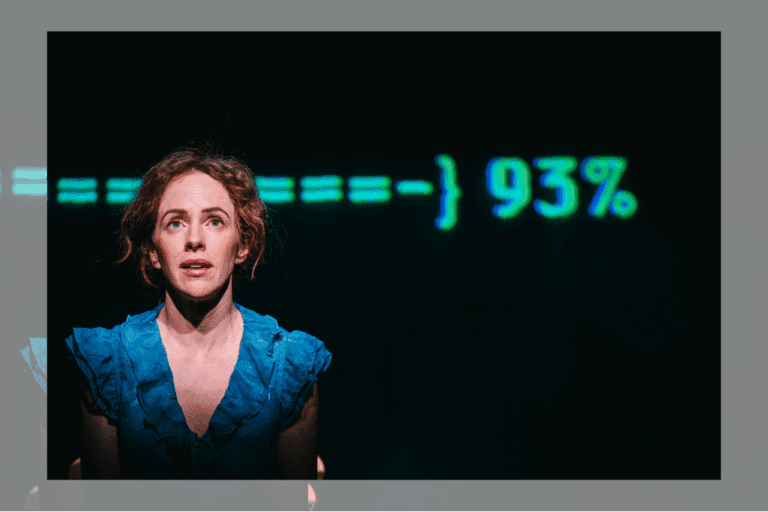 iPhoto caption: Fiona Mongillo in 'Reproduktion.' Photo by Ann Baggley.
REVIEW: Here For Now’s well-acted Reproduktion attempts to tackle too much
Amy Rutherford’s world premiere script is ambitious and the material it covers is complex — but the narrative feels disjointed.
 iPhoto caption: Kristen Thomson in 'Fulfillment Centre.' Photo by Elana Emer.
REVIEW: Coal Mine’s Fulfillment Centre asks how we end up alone, together
The production understands the play’s themes, yet feels limited by a script that delivers a package it never fully opens.
 iPhoto caption: Photo by Aisling Murphy.
In the darkest months of Yukon winter, it’s all about the Sun Room
I’m here for a week in January as a guest of Nakai Theatre, a hub for theatrical experimentation and outside-the-box programming in Canada’s westernmost territory.

Armchairs, tattoos, and an online theatre magazine
When I started at Intermission, my world was limited to the confines of an armchair. Arts journalism was a high it felt dangerously fruitless to chase. The life stretched ahead of me was amorphous and frightening, a chasm filled with hand sanitizer and immigration concerns. It was worth crying over a spilled kombucha and scrubbing at the stain.
 iPhoto caption: Liz Appel headshot courtesy of Liz Appel.
Five questions with Wights playwright Liz Appel
Intermission spoke with Appel over email for a brief Q&A about Wights, now playing at Crow’s Theatre until February 9.

Call for applications: Publishing and editorial assistant
Intermission Magazine is seeking a dynamic and collaborative individual to join our team.
 iPhoto caption: What Writing Can Do: The 2025 Musical Theatre Critics Lab
Announcing What Writing Can Do: The 2025 Musical Theatre Critics Lab
What Writing Can Do is timed to coincide with the Grand and Theatre Aquarius’ co-production of Waitress, which will serve as a jumping-off point for discussions throughout the Lab.
 iPhoto caption: A Christmas Story production still by Dahlia Katz.
REVIEW: A Christmas Story feels fresh at Theatre Aquarius
If you want to catch A Christmas Story before it closes, good luck — the show is close to sold out, and with the talent on that stage, it’s not hard to see why.
Comments