
REVIEW: Gloria at ARC/Crow’s
Mild spoilers ahead.
Prolific American playwright Branden Jacobs-Jenkins’ much-anticipated Gloria is here to ask difficult, timely questions: who gets to tell sensitive stories in the aftermath of trauma? Is it the victims themselves? The survivors? Does survivorship sensationalize storytelling — how?
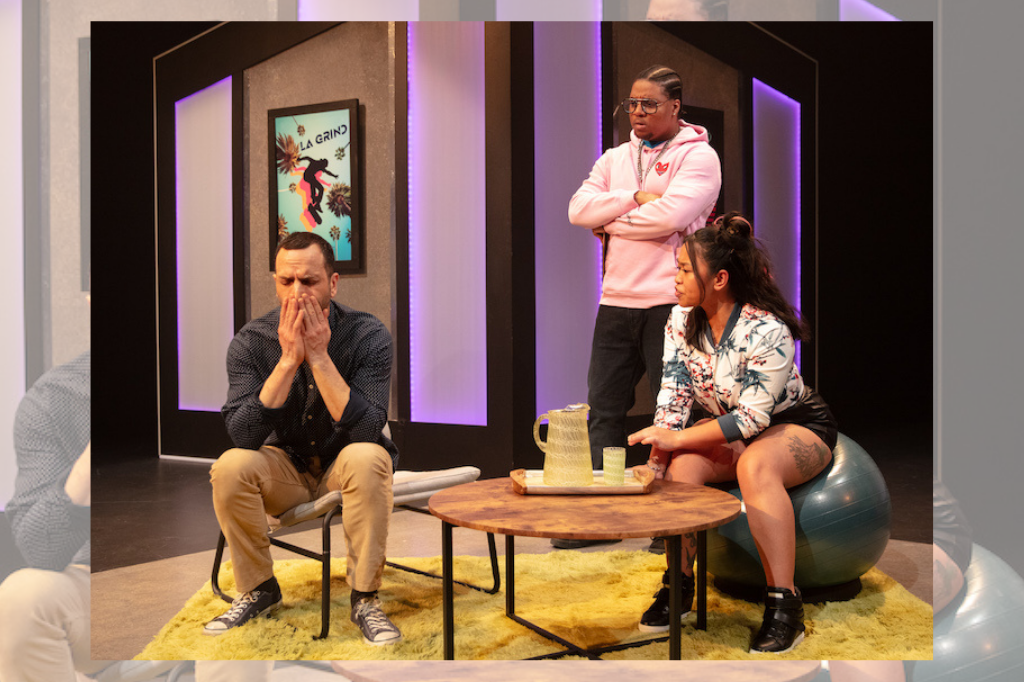
Gloria, produced by ARC in association with Crow’s Theatre, wrestles with these questions against a backdrop of oppressive-yet-prestigious workplaces, including a-magazine-that-is-totally-not-the-New-Yorker-wink-wink-nudge-nudge and a trendy, BuzzFeed-ish movie production office. Act One unfolds in the magazine’s office, a should-be-dream-job in which absolutely no one is happy or creatively fulfilled. The office is staffed by burnt-out young people: an intern, Miles, played by the lively Savion Roach, who is mostly ignored by office gossips Ani (an energetic Jonelle Gunderson) and Kendra (the amusing athena kaitlin trinh). We hear about a party nearly no one attended, whose host, Gloria, the magnetic Deborah Drakeford, is largely disliked for her strange, quiet personality — editorial assistant Dean, a frenetic Nabil Traboulsi, is the only one who attended. Dean’s boss, middle-manager Nan, is sick, a rumoured alcoholic. A beloved popstar has just died.
Seemingly throwaway details develop into the beating heart of the play: Gloria, in a jolt of an Act One finale, exacts revenge upon the office for their cruelty. Nan is not the hungover lush her subordinates call her behind her back. In the public conscience, the popstar’s death eclipses the more troubling tragedy in the play.
Director André Sills manages to wrangle a finicky play in a production which feels much shorter than its two-hour runtime: Gloria’s pacing is excellent. However, movement onstage is often quite stilted, most evidently in a bizarre slow-mo sequence which Roach executes as best as he can. Gloria additionally features not one but two extended sequences in which two characters sit at a table and do not move, creating sightline issues as well as a frustrating stasis of energy, one magnified by the comparatively strong, emotionally charged text work. Grumbles aside, Sills uses his actors well: the double-casting prescribed by Jacobs-Jenkins makes aesthetic and narrative sense and is executed well here, and Carlos Gonzalez-Vio as fact-checker Lorin and Roach as Miles/Shawn/Rashaad are formidable focal points of Gloria’s ensemble. Chris Malkowki’s slick lighting design bathes the playing space in the oppressive fluorescence of dead-end work — it’s one of the strongest parts of the production.
Gloria is bursting with questions about workplace culture, millennial despair, and ownership of stories. It’s worth noting the play has noticeably aged since its NYC premiere (“just Facebook Live it!,” peals Rashaad, one of innumerable 2015-isms which are otherwise unaccounted for through directorial choices). Jacobs-Jenkins’ NYC sweetheart (the New York Times called Gloria “a whip-smart satire of fear and loathing”) is a tricky, tricky directing project. Its structure defies the two-act standard audiences might expect on their return to the theatre, and the characters as written stand at a precipice of stereotype, where one wrong direction might send them over the edge into melodrama, which happens once or twice here. Gloria is an important piece of writing in how it deals with workplace violence and culture — both Jacobs-Jenkins and Sills seem eager to make sure we leave the theatre understanding the play’s gravity — and this production almost hits hard.
But for a play largely about the ethics of storytelling, some details of this production can’t be overlooked: a content warning for several (extremely loud) gunshots is noticeably thin, save for small, easy-to-miss signs outside the theatre and online. Gloria is also a very, very American piece of theatre: what does a Canadian vantage point offer to the story it tells and the points it makes? The choice to keep the production set jointly in New York and Los Angeles comes through quite clearly — the reasoning behind that choice does not. Gloria seems to pose more questions than it can answer, but it’s not an unpleasant two hours of dark humour. See it, and be prepared to wrestle with your own biases and preconceptions on the way home: this production’s treatment of Jacobs-Jenkins’ text will leave you emotionally winded, even if it achieves that effect a little clunkily.
Gloria runs at Crow’s Theatre until March 20. Tickets are available here.

Aisling Murphy
Aisling is Intermission's former senior editor and the theatre reporter for the Globe and Mail. She likes British playwright Sarah Kane, most songs by Taylor Swift, and her cats, Fig and June. She was a 2024 fellow at the National Critics Institute in Waterford, CT.
LEARN MORE iPhoto caption: Photo by Aisling Murphy.
In the darkest months of Yukon winter, it’s all about the Sun Room
I’m here for a week in January as a guest of Nakai Theatre, a hub for theatrical experimentation and outside-the-box programming in Canada’s westernmost territory.

Armchairs, tattoos, and an online theatre magazine
When I started at Intermission, my world was limited to the confines of an armchair. Arts journalism was a high it felt dangerously fruitless to chase. The life stretched ahead of me was amorphous and frightening, a chasm filled with hand sanitizer and immigration concerns. It was worth crying over a spilled kombucha and scrubbing at the stain.
 iPhoto caption: Liz Appel headshot courtesy of Liz Appel.
Five questions with Wights playwright Liz Appel
Intermission spoke with Appel over email for a brief Q&A about Wights, now playing at Crow’s Theatre until February 9.

Call for applications: Publishing and editorial assistant
Intermission Magazine is seeking a dynamic and collaborative individual to join our team.
 iPhoto caption: What Writing Can Do: The 2025 Musical Theatre Critics Lab
Announcing What Writing Can Do: The 2025 Musical Theatre Critics Lab
What Writing Can Do is timed to coincide with the Grand and Theatre Aquarius’ co-production of Waitress, which will serve as a jumping-off point for discussions throughout the Lab.
 iPhoto caption: A Christmas Story production still by Dahlia Katz.
REVIEW: A Christmas Story feels fresh at Theatre Aquarius
If you want to catch A Christmas Story before it closes, good luck — the show is close to sold out, and with the talent on that stage, it’s not hard to see why.
Comments