
REVIEW: Post-Democracy at Tarragon Theatre
Hannah Moscovitch has returned to Tarragon. Order is restored in Canadian theatre.
Jokes aside, Post-Democracy is an overdue homecoming for one of Tarragon’s most prolific playwrights. Prairie Theatre Exchange produced a digital rendering of her searing critique of the top 1% last year — by no means a bad production, but at the time I felt the play seemed to demand an in-person audience. The mega-rich and powerful are already oh-so-distant from the majority of folks engaging with Canadian theatre; the imposition of a screen between the art and its audience made the peek behind the corporate curtain feel somehow incomplete.
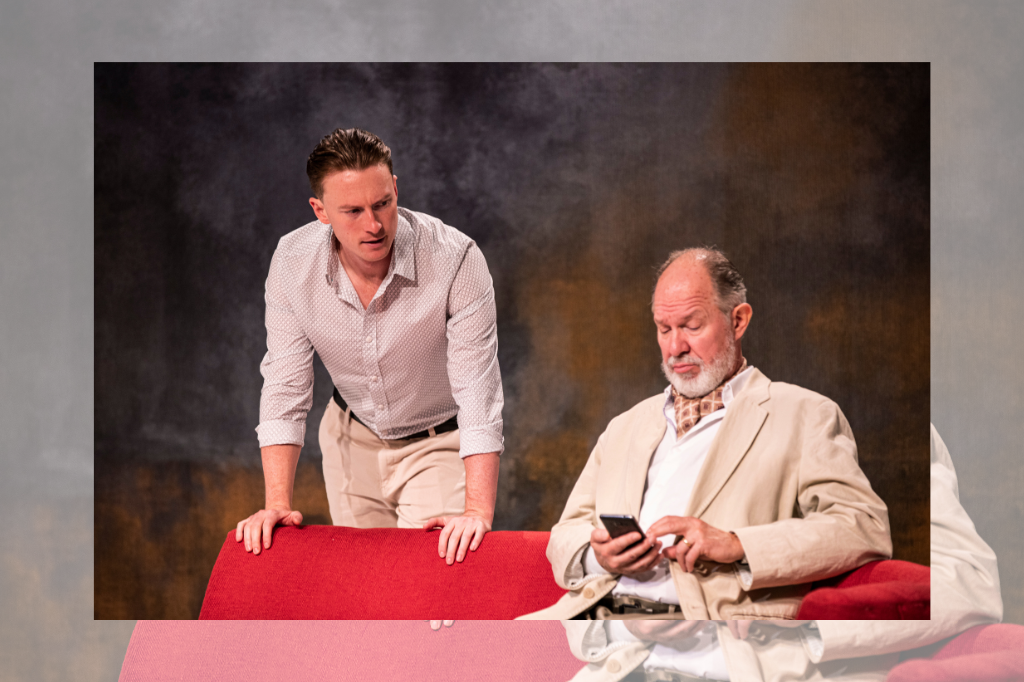
Tarragon’s Post-Democracy is certainly live, an animated romp through the sky-high stakes of the ultra-privileged. Director Mumbi Tindyebwa Otu’s direction makes stylish the underbelly of a fictional Fortune 500 company, helmed by dying CEO Bill (Diego Matomoros). He needs to name a successor, and distant cousin Lee (Jesse LaVercombe) is gunning hard for the job. Bill’s daughter, Justine (Chantelle Han), a sort-of philanthropist, doesn’t trust Lee — and halfway through Post-Democracy, she lets him know exactly what she thinks of his recent missteps. Shannon (Rachel Cairns), publicist extraordinaire, is there to make sure things run smoothly — and silently.
This all plays out in a pristine white hotel lounge, smartly designed by Teresa Przybylski. Spare a chaise longue and bar, the lounge is a non-descript void of corporate elitism — no scuff dare mar the glowing floor. An imposing abstract painting overlooks the lounge, and as time passes it gains a life all its own, mysterious and foreboding. It’s the perfect locale for the disintegration of a capitalistic legacy.
What troubles Post-Democracy is the Succession-shaped shadow looming over it, the parallels that so easily emerge between Bill and Logan; Lee and Roman; Justine and Shiv; Shannon and Gerri. At its best, Post-Democracy one-ups the sky-high stakes of HBO’s smash Succession with intimacy, leaving no room for an audience to look away from the misogyny and vitriol of the corporate world. There’s no pause button or rewind — you have to deal with the cringe and the horrors of high-rolling anxiety in real time. But when the pacing falters for even a moment, Post-Democracy feels like an approximation of the television show, and becomes bogged down in business jargon and prim silence. Content-wise, the play is pure Moscovitch, an examination of power dynamics and the women at either end of them, but there seems to be a departure in style — gone is the classic Moscovitch direct address, and much of the trademark humour. Post-Democracy deals with some very serious situations — up to and including the sexual assault of a child — and I found myself sorely missing a moment to catch my breath in the play’s relentless crossfire.
But it’s Moscovitch — even her not-best is still really good. And her characters are well played here. LaVercombe’s Lee is the perfect blend of smarm and insecurity, and Cairns’ Shannon is appropriately nervy. Han is didactic and menacing as Justine, a poster child for nepo-babies everywhere, while Matomoros achieves much with relatively little. Przybylski’s costumes mostly achieve the off-duty billionaire look — though Justine’s open-toed shoes and Lee’s creased khakis seem surprisingly casual — and Louise Guinand’s lights perfectly bathe Przybylski’s epic set in harsh, inescapable fluorescence.
Post-Democracy asks important questions, and it’s self-aware enough to land at a conclusion without many answers — some messes are more complicated than a one-hour play can convey. And it’s not without wow factor: watching it in a live audience is often quite satisfying, with the camaraderie only a shared wince or gasp can create. Moscovitch’s best play? Probably not. But with this direction and cast, it’s certainly worth seeing all the same.
Post-Democracy runs at Tarragon through December 4. Tickets are available here.
Aisling Murphy
Aisling is Intermission's former senior editor and the theatre reporter for the Globe and Mail. She likes British playwright Sarah Kane, most songs by Taylor Swift, and her cats, Fig and June. She was a 2024 fellow at the National Critics Institute in Waterford, CT.
LEARN MORE iPhoto caption: Photo by Aisling Murphy.
In the darkest months of Yukon winter, it’s all about the Sun Room
I’m here for a week in January as a guest of Nakai Theatre, a hub for theatrical experimentation and outside-the-box programming in Canada’s westernmost territory.

Armchairs, tattoos, and an online theatre magazine
When I started at Intermission, my world was limited to the confines of an armchair. Arts journalism was a high it felt dangerously fruitless to chase. The life stretched ahead of me was amorphous and frightening, a chasm filled with hand sanitizer and immigration concerns. It was worth crying over a spilled kombucha and scrubbing at the stain.
 iPhoto caption: Liz Appel headshot courtesy of Liz Appel.
Five questions with Wights playwright Liz Appel
Intermission spoke with Appel over email for a brief Q&A about Wights, now playing at Crow’s Theatre until February 9.

Call for applications: Publishing and editorial assistant
Intermission Magazine is seeking a dynamic and collaborative individual to join our team.
 iPhoto caption: What Writing Can Do: The 2025 Musical Theatre Critics Lab
Announcing What Writing Can Do: The 2025 Musical Theatre Critics Lab
What Writing Can Do is timed to coincide with the Grand and Theatre Aquarius’ co-production of Waitress, which will serve as a jumping-off point for discussions throughout the Lab.
 iPhoto caption: A Christmas Story production still by Dahlia Katz.
REVIEW: A Christmas Story feels fresh at Theatre Aquarius
If you want to catch A Christmas Story before it closes, good luck — the show is close to sold out, and with the talent on that stage, it’s not hard to see why.
Comments