
REVIEW: Inventive choreography powers delightful Some Like It Hot at Mirvish
 iPhoto caption: Members of the company of 'Some Like It Hot.' Photo by Matthew Murphy.
Through its 1950s source material, Great Depression setting, and big-band sound, the 2022 musical Some Like It Hot pays tribute to eras gone by. This vintage spirit extends to the ongoing North American tour’s promotional materials, which trumpet the arrival of “Broadway’s great big musical comedy.” The creative team features specialists in this old-school variety of razzle-dazzle: there’s director-choreographer Casey Nicholaw, a prolific showman in the vein of Gower Champion; as well as the songwriting duo Marc Shaiman and Scott Wittman, whose best previous collaborations are set during the first two thirds of the 20th century.
These artists surely know that for today’s audiences, classic musical comedies can lumber. Twenty minutes between each full-ensemble dance number? Social media wins that race. What’s impressive about Some Like It Hot, playing at the CAA Ed Mirvish Theatre, is its unstoppable momentum. A fresh engine powers this retro vehicle.
Matthew López and Amber Ruffin’s script makes the same overall journey as Billy Wilder’s film. After witnessing an organized-crime killing, male-presenting musicians Joe (Matt Loehr) and Jerry (Tavis Kordell), who are close as brothers, flee to a California hotel by disguising themselves as women and joining a single-gender jazz band. They encounter three key supporting players: Sweet Sue (Dequina Moore), the group’s rousing leader; Sugar (Leandra Ellis-Gaston), their rebellious singer; and Osgood (Edward Juvier), the hotel’s lonely millionaire owner.
Farcical antics still ensue, but the script contains fewer easy punchlines about Joe and Jerry’s disguises — and, eventually, López and Ruffin use the scenario as a channel for earnest reflections on gender. The era’s racial tensions also surface: Jerry and Sugar, both Black, discuss facing discrimination.
The heavy song-and-dance requirements of Loehr and Kordell’s roles recall MGM musicals. Fit as fiddles, Joe and Jerry introduce choreography to Sweet Sue’s band, forming, with Sugar, a “tip-tap trio” that becomes a major audience draw. These fictional performances prove great, vaudevillian fun. Numbers tracing Joe and Jerry’s offstage life tend to be even more ambitious, packaging together jazzy melodies, tough choreography, and key narrative information. This melange is blissful when it congeals, but on opening night, the performers’ time-steps often buried the lyrics’ storytelling — owing both to suboptimal sound mixing and Loehr’s performance, which, when juggling singing, dancing, and acting, sometimes allowed that last ball to slip.
The gears of Nicholaw’s production are well-oiled. Despite Art Deco set design by Scott Pask and plenty of era-appropriate choreography, the show moves with contemporary fluidity. For example, the image of actors standing and playing instruments could appear static after the first occurrence, so Nicholaw dials up the abstraction as the show progresses; by the band’s final performance, dancers still hold trumpets, but the illusion that they’re actually playing them has long faded, freeing up the ensemble to rove back and forth in large swinging steps.
Several key sequences hum with the patently ridiculous energy of Saturday morning cartoons. In the scene that prompts their flight from Chicago, Joe and Jerry enter a theatre producer’s backstage office and witness a gangster embroidering a traitor with bullets. The pair freeze in the doorway for a few seconds — Joe staring blankly, Jerry’s jaw hanging loose. Vocal scatting launches the stage into a chase; as gunshots fire behind the duo, they tap dance through the theatre’s halls over brassy orchestrations. Doorframes, screaming chorus girls, and costume racks whirlpool around Joe and Jerry until they end up cowering in a dressing room, disguised in feather boas (ace costume design by Gregg Barnes). This absurd movement score squeezes many minutes of narrative into a sliver of stage time, foreshadowing the production’s ingenious climax, an even more complex chase scene that riffs stylishly on Jerome Robbins’ influential, slapstick-inspired ballet from High Button Shoes.
Shaiman and Wittman are singular when it comes to uptempo ensemble numbers, during which the production’s real-life 12-piece band, led by conductor-keyboardist Mark Binns, sizzles like bacon in a cast-iron pan. But their climactic ballads don’t always convince. Even when strutting through fairly standard emotional beats, I sometimes get the sense that the writers are unable to pocket their jazz hands, bringing a strange cheerfulness to events that should feel high-stakes. But thankfully, Some Like It Hot doesn’t hinge on the audience investing in its dramatic turns. For all of the adaptation’s welcome new layers, López and Ruffin have structured the show to foreground Nicholaw’s barnstorming physical storytelling, which burns hot enough to justify attendance.
Some Like It Hot runs at the CAA Ed Mirvish Theatre until March 15. More information is available here.
Intermission reviews are independent and unrelated to Intermission’s partnered content. Learn more about Intermission’s partnership model here.
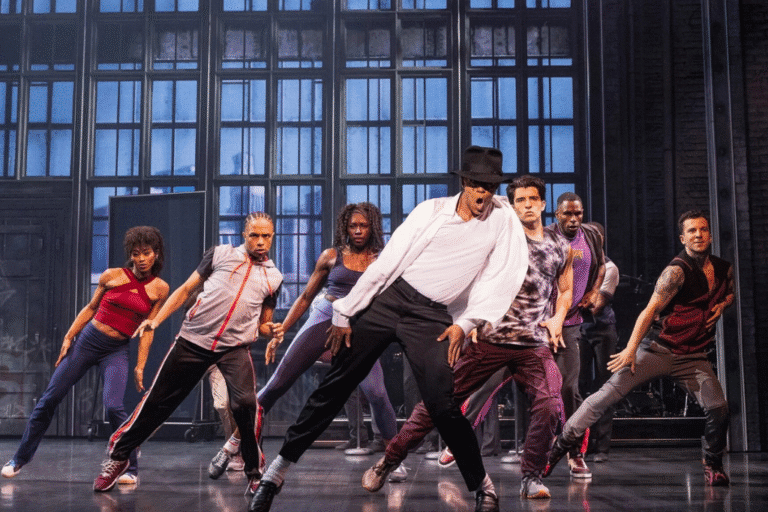 iPhoto caption: Members of the North American touring company of 'MJ.' Photo by Matthew Murphy.
Review of MJ: The Musical among winners at the 2025 Nathan Cohen Awards
The Canadian Theatre Critics Association has announced the winners of the 2025 Nathan Cohen Awards for Excellence in Critical Writing. This year’s prizes for outstanding review and critical essay were adjudicated by Natasha Tripney, international editor of the Stage.
 iPhoto caption: Mike Nadajewski in 'All the Cows Are Dead.' Photo by Dahlia Katz.
REVIEW: Two critics compare reactions to TIFT’s new musical All the Cows Are Dead
Liam wrote about observing the production's rehearsal process. Shivani viewed the musical without any insider knowledge. On the way home from seeing the show in Barrie, they discuss.
 iPhoto caption: Louise Pitre in 'Kimberly Akimbo.' Photo by Emelia Hellman.
REVIEW: Mirvish’s well-cast Kimberly Akimbo never stops surprising
The simple and the unconventional meld radiantly throughout Jeanine Tesori and David Lindsay-Abaire's Tony Award-dominating 2021 musical.
 iPhoto caption: Athena So, Mike Nadajewski, Taylor Garwood, and Ben Page in rehearsal for 'All the Cows Are Dead.' Photo by Dahlia Katz.
What I discovered at rehearsals for TIFT’s world premiere musical All the Cows Are Dead
I’m sure most new musicals have interesting rehearsal processes — but it helped my excitement level that All the Cows Are Dead is a site-specific, existential two-hander from one of Ontario’s most risk-taking companies. There'll also be countless balloons.
 iPhoto caption: L to R, top to bottom: 'The 39 Steps' (photo by Raph Nogal), 'Benevolence' (photo by Jae Yang), 'The Born-Again Crow' (photo by Jeremy Mimnagh), 'Dimanche' (photo by Thomas Müller), 'Last Landscape' (photo by Fran Chudnoff), 'The Merchant of Venice' (photo by Kyle Purcell), 'Slave Play' (photo by Dahlia Katz), 'Waiting for Godot' (photo by Elana Emer), 'The Welkin' (photo by Dahlia Katz).
Twelve indelible moments of performance from 2025
With the lights fading on another year of fleeting thrills in dark rooms, we asked 12 Ontario performing arts writers to reflect on a moment that stayed with them. The results mainly stem from Toronto theatre productions, but there are a few surprises weaved in.
 iPhoto caption: Connor Mitton and members of the company of 'Sex Dalmatian’s Hot Holiday Spectacular.' Photo by Jeremy Mimnagh.
REVIEW: Sex Dalmatian’s Hot Holiday Spectacular is a peppermint-coated acid trip
Rock Bottom Movement’s surrealist mandate is on full display in this 15-dancer fantasia, which begins with an invitation to let go: “The only thing you need to know is not to know anything at all,” pronounces the Mayor of Sex Dalmatian, the evening’s narrator and the mayor of the titular canine’s mind.
Comments