
REVIEW: Mirvish’s well-cast Kimberly Akimbo never stops surprising
 iPhoto caption: Louise Pitre in 'Kimberly Akimbo.' Photo by Emelia Hellman.
Three quarters of the way through “Make a Wish,” an early number in the musical Kimberly Akimbo, I thought I was hearing a conventional I-want song. Writing a letter to the Make-A-Wish Foundation, protagonist Kimberly Levaco — a high-schooler with a semi-fictional, one-in-50-million disease that causes rapid aging — longs for beauty and excitement. Descriptions of a Dior photoshoot and a cruise with friends transition into a rapid-fire enumeration of desires: “I want to hang glide / I want to clog dance / I want to swim at the bottom of a waterfall / I want a butler who’s a robot.” Composer Jeanine Tesori’s music swells as David Lindsay-Abaire’s lyrics reach an outlandish, Cole Porter-esque zenith.
And then everything changes. John Clancy’s orchestrations diminuendo and Kimberly’s list takes a domestic swerve: “A simple home-cooked meal / A table set for three / A wispy paper napkin resting on my knee.” Having already mapped the fantastical side of Kimberly’s mind, Tesori and Lindsay-Abaire end the tune in another, more tranquil register, fitting a bounty of psychological riches into the space of a single number.
The simple and the unconventional continue to meld radiantly throughout the Tony Award-dominating 2021 musical, which delivers a steady flow of surprises on the level of song, scene, and structure. In director Robert McQueen’s limited-run staging at the CAA Theatre (a co-production with Montreal’s Segal Centre for Performing Arts), Tesori and Lindsay-Abaire’s concerto of ideas reverberates with glimmering clarity — thanks in large part to a well-cast ensemble of Canadian performers, led by Louise Pitre as Kimberly.
There’s a banality to the show’s opening scenes that I now understand as intentional. On a late-1990s New Jersey skating rink, the show’s six teenagers sing about being “awkward” and “too weird”; later, at the Levacos’ garishly wallpapered home, Kimberly’s parents — Buddy (Cyrus Lane), who struggles with an alcohol addiction, and Pattie (Tess Benger), who’s very pregnant — flatly bicker.
The drabness lifts when Kimberly becomes group-project partners with Seth (Thomas Winiker), an awkward anagram lover with an infectious smile; the pair of misfits connect like opposing magnets. Soon after, Kimberly’s Aunt Debra (Kristen Peace) breaks into the show’s high school and starts asking students for help pulling off a check-fraud scheme. Debra’s broad comedic antics are at first incongruent with Kimberly Akimbo’s otherwise grounded storytelling — but she becomes such a central part of the story that I eventually accepted this more eccentric register as a foundational element of the show’s offer.
Kimberly’s disease means she’s statistically likely to die in the next couple of years, and her journey has a commonplace live-while-you-can overtone (“Just enjoy the ride / Because no one gets a second time around,” goes a key song). But in many welcome ways, the show is an ensemble piece. The initially unsympathetic Buddy and Pattie receive particularly nimble characterizations — Benger turning a rumination on the passing of time into a kind of torch song, Lane bringing a tender softness to a video message for the couple’s future baby.
A four-person chorus of Kimberly’s fellow students forms a love rectangle, which makes for a humorous, subtly melancholic rendering of the high-school experience: everyone is so preoccupied with their own anxiety and yearning that they’re blind to the others’ struggles. Played by Jake Cohen, Kyle Jonathon, Taylor Lovelace, and Luca McPhee, the quartet is part of a showchoir, justifying goofy but dazzlingly performed jaunts into triple-threat land (choreography by Allison Plamondon).
Although Gillian Gallow’s set clearly signposts the production’s changing locations via moving furniture, I had questions about the production’s larger design concept. The entire show takes place beneath moderately askew wood roof framing, in what seems to be the attic of a house. While Kimberly mentions wanting a treehouse, as well as being unhappy in her current home, much of the musical takes place elsewhere, and there’s even a pivotal scene where Kimberly luxuriates in having escaped the building — so is it not a little pessimistic for the set to imply she remains metaphorically trapped within its walls?
Little of this would mean much without the performance of the 69-year-old Pitre, which is central thematically as well as narratively. There’s a simplicity to Kimberly’s movement that in Pitre’s hands might normally read as wise restraint, but here plays as childlike forthrightness; this and a slightly-higher-pitched-than-usual speaking voice are her main tools for playing young. Tesori’s melodies roll out of Pitre’s voice heavily, with occasional difficulty and a lot of vibrato, which felt to me like a further manifestation of the mismatch between Kimberly and the (sleekly sung) world around her.
Beyond powering the plot, this physical disjunction makes Kimberly Akimbo a wholly theatrical experience; with eight younger actors playing characters who look and sound their age, it’s difficult to forget Kimberly’s outsider status. What’s bittersweet is how by the end of the show, this strange scenario feels like such a natural part of these simple-but-not New Jersey lives.
In a commercial theatre landscape heavy on jukebox musicals, it’s evident why Kimberly Akimbo has developed a strong reputation for originality — and McQueen’s production is a beyond-solid way of experiencing its offbeat beauty.
Kimberly Akimbo runs at the CAA Theatre until February 8. More information is available here.
Intermission reviews are independent and unrelated to Intermission’s partnered content. Learn more about Intermission’s partnership model here.

Liam Donovan
Liam is Intermission’s senior editor. He lives in Toronto. His Substack newsletter is available at loamdonovan.substack.com.
LEARN MOREComments
Leave a Comment
 iPhoto caption: Stratford's Tom Patterson Theatre. Photo by Ann Baggley.
2027 highlights include a new Canadian Jacob Two-Two musical and two of the Bard’s thornier plays: The Merchant of Venice and The Taming of the Shrew.
 iPhoto caption: Devon Michael Brown as Rusty Charlie with members of the 'Guys and Dolls' company. Stratford Festival 2026. Photo by Ann Baggley.
“It's so exhausting, but it's really rewarding when you get to dance so full-out,” says Devon Michael Brown. “You get to use your technique and your training to the fullest extent.”
 iPhoto caption: Ping-Hsiang Wang in 'Retina Maneuver.' Photo by Hang Su.
REVIEW: At this year’s SummerWorks Performance Festival, physical storytelling is central
From a dancer becoming a canine to a shy theatre director practicing his swordsmanship, the shows I’ve seen so far use performers’ bodies to dramatize defiance.
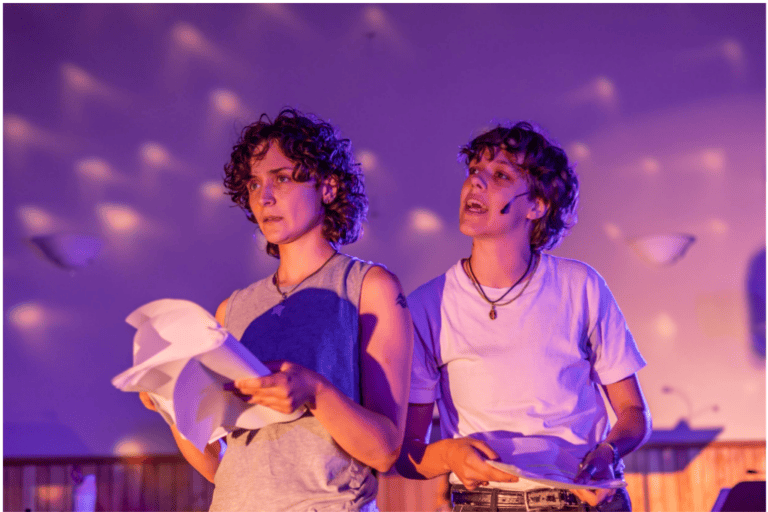 iPhoto caption: Anna Morreale and Luca McPhee perform in 'From Stardust' at the 2025 MADGEN Theatre Festival. Photo by Dave Klassen.
MADGEN Theatre Festival returns to the Danforth
Theatre of the Beat selected four producers under the age of 30 to receive paid mentorship from Toronto theatre-makers. From August 20 to 22, each member of the cohort mounts a new one-act Canadian play.
 iPhoto caption: Steven Sutcliffe and company in 'Twelfth Night.' Photo by Dahlia Katz.
REVIEW: High Park Twelfth Night pays tribute to the crazy things we do for love
As the play’s events ping-pong between seriousness and frivolity, Caroline Toal’s Viola appears constantly aware of the dangerous contradictions in the air, remaining guarded against the chaos' pull — and yet never entirely abandoning the possibility of enchantment.
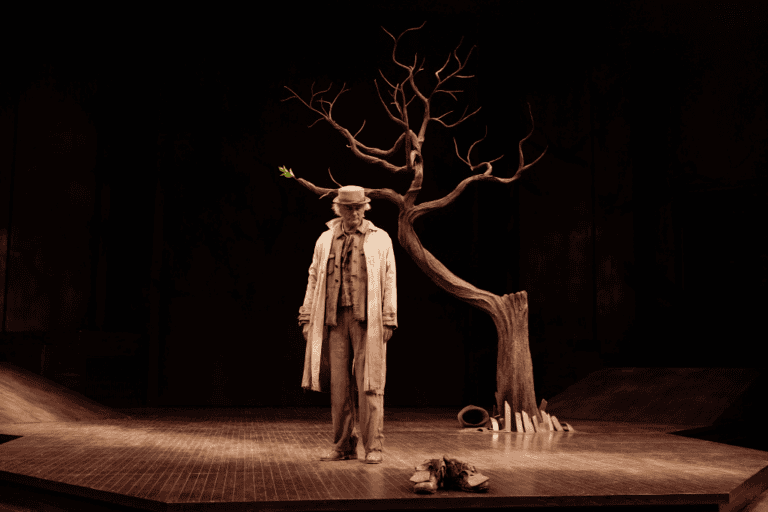 iPhoto caption: Paul Gross in 'Waiting for Godot.' Photo by David Hou.
Why Paul Gross thinks Waiting for Godot is ‘one of the great achievements of human creativity’
“The audience is with you. You bring them in. There isn't a big division between the stage and the audience,” says Gross, currently playing Vladimir in Waiting for Godot at the Stratford Festival. “They’re the final piece of the storytelling. We need them to complete the circle.”
Why have a 70 year old actress play a 16 year old girl?
This is the theatre…haven’t they ever heard of makeup?
I really disliked the direction of the title character. You say “but here plays as childlike forthrightness” and I agree… except Kimberly is not a child, she’s a 15 year old teen! All the young characters are 15 or 16, and dressed and act plausibly, but she’s directed and costumed like she’s an 8 years old kid sister child. She should be dressed and act like the other teens, but just played by a 70 year old actor. It was a miss for me.