
REVIEW: Canadian Stage’s Wine in the Wilderness paints a lovely, if languorous, picture of 1960s Harlem
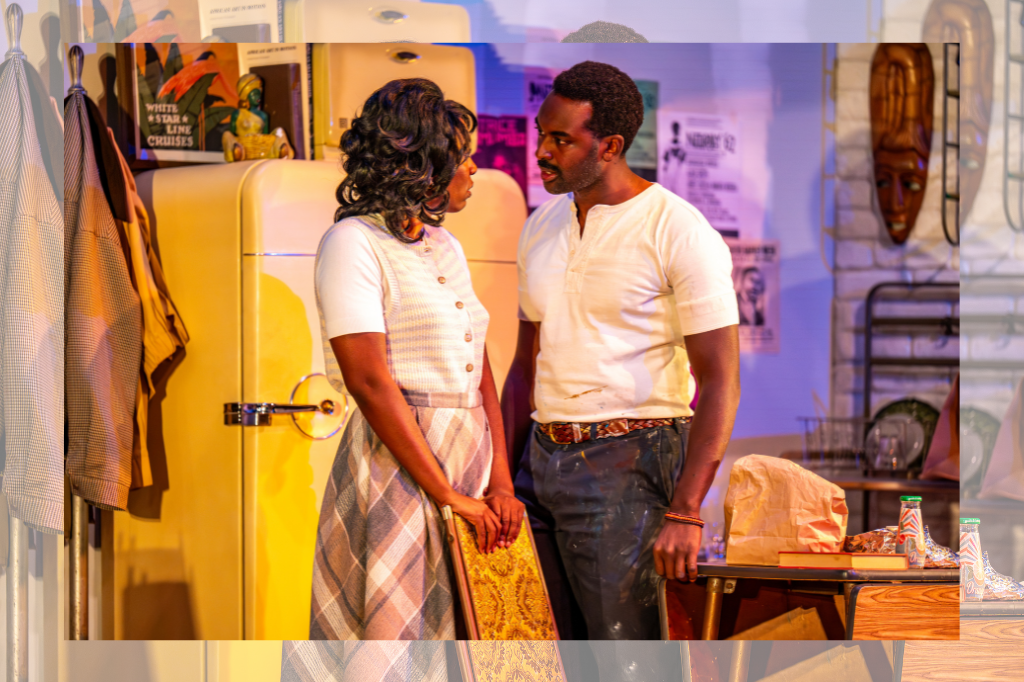 iPhoto caption: Virgilia Griffith and Mazin Elsadig in 'Wine in the Wilderness.' Photo by Dahlia Katz.
When I first read the synopsis of Alice Childress’ play Wine in the Wilderness, my interest was piqued. Set in Harlem, the play takes place during the race riots of 1964 in which New Yorkers took to the streets to protest the killing of a Black teenager by a white off-duty police officer. Any prior knowledge I had of Harlem had to do with the glitz and glamour of the Harlem Renaissance; I knew nothing of the 1964 riots.
I suspected that the play, directed by Canadian Stage associate artistic director Jordan Laffrenier, would offer a glimpse into the more intimate reality of African-American life and struggles during a period of effusive tension, civil unrest, and anti-Black violence — which it does. In his Artist Perspective for Intermission, Laffrenier seemed drawn to the play for this exact reason. Wine in the Wilderness lays bare many of its characters’ emotional cores. But because it takes so long to reach that vulnerability, the revelations land with inadequate force.
The play begins with its central character, the painter Bill (Mazin Elsadig), holing up in his apartment while the clamour of police sirens and gunshots sounds just outside his window. As the cacophony begins to die down, Oldtimer (Andrew Moodie), the neighbourhood elder and resident alcoholic, pays a visit. The two men get into an ethical debate about the merit of the riots, with Bill insisting: “A revolution should not be looting and stealing. Revolutions are for liberation.” For me, the dialogue was painfully reminiscent of conversations that happened in 2020 around the Minneapolis riots incited by the murder of George Floyd, despite being written almost 60 years ago.
Bill introduces Oldtimer to his current work-in-progress: a triptych entitled “Wine in the Wilderness.” He elucidates his creative vision, unveiling the works in turn: a portrait of a young Black girl, representing childhood innocence; a stunning young woman, presented as African royalty; and a blank canvas. This is where Tommy, played by Virgilia Griffith, comes in. Bill’s vision for his final painting is of an “unfeminine, coarse, rude” woman. His friends Sonny-Man (Jamar Adams-Thompson) and Cynthia (L.A. Sweeney) meet Tommy during the riots and bring her to Bill’s apartment as his prospective muse.
Wine in the Wilderness gently morphs into a two-hander between Tommy and Bill, who verbally spar as they each grapple with ulterior motives. To assuage her loneliness, Tommy hopes to charm Bill into falling in love with her, while Bill conceals that Tommy’s portrait will be one of a neglected, down-on-her-luck woman.
The play is dialogue-heavy and takes place solely in the open layout of Bill’s apartment, creating an element of stagnancy. Childress’ decision to have Bill’s portraits (painted by Ontario artist Craig Guthrie) unveiled onstage adds a necessary element of texture and intrigue: the opening night audience was audibly wowed.
Scott Penner’s set design transforms the Berkeley Street Theatre stage into something intimate, warm, and rife with references to Black activists and culture, including portraits of Frederick Douglass and Patrice Lumumba, West African wooden masks, and posters advertising Black Panther initiatives. A bicycle, patterned rugs, and houseplants make the set look appropriately lived in. Daniel Bennett’s brilliant lighting design complements this realistic approach: cold blue lighting shines through frosted glass windows to signify twilight, while lamps suspended intermittently throughout the space emanate golden, scattered beams that illuminate the actors’ skin beautifully.
Like Chekhov and Ibsen, Childress’ plays are grounded in realism and focus on teasing out the emotional stakes roiling within a given character. Griffith is luminescent as the coy, playful Tommy, affording her character a sense of youthfulness and depth that makes her ring strikingly true. In moments of bravado, Griffith’s lip still trembles; when Tommy displays vulnerability, her head is still held high. These small but mighty juxtapositions are what make Tommy human, and Griffith enthralling.
There’s something slightly mechanical about some of the other performances, causing them to feel more like imitations of Harlemites of the time period, rather than fully fleshed-out, multifaceted characters. What presumably was intended to sound like a uniform New York accent actually varies in intonation from person to person, pulling my focus from the dialogue.
I enjoyed the play’s focus on issues that continue to concern the Black community, namely misogynoir, colourism, and texturism. At one point, Cynthia instructs Tommy, “You have to let the Black man have his manhood.” It becomes clear from Bill’s numerous monologues that he agrees the Black women in his life (and society at large) owe him said manhood. His inability to recognize the instances when his pro-Black rhetoric is at odds with his misogyny shapes both the latter half of the play and his relationship with Tommy.
Although I found Wine in the Wilderness’ ending somewhat predictable (spoilers abound!), Laffrenier’s love and respect for Childress and this moment in African-American history is indisputable. To return to his own words: “Theatre shouldn’t recycle our humanity back to us. It should expand what our definition of humanity can be.”
Wine in the Wilderness runs at the Berkeley Street Theatre until October 11. More information is available here.
Intermission reviews are independent and unrelated to Intermission’s partnered content. Learn more about Intermission’s partnership model here.

Abi Akinlade
Abi is a Nigerian-Canadian multidisciplinary artist based in Toronto. She holds a Bachelor of Arts degree in English Literature and Drama from the University of Toronto. Represented by AMI Talent Agency, she has performed in both film and theatre productions. She is currently a cohort member of the inaugural theatre criticism program Page Turn, as well as a journalism fellow at Inkspire. Driven by a strong passion for theatre, literature, and film, she aims to use storytelling as a means to uncover a deeper sense of identity and foster meaningful connection.
LEARN MORE iPhoto caption: Hailey Gillis and Andrew Penner in 'Tiger Bride.' Photo by Dahlia Katz.
REVIEW: Soulpepper’s Tiger Bride bites into a rock-’n’-roll-meets-steampunk aesthetic
Although the premise of Girl on the verge of self-actualization is enticing, and one that the trio approaches with clear, affecting lyrics, Tiger Bride stops short of fully embracing the messiness of her metamorphosis.
 iPhoto caption: Jonelle Gunderson, Nabil Traboulsi, and Paul Smith in 'A Mirror.' Photo by Kendra Epik.
REVIEW: A Mirror is a dystopian, metatheatrical marvel
Over the course of two tense hours, A Mirror scrutinizes censorship, the responsibility of art, and the cost of insurgency.
 iPhoto caption: Nicholas Eddie and Tantoo Cardinal in 'Witch.' Photo by Dahlia Katz.
REVIEW: Soulpepper’s Witch is thematically alluring but dramatically thin
Jen Silverman’s play aspires to communicate something substantive about the human condition — touching on loneliness, ostracization, misogyny, ageism, yearning, and ego — yet it never quite settles on a cohesive or definitive thesis. Lancaster’s production commits to heady visuals and clever idiosyncrasies to fill the gap, with mixed results.
 iPhoto caption: Tony Ofori and Daren A. Herbert in 'Moonlight Schooner.' Photo by Dahlia Katz.
Kanika Ambrose’s Moonlight Schooner is animated and visually stunning, but its individual pieces don’t come together as neatly as I would've expected.
 iPhoto caption: Danté Prince and Savion Roach in 'The Christmas Market.' Photo by Kenya Parsa.
Among softly falling snowflakes, dense rum cake, a tree that twirls of its own accord, and a lively soca rendition of classic carol “My Favourite Things,” The Christmas Market unfolds, gradually steering away from familiar festive comforts toward a sharper story of labour and exploitation.
 iPhoto caption: Benu. Photo by Selina McCallum.
REVIEW: The Sankofa Trilogy is a passionate love letter to Jamaica and Black womanhood
“Politician, yuh have to listen.” “No borders on stolen land.” “No genocide inna Gaza.” These are just three of the rallying cries featured on signs held by picketers in word! sound! powah!, the final installation of d’bi young anitafrika’s Sankofa Trilogy.
Comments