
Rhubarb! Festival director Ludmylla Reis wants artists to embrace ‘the detour’
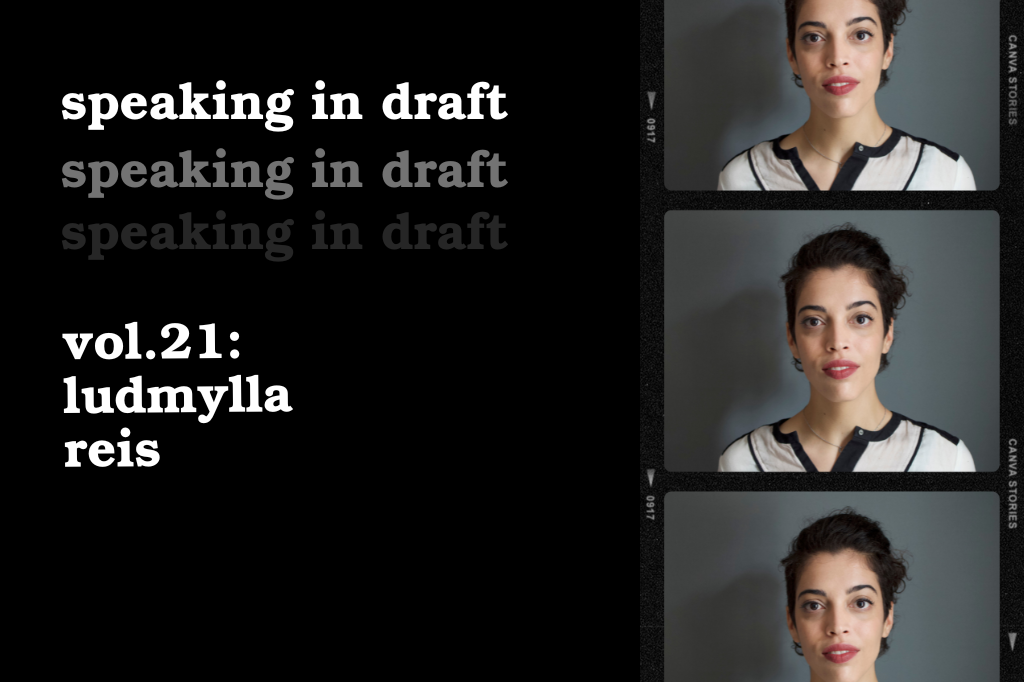
Speaking in Draft is an interview series in which Intermission staff writer Nathaniel Hanula-James speaks with some of the artistic voices shaping Canadian theatre today. The column invites artists to share nascent manifestoes, ask difficult questions, and throw down the gauntlet at the feet of a glorious, frustrating art form.
My friends and family know that I love a little treat. I stumbled into 2026 with a belly full of canapés and holiday cookies, as well as a cupboard full of chocolate. If I have one regret from my time off, it’s not having made or sought out my favourite dessert, rhubarb pie.
I like it the way my grandma made it: Not too sweet, with the rhubarb itself the primary flavour, and with a firm-but-tender crust that doesn’t collapse when you cut yourself a slice. All in all, a tangy delight with just the right amount of structure.
Come to think of it, that’s how I like my art, too. How lucky, then, that one of Toronto’s longest-running performance events should share a name with my favourite ingredient, and the character of my favourite dessert. I’m talking, of course, about Buddies in Bad Times Theatre’s Rhubarb! Festival.
Rhubarb’s current director, Ludmylla Reis, cares deeply about the structure and flavour of every theatrical experience they prepare for others. The multi-hyphenate’s formative years as a director, curator, writer, and dramaturg were shaped by their time in an anarchist theatre troupe in Rio de Janeiro, Brazil, where they grew up and completed their BFA. That experience — a continuous dance between structure and structureless-ness — continued to inform Reis’ practice when they moved to Canada in 2016 to pursue an MFA in directing at the University of Ottawa, and remains relevant in their current role at Buddies.
In Canadian theatre, with its rich history of devised work and collective creation stretching back at least to The Farm Show — first produced in 1972 — countless creative teams have had to figure out how to balance a radical desire for equality with the need for a clear and consistent framework.
As a co-leader of a collectively run theatre company myself, it was an extra-special pleasure to interview Reis. In a chat over Zoom before the holidays, we discussed their bespoke approach to collaboration and leadership — as well as Toronto’s theatre’s concerning lack of curtains.
This interview has been edited for length and clarity.
What’s your secret to getting through a Toronto winter?
(Laughing) I left! My first winter in Toronto was last winter. It’s the hardest I’ve experienced, compared to Ottawa and a Christmas I spent in Quebec City. In Ottawa, I really liked walking in the snow, because snow helped me understand that winter is temporary. Toronto winter is just dark and windy for a very long time, and it feels like it goes on forever.
Where are you right now?
I’m in Lyon, France. The festival Les Urbaines was in Switzerland, so I [arrived] through Paris. After this, I’ll pass through Spain and make it to Portugal, which I’m calling the colonizers trip. I want to see where my gold went!
That’s the best name for a trip I’ve ever heard. Can you tell me more about Les Urbaines?
It happens in Lausanne, which is a fairly small town. The festival is close to Rhubarb in many ways, and we’ve been developing a relationship with them since [the tenure of Clayton Lee, Rhubarb’s previous director]. For Toronto folks, I’d describe it as like SummerWorks in the winter, but because Lausanne is such a small town it feels different, a bit more contained.
It’s my first time coming to Europe, and my first time going to a festival here as a curator and producer. It’s a different mindset.
I’m curious to know more about your artistic influences. What’s your first memory of engaging with performance?
Circus is really important in Brazil. When I was growing up, there would be traveling circuses — barely any animals, but a lot of clowns, performers, and acrobats. There was a time in my life when I thought I was going to study this genre that in Portuguese is called ‘circus-theatre’: miniature novella-like melodramas that would happen as part of circus performances.
Circus continues to be a huge influence. To this day, I always want to do shows in the round. While participating in the Langham Directors’ Workshop in 2024, I found out that the Tom Patterson Theatre at Stratford could be reconfigured to be in the round. The stage is an elongated thrust, but you can open the back and make it 360 degrees.
An early theatre memory for me is watching a TYA version of the play Cyrano de Bergerac in Brazil as a kid. I remember this actor with a prosthetic nose coming in through a curtain. I don’t know why Canadian theatre doesn’t have curtains anymore.
Thank you for speaking to this!
Who stole the curtains? What did they do with them? Have them give me a call.
Where in Brazil did you grow up?
In the ‘burbs of Rio de Janeiro: about an hour’s drive from Rio the city, but still in Rio the state.
On the “thoughts on process” page of your website, you mention that in your second year of theatre school you joined an anarchist theatre company. How did that experience shape your artistic path?
That was during my BFA, which I did in Rio city. The decision to make theatre was not a cheap one, and not just financially. I come from a working-class family. I’m the first kid that can choose to do anything, and I decided to do dang theatre! So when I got to theatre school, I was committed 180 per cent.
By the end of my second year, most of the other students were more interested in just getting through the program. I started to look for other outlets beyond the classroom where I could redirect my energy, so I could stop stressing out my classmates.
I responded to the call of a company called Nove de Ouros, [which translates to Nine of Diamonds in English]. It was run by a duo of dudes named Nathan Braga and Thiago Saraiva, who had no actual training in theatre. They put out this call: ‘We don’t have money, we don’t have space, we don’t have anything. Do you want to join?’
I was like, ‘yes!’ When I met them, they told me that they didn’t believe in having any hierarchy in the project. It went beyond devising or collective creation. The play we ended up doing was about the dictatorship years in Brazil.
After we did two performances, a local theatre invited us to present something in their season. This was 2015. We got together and decided that we wanted to do a completely different project. Thiago and Nathan said I should direct it.
I was like, ‘I haven’t studied directing. I can’t do this.’ But in the end I wrote, directed, and devised a show with that group and for that group. It was a coming-of-age piece called The Glass.
It changed my life. I’m still friends with Nathan and Thiago. They went into fine arts, and they’re awarded and shit.
You mentioned that the first process was different from devising or collective creation. Can you say more about that?
With Nove de Ouros, there was absolutely no structure to the creative process; and if we tried to structure, we would stop and say ‘No, we’re not going to structure!’
I’m not going to say we loved it. At the end of that first process, we realized it didn’t work. That’s why they asked me to direct the next one!
But what I learned from that structureless approach, and those 20-year-old resourceless weirdos, was a spirit of just trying stuff. If it didn’t work, that was okay. We were rehearsing in a park on Sundays at nine in the morning, with a drum made out of a bucket, after I’d done 90 hours of conservatory acting classes during the week.
I got to know those artists, and I adapted my process to each one of them. The final product was meeting them as much as they were meeting it.
In your bio, you also say that ‘tenderness, as a concept, carries softness and soreness.’ From those anarchist park days to now, what’s been the role of tenderness in your varied practice?
It’s been very challenging to define myself and the way I work because there’s no consistency — or the consistency is that I adapt my whole approach to the people I’m working with and the time that I have. Maybe I have two weeks, maybe six months. Maybe my entire team is emerging on the design side and senior on the acting side, or the reverse. I’m always trying to gain new skills, so that when I get involved with a new project or a new group, I have more to offer that’s bespoke to them.
I loved taking that approach with The Glass, and I’ve held on to it. Everything was tender — but tender can be like a bruise, but also like a kiss. The whole process was very touch-and-go, very grab-and-hold. I loved that I could challenge these artists, and that together we could go to places in the work that they wanted to go to, but didn’t know how to access yet. At the same time, we didn’t cross any lines.
I love that image of tenderness as both bruise and kiss.
There’s an aesthetic narrative pressure of being one thing that I refuse. If I’m doing something like Shakespeare’s Titus Andronicus, which I explored during the Langham workshop, then I’m doing it tender, because that piece is so sore. But if I’m working on a play that’s soft, then I’m thinking, where’s the soreness in this?
How have you been thinking through these questions of process, structure, and tenderness, within the container of Rhubarb?
Rhubarb is a gift. I never thought that this job would be available, or that I would do it. It’s such a nimble festival, because it can be so many things. Its lack of inherent structure allows you to shape and reshape it, but every shape is always grounded in the festival’s values.
I don’t think anybody [else] should do Rhubarb the way I do, because I think each festival director should come up with a vision that’s transgressive for its time. In theatre, I like to experiment with the hyper-local. The way that I curate Rhubarb is a lot less about my personal aesthetic taste, and more about: what’s interesting in this place, with these people, right now?
Radical and transgressive are two words, within the vision of the festival, that are also about context: right here, right now. My example from life is that, sometimes, the dress code for ‘queer’ in North America means nothing in South America. Micro shorts and no shirt at a club? In Brazil, that’s not a gay man, that’s my cousin!
That’s a challenge that I sometimes find, as an artist and as a curator. We sometimes think that ‘experimental’ or ‘radical’ refers to an unchanging aesthetic, from a time when that aesthetic was popular. During the dictatorship in Brazil, radical meant being full-on naked in front of a person. That meant something. But today, depending on the body, it doesn’t mean as much (if it’s a marginalized body, it still does).
What does radical mean in the Toronto theatre scene today?
I want to answer this right, because this is important to me!
Pushing for collectivity and conversation is one thing that I think we should be doing, to shift the way that we make things. Often, festivals program shows to talk to one another — but at Rhubarb, I think the artists who made those pieces should also talk to one another. I want them to share dressing rooms, see each others’ work, and be seen together by the right people.
The second thing is the idea of the detour. Say I’m doing a piece about the blue whale. Maybe I wrote a script and did a workshop. In our current system, I try to get into a festival that does works-in-progress, and then maybe I get more workshop funding, a residency somewhere, then a production of that piece. That’s kind of the path.
What I ask artists — and this is why I curate the process and the artist more than the piece — is to ask themselves, ‘What if I take a detour from that pathway, and instead of thinking toward production, I answer that one question that I really wanted to ask about that freaking whale?’
I’m asking you to go to another corner of your project. I’m going to give you the time to do that, and the space to share that with people. If you don’t like what happens, that’s okay! You don’t have to do it again. But now you know — and if you like it, you take it with you.
I want to ask you about one more quote from your website: ‘My work wants to engage with all the communities I love, and I love many of them, and so I must keep escaping.’ It seems like there’s a connection here between the detour and escape.
You would have a blast looking at the concept of fugitivity in Black studies. I’m far from good at explaining it, but I think it’s at the centre of this idea of escaping. To say it in a non-academic way — but [even trying to explain it in non-academic terms is an example of the need for escape, right?] If I fully go academic in my life, I’m going to alienate most of the people that I grew up with and love. But if I never go academic, I also don’t learn anything that I need to be free.
This is going to be a bit nerdy — Brazil’s colonial project involved an eugenics transgenerational process of whitening the population, which by then was already constituted of varied ethnicities, which was enabled by economic pressures as well. I am, for instance, a fully realized, phenotypic and sociological result of that process.
At the same time, I was raised to be a ‘good result’ of that process. I’m the first person in my family to fully be able to choose which school I went to. My parents went to university after I was born. I graduated university before one of my parents did.
Artists like Édouard Louis and Annie Ernaux talk about how, when they became middle-class intellectuals, they couldn’t connect with their families at all. I’ve always been very aware of this phenomenon — and it happens in multiple ways: as an immigrant, as a queer person, as an artist, and through class.
I feel that if I fully cross into any one of those lands, I will leave everyone else behind. I don’t want to do that. At first, it was out of guilt. Now, it’s out of principle. It’s kind of exhausting, but I can be very stubborn! I’m a Capricorn rising.
Not wanting to define my process is a part of this conversation too, because as soon as I define my process, I exclude. That’s a bit of the journey I’ve had, in terms of understanding class, race, all of those things. Ask me again in 10 years to know where I’m at.
This conversation has been such a pleasure. I have a lot to read!
I’m fascinated that you got right away how my experience with the folks in Rio informed so much of my future career. We found an approach that I brought into my MFA and continue to hold onto.
And don’t we all, right? We do something formative at some point in the arts, and then we just continue doing that in different fonts until we’re no longer on this earth. The important thing is to know what that is, because you don’t want to be controlled by it. You want to be in control.
Rhubarb! 47 runs from February 4 to 7 at Buddies in Bad Times Theatre. Tickets and full programming will launch on January 15.
Nathaniel Hanula-James
Nathaniel Hanula-James is a multidisciplinary theatre artist who has worked across Canada as a dramaturg, playwright, performer, and administrator.
LEARN MORE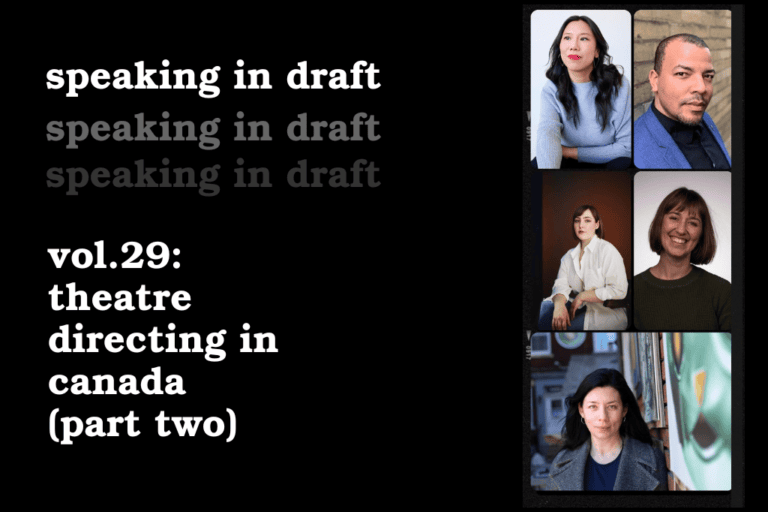 iPhoto caption: Headshots of Sophie Gee, Ray Hogg, Margot Greve, Leora Morris, and Jessica Carmichael.
Five theatre directors offer advice to the next generation — and the programs training it
The artists on this call were candid and vulnerable. They spoke openly about their professional frustrations and challenges — and they weren’t shy about pinpointing the ways that mainstream anglophone Canadian theatre practices fail directors and artists more broadly. That said, I didn’t leave our chat feeling hopeless or cynical.
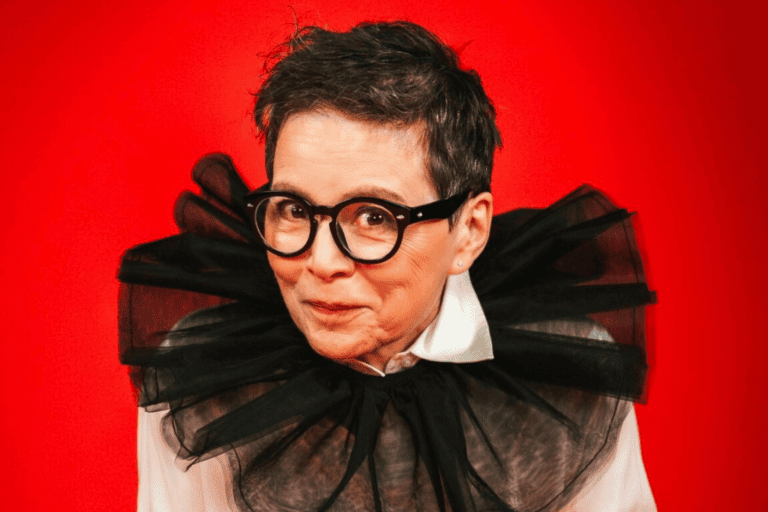 iPhoto caption: Ann-Marie MacDonald in 'Goodnight Desdemona (Good Morning Juliet).' Photo by Elana Emer.
“Sexism kept me out of hockey as a kid,” says Ann-Marie MacDonald. “But sexism also shut me out of Shakespeare."
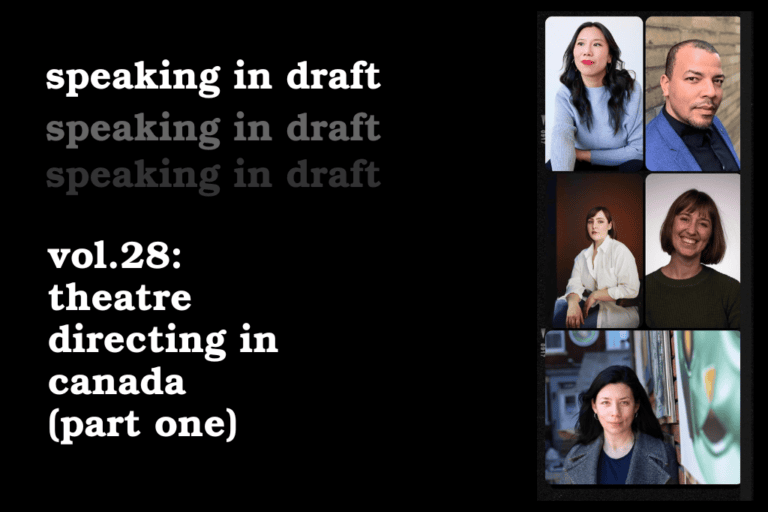 iPhoto caption: Headshots of Sophie Gee, Ray Hogg, Margot Greve, Leora Morris, and Jessica Carmichael.
How can theatre directors forge a sustainable career in Canada?
It’s increasingly unlikely that directors will hone their craft through formal training. Relatively few post-secondary programs devoted to directing exist, and it seems to me that directing-specific mentorship programs are less common than similar initiatives for actors or playwrights. To convene a roundtable about director training, I reached out to five very different artists on a continuum of early- to mid-career.
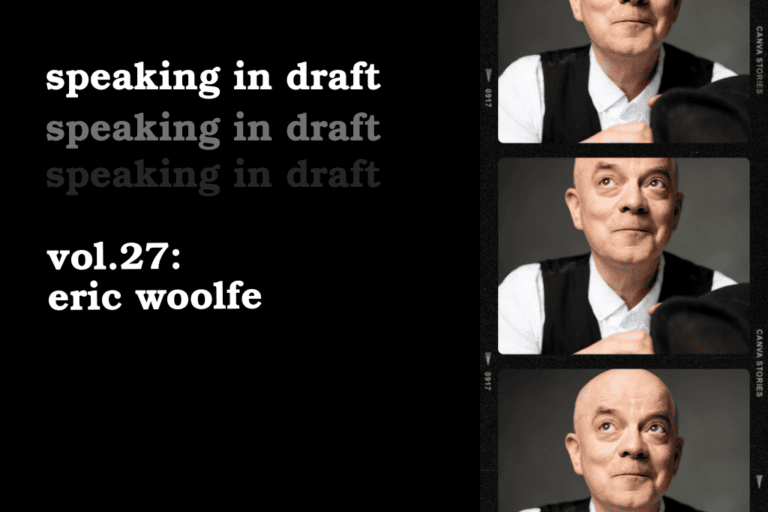 iPhoto caption: Portrait of Eric Woolfe. Photo by Dahlia Katz.
Eric Woolfe’s inventive horror theatre is a monster mash of artistic influences
For the past 26 years, Eldritch Theatre’s director of the uncanny has given ghoulies, ghosties, and long-legged beasties of all kinds a spot in the limelight, in productions that serve up puppets, magic, and a crumbling castle’s-worth of uncanny influences, including schlock-horror B-movies, Shakespeare at his bloodiest, and the fiction of H.P. Lovecraft.
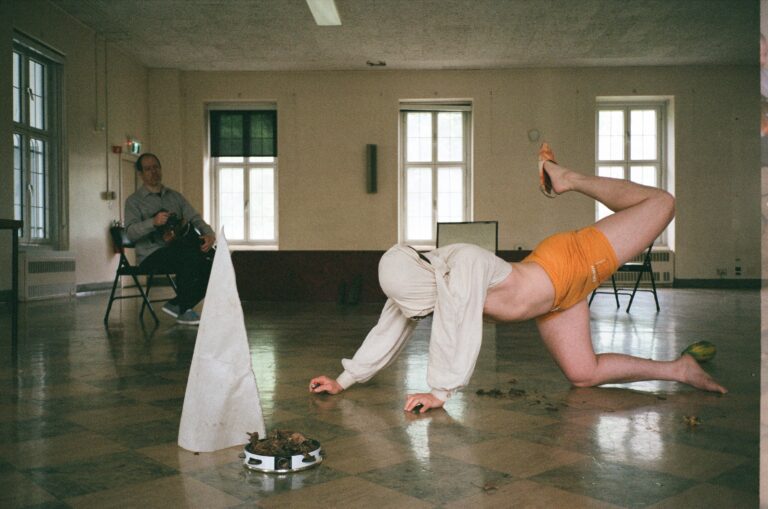 iPhoto caption: Nate Yaffe in 'Rot Hat.' Photo by Kinga Michalska.
This year’s SummerWorks Performance Festival strives to make accessibility intrinsic
The curated festival’s 36th edition features a range of works by Disabled and neurodivergent artists where the medium is very much the message.
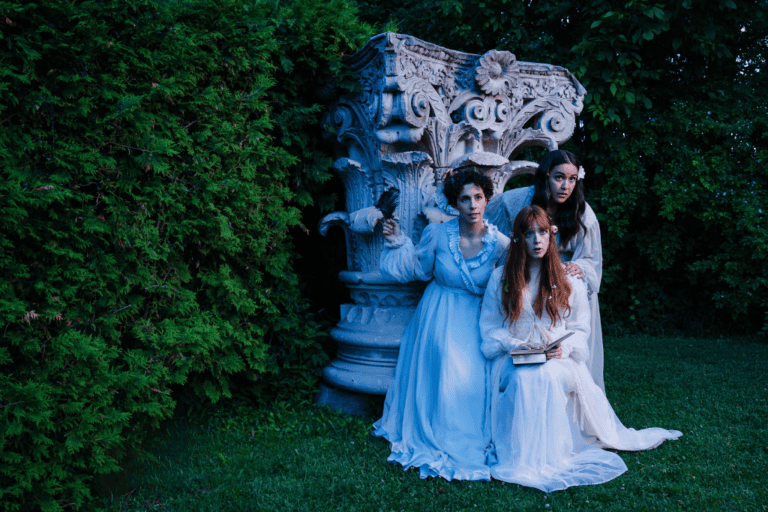 iPhoto caption: Laura Del Papa, Hilary Scott, and Lara Lucia in 'Brontë: The World Without.' Photo by Raph Nogal.
GFT’s Brontë: The World Without is a window into the ordinary lives of literary icons
Directed by Helen Juvonen in Guild Park and Gardens’ Greek Amphitheatre, The World Without follows sisters Emily, Charlotte, and Anne Brontë — the authors of Wuthering Heights, Jane Eyre, and The Tenant of Wildfell Hall, respectively.
Comments