
REVIEW: With the help of a daring set, The Caged Bird Sings brings Rumi into the present day
 iPhoto caption: Photo by Zeeshan Safdar.
The last time a Toronto theatre show put up walls around the stage, it didn’t entirely work. Staged inside a boxing ring, Canadian Stage’s September 2023 production of Suzan-Lori Parks’ Topdog/Underdog found itself confined by the ropes surrounding it: the visual barrier of the set also proved something of an emotional one.
A Modern Times Stage Company (MTSC) production in association with Theatre ARTaud, the world premiere of The Caged Bird Sings (written by MTSC artistic director Rouvan Silogix, Ahad Lakhani, and Rafeh Mahmud, also the director) involves an even more extreme structure. Around and above the playing space, set designer Waleed Ansari has erected a full-on cage, complete with golden bars. It’s a courageous swing that pays off, with a three-row, in-the-round seating configuration in the Aga Khan Museum’s courtyard offering enough intimacy to counteract any energy sapped by the divide between actor and audience.
It helps that literal and metaphorical cages abound in The Caged Bird Sings. A radical adaptation of The Masnavi, a lengthy and influential work of Sufism by Rumi, the show concerns Sal (Silogix), a king who’s been imprisoned for over 1,000 years. The arrival of two contemporary women, Rumi (Mikaela Lily Davies) and Jin (Navtej Sandhu), pierces his solitude. Scientists and lovers, the pair look like salvation to the egoistic Sal, who presents a potion that transforms the drinker’s heart to stone, claiming that if one of the women consumes it, all three will be freed.
Running 90 minutes with no intermission, the piece is split into three acts, “fortune,” “frenzy,” and “fanaa” (the annihilation of the self in Sufism), indicated to the audience by writing on a small chalkboard. The acts themselves are divided into several scenes; the actors mark the start of a new one by speaking its title (“The Price You Pay Including Tax,” “Gin Rumi,” The Jackal Who Pretended to Be a Peacock,” et cetera). Scenes taken from The Masnavi interweave with ones referencing Western literature or modern life. The goal is to make Rumi accessible for a 2024 Toronto audience while honouring his work’s spirit, something “never really done,” according to Silogix in a press release about the show.
Despite Ansari’s tight playing space, which houses two beds, three hanging light bulbs, and a few carpets, Mahmud’s staging is dynamic, often unfolding along the stage’s edges instead of getting trapped in the centre where it might feel closed off. The show moves with enough vigour that the cage has a framing effect rather than an obfuscating one.
Less elegant is The Caged Bird Sings’ depiction of Rumi and Jin’s relationship. The question of why they’ve ended up in jail is never satisfyingly answered. We vaguely hear they’re creating a kind of love potion (though its connection to Sal’s tincture is relatively unclear), so perhaps God is punishing them for upsetting the natural balance of the world — but could they really be the first people in 1,000 years to do such a thing?
And while the duo’s dialogue aims at realism (it wouldn’t be out-of-place on a Netflix show), the cast’s acting is heightened and explosive, a style better suited to the play’s frequent jaunts into fable. The show’s final act-and-a-half, which features plenty of poetic monologues and a higher proportion of surreal content, therefore comes together much better than the more mundane first half; stylish injections of light (designed by Ansari and anchored by neon bars on the cage’s ceiling) as well as sound (including an atmospheric score by designer John Gzowski) contribute theatricality to these galvanizing departures from reality.
But what if when you leave Earth’s logic behind, you arrive somewhere more real? It’s a question the show raises via repeated references to Plato’s “Allegory of the Cave,” here sometimes reframed as the “Allegory of the Cage.” Just as the long-imprisoned Sal has all but forgotten the outside world, the allegory speaks of people chained in a cave all their lives, mistaking shadows on the wall for the whole of what the universe has to offer. Plato’s tale resonates with The Masnavi’s final third, which purports that humans must reject the lure of worldly experiences — of the cave — if they wish to understand God.
The Caged Bird Sings’ penultimate scene brings this exploration into the present day. Davies and Silogix sit typing at invisible computers, making monkey sounds as Sandhu describes a bustling corporate office where workers only look at their screens: “They never venture beyond their desks, believing this digital world is all there is.”
That is until Davies’ character sneaks off, looks out a window, and gets a glittering panoramic view of a great metropolis packed with skyscrapers, strangers, and plants. “I’m one with the universe,” she realizes. “Part of something vast and beautiful — full of roaring rivers, volcanic planets, endless space-time, cuddly pussycats.” The music crescendos and the lights shift. “The past no longer holds me. The future no longer haunts me. I am here now, present and open.” As she looks out to the audience, her face shimmering with hope, the show’s jagged array of pieces unify, releasing The Masnavi from Time’s cage. “I am free.”
The Caged Bird Sings runs at the Aga Khan Museum until June 26. Tickets, available here, include same-day museum admission.
Intermission reviews are independent and unrelated to Intermission’s partnered content. Learn more about Intermission’s partnership model here.
Comments
Leave a Comment
 iPhoto caption: Photo Tarragon Theatre by Teagan McCanny.
Tarragon Theatre reveals premiere-packed 55th anniversary season, including return of Yaga and MONKS
Tarragon Theatre’s 2026-27 season features world premieres by Anahita Dehbonehie, Katherine Gauthier, Ho Ka Kei (Jeff Ho), and Luke Reece, plus four other Canadian works.
 iPhoto caption: 'Une Traversée' puppet design by Natacha Belova et Tita Iacobelli. Photo by Pierre-Yves Jortay.
REVIEW: Montreal in March? Bring on the puppets.
The 21st annual Festival International de Casteliers featured an energizing series of Quebecois and European productions that took the medium of puppetry in surprising directions.
 iPhoto caption: Photo courtesy of the Grand Theatre.
London’s Grand Theatre announces 2026-27 season
A Dolly Parton musical and the Canadian premiere of a drama by Matthew López are among the productions in the Grand Theatre’s 2026-27 season.
 iPhoto caption: Ordena Stephens-Thompson and Tony Nappo in 'The Neighbours.'
REVIEW: In Nicolas Billon’s The Neighbours, everyone’s a bystander
Green Light Arts’ The Neighbours, playing at the Tarragon Theatre Extraspace, encourages audiences to reconsider their assumptions about the comfort of spectatorship.
 iPhoto caption: Pip Dwyer, Jeanie Calleja, and Natalia Bushnik in 'Night at the Grand Guignol.' Photo by Jack Woolfe.
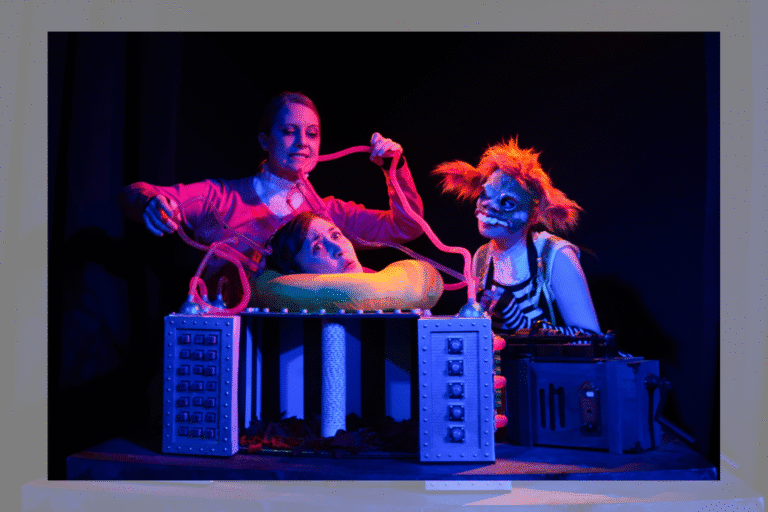
REVIEW: Eldritch’s Night at the Grand Guignol features spurting blood and severed eyes
The show hits the pulpy B-movie bullseye at which the indie company has long taken aim. Over the course of four playlets, a catalogue of deaths unfurls — shlockily! gorily! — in macabre locales.

Q&A: Hybrid conference explores the potential of VR theatre in Canada
Single Thread Theatre’s Performance and Extended Realities Conference features a mix of live performances, interactive digital presentations, and technical deep dives, as well as virtual and in-person installations.
I’ve attended this play with my daughter, last Sunday at Agha Khan Museum and we were really disappointed and offended. We couldn’t last more than 10/15 minutes and left the show. First of all it started with hearing the sound of Athan ( the call for prayers) in Islam, with a woman guiding a blind folded man to a cage, which has nothing to do with the scene after! Then a lot of meaningless shouting and jumping around that disturbed the audience.
I was expecting Rumi’s poetry accompanied by some mystic music that what I understood from the title and description of the show, it was unfortunate, indeed. Not the standard, I’ve always enjoyed at Agha Khan Museum.