
REVIEW: Stratford Festival’s Forgiveness tells a deeply personal story on a sprawling scale
 iPhoto caption: Jeff Lillico as Ralph with Yoshie Bancroft as Mitsue in 'Forgiveness.' Photo by David Hou.
Mitsue Sakamoto’s son is dating Ralph MacLean’s daughter, and now the MacLeans are coming for dinner.
Such is the establishing conflict of Forgiveness, Hiro Kanagawa’s stage adaptation of Mark Sakamoto’s 2014 memoir of the same name, directed at the Stratford Festival by Stafford Arima. It’s a deeply personal story — Mitsue (played by Yoshie Bancroft) is Mark Sakamoto’s paternal grandmother, and Ralph (Jeff Lillico) his maternal grandfather — told on a sprawling scale.
Over the course of nearly three hours (a runtime that was extended on opening night due to a medical emergency in the audience, gracefully handled by cast and crew alike), the audience follows Mitsue and Ralph across their divergent storylines. From 1930s teenhoods defined by racism for Japanese-Canadian Vancouverite Mitsue and by abusive familial relationships for Magdalene Islander Ralph, the play moves to the outbreak of the Second World War, and eventually to Mitsue and Ralph’s respective detainments — Mitsue in a Canadian internment camp, and Ralph in a Japanese prisoner of war camp. It’s these complex personal histories, shaped by the interlinked traumas of racism and war, which make the idea of Mitsue and Ralph meeting over dinner so complicated.
Kanagawa’s 2023 adaptation is framed as a memory play, introduced by Ralph and Mitsue in fourth wall-breaking addresses at the top of the show’s two acts. It’s an interesting narrative device that I was disappointed not to see satisfyingly resolved at the end of the play. In Ralph and Mitsue’s memories, time is malleable, and the play flashes back and forth between their pre-war lives, dinner plans in 1968, and a range of times and places across the intervening years. These frequent shifts are tricky to follow at times, but are supported by Lorenzo Savoini’s detailed costume design, and Cindy Mochizuki’s place-establishing illustrations and animations, which are projected around the theatre (projection design by Sammy Chien [Chimerik 似不像]).
The production’s synergy between design and staging is its strongest point — Kaileigh Krysztofiak’s lighting, Chien’s projections, Anita Nittoly’s fight direction, and Stephanie Graham’s choreography combine to create intense combat sequences. The incorporation of historic radio broadcasts and images during depictions of some of the war’s most pivotal events, like the attack on Pearl Harbor, illustrate the intensely felt impacts of this well-known history on the play’s characters. Sound designer Olivia Wheeler and composer Allison Lynch’s soundscapes and cinematic scoring also lend much emotional weight to the play’s many settings.
The cast give strong performances — demonstrating an impressive versatility after his turn as a flamboyant, singing Shakespeare in last season’s Something Rotten!, Lillico plays Ralph with a youthful mix of fear and resolve. Subtle shifts in Bancroft’s movement and mannerisms make Mitsue’s aging from a teen to a mother with teenage children of her own completely believable. Kanagawa’s contrasting roles as Mitsue’s father Yosuke and the sadistic camp commandant Kato are striking in their differences, and one of the most effective of the play’s many dual castings.
Despite all this, though, Forgiveness’s narrative feels incomplete. With its constant dipping in and out of times and places and its wide range of supporting characters (Bancroft and Lillico aside, most cast members play at least two named roles, one as many as seven), the script seems geared to breadth rather than depth. In its attempt to invest the audience in such an expansive series of people and events, it often glances off the surface of what could be powerful moments of loss, grief, and (occasionally) joy.
This extends to its titular theme: while a program note suggests that the budding relationship between their children forces Mitsue and Ralph to confront their traumatic anger and grief in search of forgiveness, the production shows very little of this internal confrontation. A two-decade time skip between the end of the war and the family dinner means we don’t see how those negative emotions have festered, and it’s unclear how the characters have found it within themselves to forgive the atrocities we have spent the past two-and-a-half hours witnessing. In these later scenes, Ralph’s character has more depth than Mitsue’s, but even then it seems to be more a battle of forgiving himself in the face of overwhelming survivor’s guilt than a question of reconciliation.
Presented in an increasingly tense political moment, where questions and conflicts of national identity, migration, detention, and what it means to call a place home have very tangible impacts both in North America and around the world, Forgiveness resonates on a level that is part reflection, part warning. There’s an important message here, but its delivery is unfortunately hazy.
Forgiveness runs at the Stratford Festival’s Tom Patterson Theatre until September 27. Tickets are available here.
Intermission reviews are independent and unrelated to Intermission’s partnered content. Learn more about Intermission’s partnership model here.
Charlotte Lilley
Charlotte Lilley (she/her) is a writer currently living in Hamilton, ON. She holds a BA from Western University, a Master of Applied Literary Arts from the Memorial University of Newfoundland (Grenfell), and currently studies at McMaster University. Her writing has appeared in Horseshoe Literary Magazine, Prelude (Calgary Phil), the Stratford Beacon Herald, and elsewhere. Charlotte’s writing and academic work explores speculative fiction, sustainability, and hope. www.charlottemlilley.com
LEARN MORE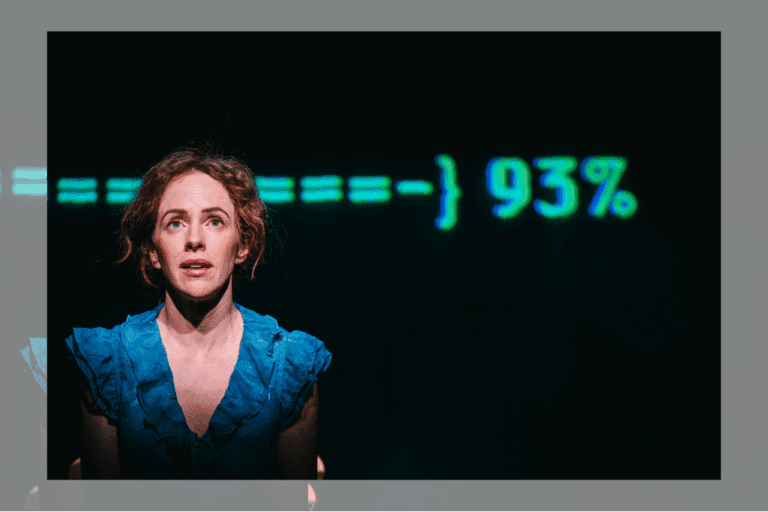 iPhoto caption: Fiona Mongillo in 'Reproduktion.' Photo by Ann Baggley.
REVIEW: Here For Now’s well-acted Reproduktion attempts to tackle too much
Amy Rutherford’s world premiere script is ambitious and the material it covers is complex — but the narrative feels disjointed.
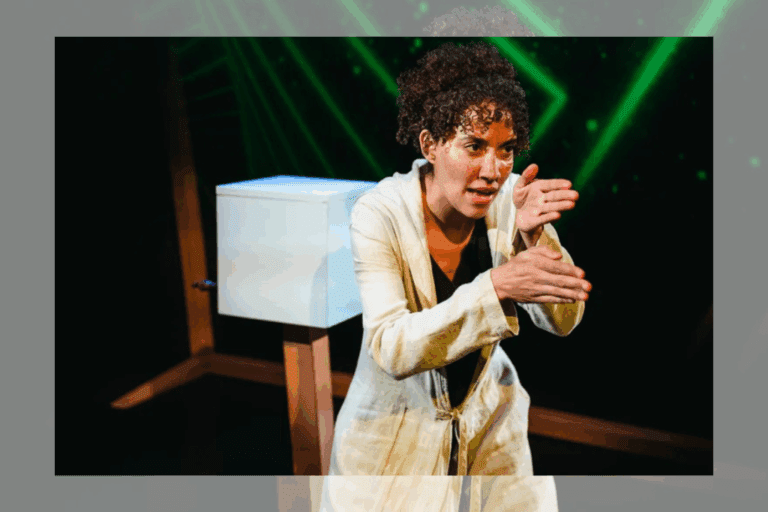 iPhoto caption: Jessica B. Hill in 'Pandora.' Photo by Ann Baggley.
REVIEW: Jessica B. Hill’s Pandora thinks outside the box at Stratford’s Here For Now Theatre
With its assemblage of theatrical meta-commentary, mythical allusions, science facts, and weasels, at face value Pandora resembles random chaos. But weave those parts together and a story emerges that is equal parts moving and fascinating.
 iPhoto caption: Richard Alan Campbell and Mary Long in 'The Time Capsule.' Photo by Dahlia Katz.
REVIEW: Theatre Aquarius’ The Time Capsule pays lighthearted tribute to Hamilton, Ontario
As the evening progresses and the characters begin open up and butt heads, the play becomes a comedic yet heartfelt reflection on memory. We learn that the past is never as far away as we might think, that a moment forgettable for one person could be life-changing for another, and that it takes more than just a Hamilton Ticats pin or a Tim Hortons cup to memorialize a city and its people.
 iPhoto caption: Photo of Staircase Theatre by Aleena Faisal.
REVIEW: Hamilton Fringe Festival 2025
For this set of reviews, I’ve tried to capture the breadth of this year’s theatrical offerings, visiting nearly half of the festival's venues to take in productions ranging from new dramas and musical comedies to experimental collaborations with technology.
 iPhoto caption: Braeden Etienne in 'Believe In It Alive.' Photo courtesy of Treading Theatre Festival, taken by Phi Doan.
Running at the Schneider Haus National Historic Site in downtown Kitchener, the festival features five site-responsive productions in intimate and unconventional performance spaces.
 iPhoto caption: Photo by Jae Yang.
REVIEW: Tarragon’s wonderful Benevolence reflects on diaspora, community, and place
Playwright-performer Kevin Matthew Wong’s script is heartfelt, conversational, and at times poetic, moving effortlessly between heavier moments of grief and lighter moments of joy and humour.
Comments