
REVIEW: Jessica B. Hill’s Pandora thinks outside the box at Stratford’s Here For Now Theatre
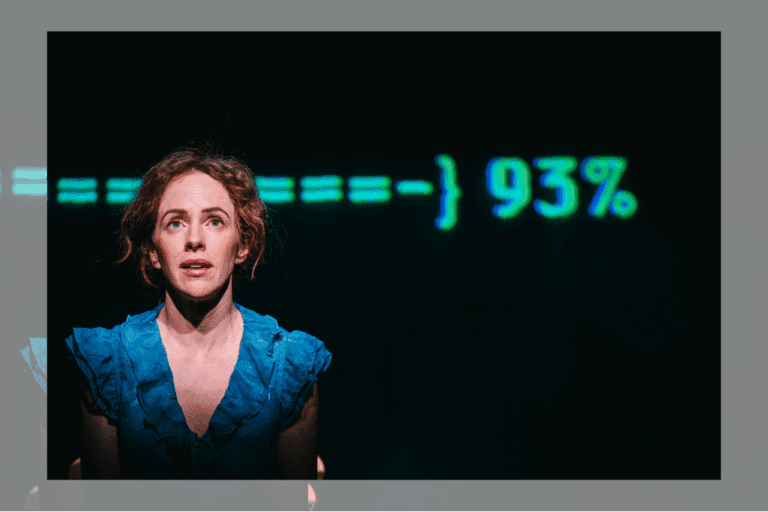
 iPhoto caption: Jessica B. Hill in 'Pandora.' Photo by Ann Baggley.
Once, Pandora was the world’s first woman, gifted with insatiable curiosity and a box that must never be opened. Now she’s a quantum physicist, attempting to find meaning in the most mechanical inner workings of the universe. And she has a lot to apologize for.
Such is the conceit of Jessica B. Hill’s solo show Pandora, which retells the Greek myth of the same name. The one-act play premiered in Winnipeg in 2023, and has now returned to Here For Now Theatre in Stratford (which commissioned it), directed by Rodrigo Beilfuss, as the first show in Here For Now’s inaugural winter season.
Hill, fresh from doing triple duty in the Stratford Festival’s 2025 season as part of Dangerous Liaisons, Sense and Sensibility, and As You Like It, demonstrates her versatility as both actor and playwright, taking on her play’s titular role. Speaking directly to the audience (the fourth wall breaks are frequent and endearing), Hill’s Pandora mesmerizes. Through her fluid movements and expressive storytelling, she captures both Pandora’s bright-eyed, infamous curiosity and the weightiness that comes with millennia of regret. Though she retains her optimism, this Pandora remains haunted by the evils she’s unleashed — what she calls the weasels of the world. (Intermittent wifi is her fault, she regretfully informs the audience. So are microplastics.)
Retellings of Greek mythology have become popular over the past few years – think Madeline Miller’s The Song of Achilles going viral on TikTok, Christopher Nolan’s hotly anticipated film adaptation of The Odyssey, or even Erin Shields’ Ransacking Troy at the Stratford Festival this past season. Among this proliferation of adaptations, though, this take on Pandora’s myth feels unique and timely.
Hill’s script plays with some familiar mythological threads — we see Pandora encounter gods, journey to the underworld, sit with Prometheus around the first campfire, and grapple with the versions of her own mythology that frame her as a scapegoat for everything wrong with our world. But Hill’s voice as a playwright most clearly shines when she begins to deviate from the more well-worn tropes.
In a series of interleaved stories, Hill’s Pandora — as at home in 2025 as she is in the distant past — makes frequent references to Hamlet, offers lectures on the scientific incompatibility of general relativity and quantum mechanics, and muses on the transformative nature of performance and shared witnessing. She regales the audience with tales about literal weasels and metaphorical ones. She meditates on loss, loneliness, and climate change. She considers the potential of hope.
Jaymez’s sparse yet effective lighting, stage, and projection design supports this collage of interwoven anecdotes. Most of the play’s action takes place within a large, cube-shaped frame, positioned diagonally within the playing space of the Rose McQueen Stage. Screens across the frame’s two rear sides display projections, immersing Pandora in sweeping galactic landscapes, microscopic webs, and ancient Greek architecture.
Pandora’s box itself also features. (Although, as Pandora explains, the box is just for narrative effect — the real thing was more of a jar.) Centred on a pedestal in the middle of the stage, projections transform its simple white sides into Prometheus’ fire and a big red button that controls CERN’s Large Hadron Collider.
When Pandora steps outside of the frame (often with a self-aware, box-related quip), Jaymez highlights her with warm spotlights. In the small, black box theatre the effect is intimate, and only heightened by Hill’s frequent and direct eye contact with members of the audience. It’s an overarchingly simple, minimalist staging, one which allows the audience to keep their focus on Hill’s excellent script and delivery.
Near the end of the play, Pandora describes the world as “random chaos, entangling us together until there’s a story.” Pandora is proof-of-concept – with its assemblage of theatrical meta-commentary, mythical allusions, science facts, and weasels, at face value it resembles that random chaos. But weave those parts together and a story emerges that is equal parts moving and fascinating.
Pandora runs at Here For Now Theatre in Stratford, Ontario until November 15. More information is available here.
Intermission reviews are independent and unrelated to Intermission’s partnered content. Learn more about Intermission’s partnership model here.
Charlotte Lilley
Charlotte Lilley (she/her) is a writer currently living in Hamilton, ON. She holds a BA from Western University, a Master of Applied Literary Arts from the Memorial University of Newfoundland (Grenfell), and currently studies at McMaster University. Her writing has appeared in Horseshoe Literary Magazine, Prelude (Calgary Phil), the Stratford Beacon Herald, and elsewhere. Charlotte’s writing and academic work explores speculative fiction, sustainability, and hope. www.charlottemlilley.com
LEARN MOREComments
Leave a Comment
 iPhoto caption: Fiona Mongillo in 'Reproduktion.' Photo by Ann Baggley.
REVIEW: Here For Now’s well-acted Reproduktion attempts to tackle too much
Amy Rutherford’s world premiere script is ambitious and the material it covers is complex — but the narrative feels disjointed.
 iPhoto caption: Richard Alan Campbell and Mary Long in 'The Time Capsule.' Photo by Dahlia Katz.
REVIEW: Theatre Aquarius’ The Time Capsule pays lighthearted tribute to Hamilton, Ontario
As the evening progresses and the characters begin open up and butt heads, the play becomes a comedic yet heartfelt reflection on memory. We learn that the past is never as far away as we might think, that a moment forgettable for one person could be life-changing for another, and that it takes more than just a Hamilton Ticats pin or a Tim Hortons cup to memorialize a city and its people.
 iPhoto caption: Photo of Staircase Theatre by Aleena Faisal.
REVIEW: Hamilton Fringe Festival 2025
For this set of reviews, I’ve tried to capture the breadth of this year’s theatrical offerings, visiting nearly half of the festival's venues to take in productions ranging from new dramas and musical comedies to experimental collaborations with technology.
 iPhoto caption: Jeff Lillico as Ralph with Yoshie Bancroft as Mitsue in 'Forgiveness.' Photo by David Hou.
REVIEW: Stratford Festival’s Forgiveness tells a deeply personal story on a sprawling scale
Presented in an increasingly tense political moment, Forgiveness resonates on a level that is part reflection, part warning.
 iPhoto caption: Braeden Etienne in 'Believe In It Alive.' Photo courtesy of Treading Theatre Festival, taken by Phi Doan.
Running at the Schneider Haus National Historic Site in downtown Kitchener, the festival features five site-responsive productions in intimate and unconventional performance spaces.
 iPhoto caption: Photo by Jae Yang.
REVIEW: Tarragon’s wonderful Benevolence reflects on diaspora, community, and place
Playwright-performer Kevin Matthew Wong’s script is heartfelt, conversational, and at times poetic, moving effortlessly between heavier moments of grief and lighter moments of joy and humour.
Great review. So, so true. I loved Pandora! What a treat and what a performance!