
REVIEW: Tarragon’s wonderful Benevolence reflects on diaspora, community, and place
 iPhoto caption: Photo by Jae Yang.
In its first moments, Benevolence breaks the fourth wall. Welcomed into the performance space, a few audience members volunteer to participate in an opening dragon dance. They’re later offered tea, timed to be served at just the right temperature.
This is the vibrant, communal opening to Kevin Matthew Wong’s world premiere work, produced by Tarragon Theatre in association with Why Not Theatre and Broadleaf Creative. A one-act autobiographical solo performance that’s part play, part documentary, Benevolence traces a narrative of movement and migration while navigating questions about diasporic cultural identity and community across generational divides. Drawing on Wong’s experience with his own Hakka culture (China’s nomadic people, whose name translates to “guest families”), these themes are deeply personal. They also, as Wong explains in a program note, engage with broader questions “about identity and being here in Canada,” which will likely resonate with audiences from a diverse range of backgrounds.
The play (written, directed, and performed by Wong) follows Kevin, a young, Toronto-based theatre creator unexpectedly invited to develop a piece based on Hakka identity for the upcoming World Hakka Conference. Worried that he lacks an understanding of his culture (and the authority to share it), Kevin connects with his family and with Hakka communities as far away as Vancouver and Victoria as he works to understand his culture and his place within it.
(For audience members like myself who may be unfamiliar with Hakka culture prior to seeing the play, Kevin’s journey also serves as a generous and accessible introduction, as we are invited to learn alongside him.)
Tarragon’s production is one of a series of works Wong has developed exploring Hakka culture and identity. Others include a documentary (also called Benevolence), and 2024’s immersive Benevolence Hall installation, which won the inaugural Dora Award for outstanding innovative experience. Wong’s versatility in working across mediums is clear in Tarragon’s production as he crafts a collage of multimedia elements which come together in an attention-grabbing (and attention-holding) 90 minutes.
His script is heartfelt, conversational, and at times poetic, moving effortlessly between heavier moments of grief and lighter moments of joy and humour. Across the board his dialogue flows smoothly and his characters feel real. Wong’s delivery, too, is spot-on: honest and evocative, and complemented by fluid gestures and a dynamic use of the playing space. In some moments his performance is more abstract, working with mime and dance, while in others Wong’s character work shines as he embodies many of the individuals Kevin meets (especially distinct are the insistent and encouraging conference planner Sonia, with her penchant for standup comedy; and the defensive George, who questions whether Kevin is “Hakka enough”). In other scenes the fourth wall drops again, and Wong’s storytelling is straightforward as he returns to address the audience directly.
A visually striking support for the play’s at times documentary-like style, video projections (designed by Wong) appear on a range of surfaces across Echo Zhou 周芷會’s set, turning folding tables placed on end into doors, and the wall behind the playing space into community centre interiors and rainy cityscapes. Chris Ross-Ewart’s sound design seamlessly supports these visuals. From both literally and metaphorically disruptive ringtones to more atmospheric soundscapes, Ross-Ewart and Wong’s combined audio and visual work merge to evoke an array of physical places and emotional registers.
The projections also present a unique opportunity for Wong to share the stage with others: in some cases he interacts with the projections — like when he poses to recreate a photo with Peter, a leader at Vancouver’s Hakka community centre — while in others he lets them speak for themselves. In one particularly poignant sequence he steps aside completely to allow the audience to observe a conversation with his centenarian grandmother, a powerful representation of intergenerational connections and divides.
A meditation on a personal journey with one’s culture that also reflects more broadly on themes of diaspora, community, and place, Benevolence is technically masterful and emotionally resonant. I’ll be thrilled to see where Wong takes this project next.
Benevolence runs at Tarragon Theatre until May 4. Tickets are available here.
Intermission reviews are independent and unrelated to Intermission’s partnered content. Learn more about Intermission’s partnership model here.
Charlotte Lilley
Charlotte Lilley (she/her) is a writer currently living in Hamilton, ON. She holds a BA from Western University, a Master of Applied Literary Arts from the Memorial University of Newfoundland (Grenfell), and currently studies at McMaster University. Her writing has appeared in Horseshoe Literary Magazine, Prelude (Calgary Phil), the Stratford Beacon Herald, and elsewhere. Charlotte’s writing and academic work explores speculative fiction, sustainability, and hope. www.charlottemlilley.com
LEARN MOREComments
Leave a Comment
 iPhoto caption: Fiona Mongillo in 'Reproduktion.' Photo by Ann Baggley.
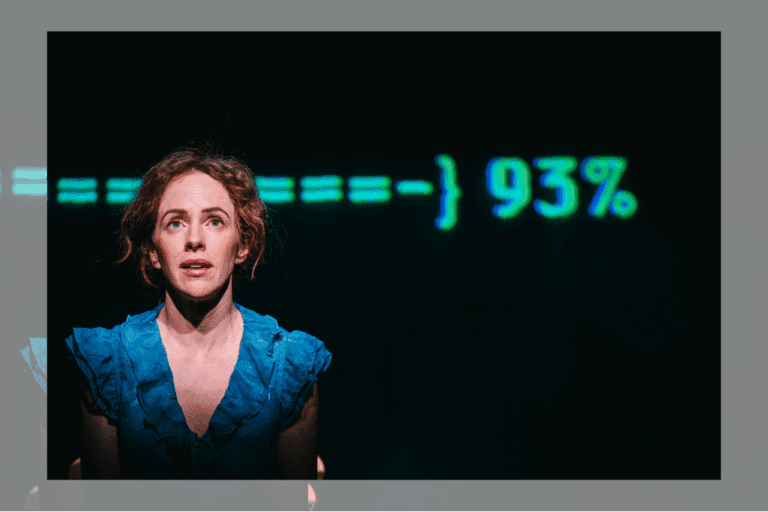
REVIEW: Here For Now’s well-acted Reproduktion attempts to tackle too much
Amy Rutherford’s world premiere script is ambitious and the material it covers is complex — but the narrative feels disjointed.
 iPhoto caption: Jessica B. Hill in 'Pandora.' Photo by Ann Baggley.
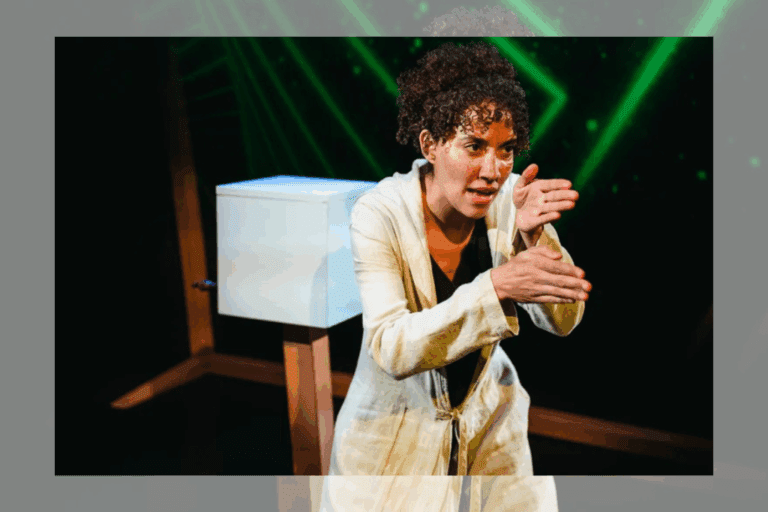
REVIEW: Jessica B. Hill’s Pandora thinks outside the box at Stratford’s Here For Now Theatre
With its assemblage of theatrical meta-commentary, mythical allusions, science facts, and weasels, at face value Pandora resembles random chaos. But weave those parts together and a story emerges that is equal parts moving and fascinating.
 iPhoto caption: Richard Alan Campbell and Mary Long in 'The Time Capsule.' Photo by Dahlia Katz.
REVIEW: Theatre Aquarius’ The Time Capsule pays lighthearted tribute to Hamilton, Ontario
As the evening progresses and the characters begin open up and butt heads, the play becomes a comedic yet heartfelt reflection on memory. We learn that the past is never as far away as we might think, that a moment forgettable for one person could be life-changing for another, and that it takes more than just a Hamilton Ticats pin or a Tim Hortons cup to memorialize a city and its people.
 iPhoto caption: Photo of Staircase Theatre by Aleena Faisal.
REVIEW: Hamilton Fringe Festival 2025
For this set of reviews, I’ve tried to capture the breadth of this year’s theatrical offerings, visiting nearly half of the festival's venues to take in productions ranging from new dramas and musical comedies to experimental collaborations with technology.
 iPhoto caption: Jeff Lillico as Ralph with Yoshie Bancroft as Mitsue in 'Forgiveness.' Photo by David Hou.
REVIEW: Stratford Festival’s Forgiveness tells a deeply personal story on a sprawling scale
Presented in an increasingly tense political moment, Forgiveness resonates on a level that is part reflection, part warning.
 iPhoto caption: Braeden Etienne in 'Believe In It Alive.' Photo courtesy of Treading Theatre Festival, taken by Phi Doan.
Running at the Schneider Haus National Historic Site in downtown Kitchener, the festival features five site-responsive productions in intimate and unconventional performance spaces.
An appealing subject, conceived & presented by a most appealing performer wih imaginative projections.