
REVIEW: During this year’s TIFF, two films depicted theatre as a vessel for transcendence
 iPhoto caption: 'Kokuho' still courtesy of TIFF.
Spoiler alert: This article involves description of Kokuho and Hamnet‘s final scenes.
The 50th Toronto International Film Festival (TIFF) featured a bounty of films with links to the world of theatre. Adaptation-wise, there was a South Asian-led contemporary Hamlet, a sapphic mid-century Hedda Gabler, as well as a take on Bernard-Marie Koltès from French auteur Claire Denis. Toronto theatre history even took the spotlight in You Had to Be There: How the Toronto Godspell Ignited the Comedy Revolution, Spread Love & Overalls, and Created a Community That Changed the World (In a Canadian Kind of Way), a documentary about the oft-discussed, star-stacked 1972 production at the Royal Alexandra Theatre.
But of the performing arts-adjacent selections I viewed, most affecting were two dramas: Lee Sang-il’s Kokuho and Chloé Zhao’s Hamnet. In both period pieces, theatre creation serves as an emotional outlet for an artist navigating devastating loss. Sang-il and Zhao capture the stage’s power to offer transcendence for actor and audience, while underlining the danger of letting it consume you.
This year’s Japanese entry for best international feature at the Oscars, Kokuho begins in 1964 Nagasaki, where on a peaceful winter’s night, a 14-year-old boy named Kikuo (Sōya Kurokawa) watches his father — a high-ranking member of the yakuza (the Japanese mafia) — get shot to death. The orphaned Kikuo finds refuge with a family of kabuki practitioners, who train him to perform in the centuries-old performance tradition next to their similarly aged son, Shunsuke (Keitatsu Koshiyama). Kikuo then spends decades working to become the greatest kabuki performer in Japan. (After they mature into adulthood, Kikuo is played by Ryo Yoshizawa and Shunsuke by Ryusei Yokohama.)
In the TIFF People’s Choice Award-winning Hamnet, an adaptation of Maggie O’Farrell’s elegant 2020 novel, the titular son of William Shakespeare (Paul Mescal) dies at the age of 11, inspiring a four-hour play that’s become pretty famous. (Opening captions explain that the names “Hamnet” and “Hamlet” were interchangeable in Elizabethan England.) While William’s off in London, his two other children and wife Agnes (Jessie Buckley) remain at home in Stratford, where O’Farrell and Zhao’s screenplay primarily trains its eye.
Kikuo and William escape into the grind of theatre creation. This demands self-sacrifice. Kukuho’s Hanai Hanjiro II, the father of Shunsuke, trains the kabuki novices abusively, but Kikuo pushes through the pain. He later adopts Hanai’s destructive methods into his work, in one scene forcing Shunsuke into an intense, improvised sequence of stage action that goes beyond reasonable physical limits.
William, too, works unflaggingly: After Hamnet dies, he’s unable to take even 24 hours off. Yet during the only scene set at Hamlet rehearsal, William’s mind seems to be half at home. As the actors playing Ophelia and Hamlet work through dialogue, cinematographer Łukasz Żal keeps his eye on William. The playwright paces back and forth, growing increasingly frustrated that the performers aren’t finding the right emotional register. He demands Hamlet repeat his lines, then repeat his lines, then repeat his lines, until suddenly William is hoarse with emotion, yelling the iambic pentameter back at the actors. (Of a similar spirit, but too obvious, is a moonlit sequence in which William mumbles the “to be or not to be” speech while staring down at the Thames.)
These obsessive tendencies send shrapnel flying in every direction. Kabuki is traditionally a family business, but Kikuo’s work ethic leads him toward following in Hanai’s path as the troupe’s next great star — an usurpation of Shunksuke that devastates much of the family. And while William’s success allows him to buy his family impressive gifts, including the largest house in Stratford, Zhao gives space to Agnes’ icy reactions, foregrounding her discontent over his absence from domestic life.
By focusing primarily on the artist, Kukuho makes Kikuo’s decision to dedicate himself to kabuki immediately understandable. It’s clear that before the arrival of the opportunity to perform, he has nothing — so why wouldn’t he do anything to hold onto this lifebuoy called kabuki? But we eventually learn more about the damage Kikuo has wrought, complicating the ethical stakes.
Most of Hamnet gives prime place to the negative effects of William’s actions, but when Agnes eventually makes the trip to London to see Hamlet, the implication is that maybe William’s absence was worth it. Although Agnes enters the Globe Theatre with skepticism, the play gives her a powerful chance to reunite with her boy, or at least a young man with his name. (A glib takeaway: If you’re going to abandon your family to write a play, it better be as good as Hamlet.)
Like a sports movie ending with the championship game, it’s inevitable (and a little formulaic) that both films conclude with scenes of performance. In Kukuho, it’s the culmination of several kabuki sequences, whereas in Hamnet, it’s the sole formal production — though, before his son’s death, William loved to tell stories around the house, once even dressing up his children as the witches from Macbeth.
Perhaps in response to nature’s cruelty, the climactic creations of both artists forge artificial versions of the natural world. Performing a play called The Heron Maiden, Kukuo doesn’t just embody a bird, but dances under a stream of fake white snow, echoing the weather that accompanied his father’s shooting. And William, who met Agnes in a forest next to Stratford, hangs a painted tapestry of trees at the back of Hamlet’s set (despite the play usually taking place in a castle).
I found it incredibly resonant to watch these characters use art to move beyond their painful circumstances. The Heron Maiden’s poignancy arises from its abstract form, mostly built around movement and light. Kikuo is able to harness the simple, eternal power of a body on stage, and retreat from reality into metaphor. What’s striking about cinematographer Sofian El Fani’s treatment of this scene is that the audience remains a peripheral, anonymous mass. The film’s perspective is instead intensely personal; once, it even slips into first-person point-of-view, revealing that, like the camera, Kikuo isn’t watching the audience: He’s admiring the beauty of the falling snow.
But Hamlet almost becomes a community event. While William gets the catharsis of playing the ghost of Hamlet’s father — a moving inversion of the father-son duo’s real-life circumstances — Zhao highlights the groundlings. The play nearing its end, Agnes reaches a hand toward Hamlet, who kneels downstage among royal corpses. The surprised actor returns the gesture. Then, the heart-render: Many of the other groundlings also outstretch an arm. Hamnet’s death may have been William’s inspiration, but the embodied text takes on a more expansive power, becoming a vessel for the whole crowd to transcend their pain.
The 50th Toronto International Film Festival ran from September 4 to 14, 2025.
Intermission reviews are independent and unrelated to Intermission’s partnered content. Learn more about Intermission’s partnership model here.

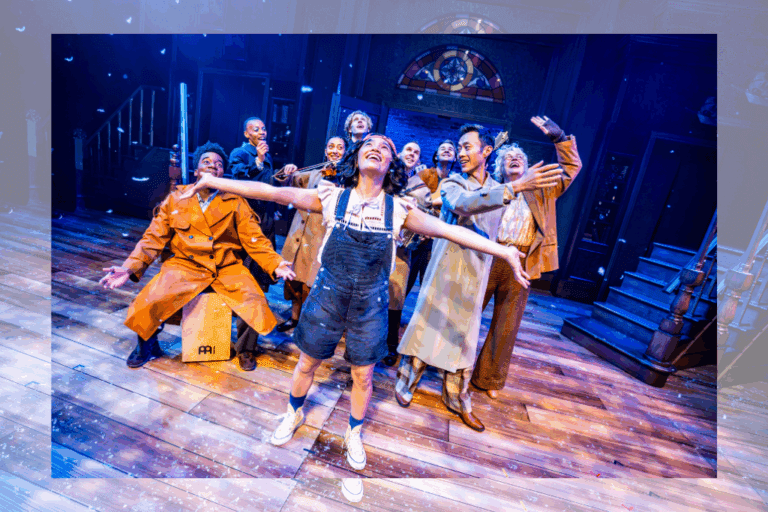 iPhoto caption: Members of the company of 'Narnia.' Photo by Dahlia Katz.
REVIEW: Bad Hats’ Narnia is a joyful, heartwarming escape
The spirit of openness and the joy of discovery rule over this Narnia. Open the wardrobe and see.
 iPhoto caption: Members of the company of 'Robin Hood.' Photo by Dahlia Katz.
REVIEW: Canadian Stage’s Robin Hood panto is anti-capitalist fun for the whole family
Following Ross Petty’s legacy of scene-stealing, Damien Atkins as the evil Prince John is easily the greatest delight of the show.
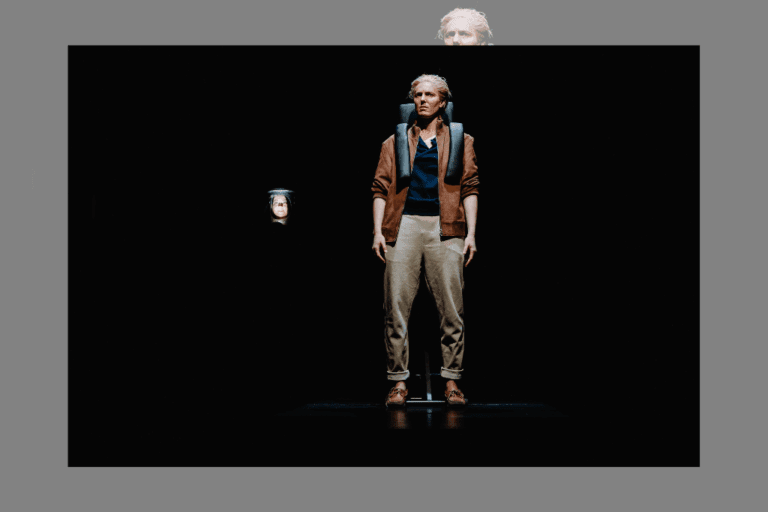 iPhoto caption: Lauren Gillis and Alaine Hutton in 'Public Consumption.' Photo by Eden Graham.
REVIEW: Lester Trips’ stylish Public Consumption captures the internet’s profound emptiness
Rather than directly representing online life, Public Consumption speculates — with virtuosity — about how the digital world affects our bodies. And the show's findings are by no means comfortable.
 iPhoto caption: Tony Ofori and Daren A. Herbert in 'Moonlight Schooner.' Photo by Dahlia Katz.
Kanika Ambrose’s Moonlight Schooner is animated and visually stunning, but its individual pieces don’t come together as neatly as I would've expected.
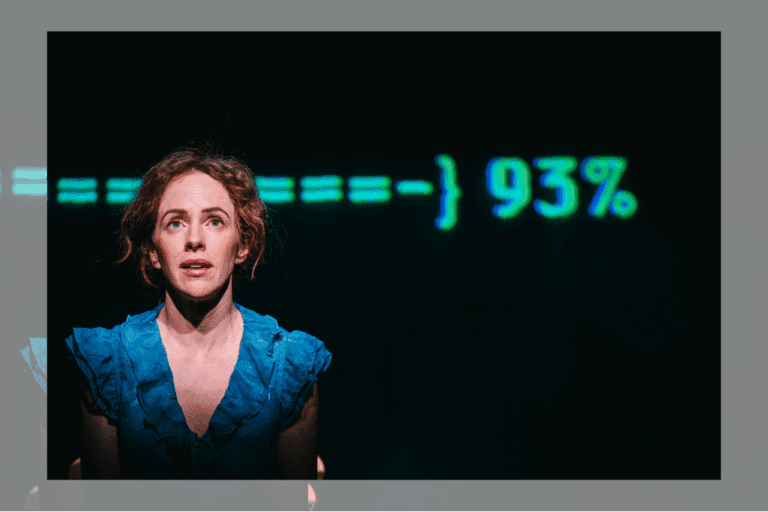 iPhoto caption: Fiona Mongillo in 'Reproduktion.' Photo by Ann Baggley.
REVIEW: Here For Now’s well-acted Reproduktion attempts to tackle too much
Amy Rutherford’s world premiere script is ambitious and the material it covers is complex — but the narrative feels disjointed.
 iPhoto caption: Kristen Thomson in 'Fulfillment Centre.' Photo by Elana Emer.
REVIEW: Coal Mine’s Fulfillment Centre asks how we end up alone, together
The production understands the play’s themes, yet feels limited by a script that delivers a package it never fully opens.
iPhoto caption: Lauren Gillis and Alaine Hutton in 'Public Consumption.' Photo by Eden Graham.
REVIEW: Lester Trips’ stylish Public Consumption captures the internet’s profound emptiness
Rather than directly representing online life, Public Consumption speculates — with virtuosity — about how the digital world affects our bodies. And the show's findings are by no means comfortable.
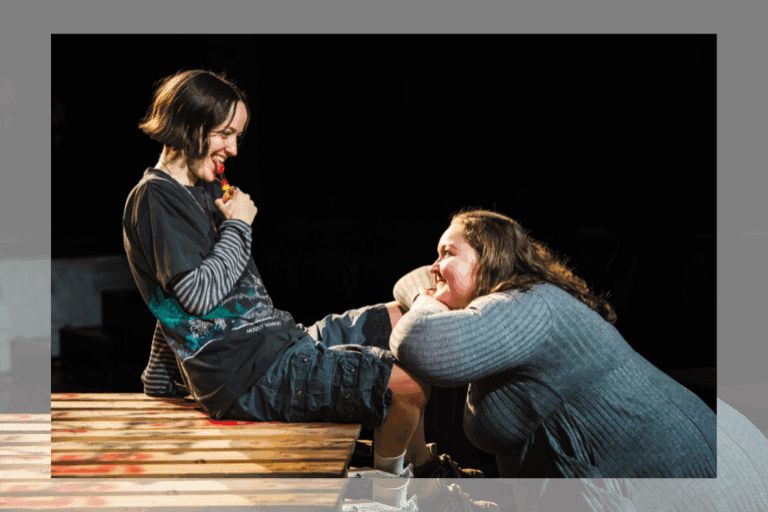 iPhoto caption: Photo by Elana Emer.
REVIEW: Icarus Theatre’s DNA paints a disturbing mural of teenage rebellion
While director Erik Richards’ tendency toward snappy, thriller-esque pacing doesn’t suit all of DNA’s more intimate moments, it adds electricity to the drama’s group scenes, bringing playwright Dennis Kelly’s reflections on groupthink and collective grief into clear view.
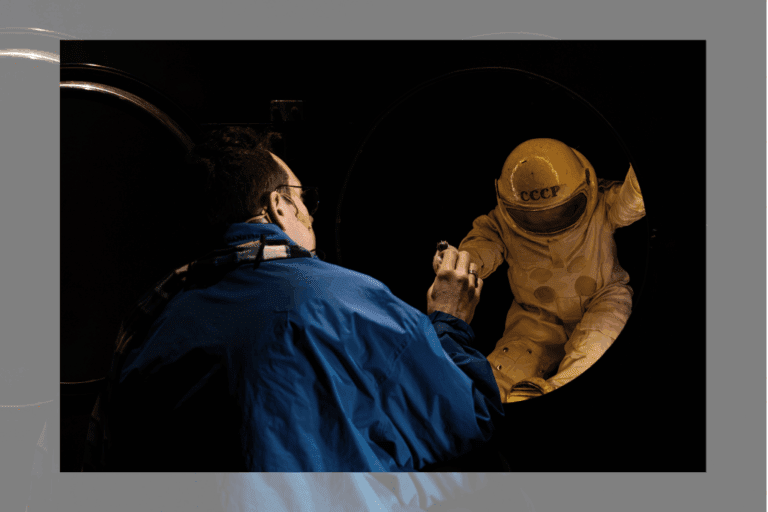 iPhoto caption: Olivier Normand in 'The Far Side of the Moon.' Photo by Li Wang.
REVIEW: Lepage’s ethereal The Far Side of the Moon is insomniac theatre
The Far Side of the Moon begins and ends with a large mirror on stage, and the show extracts enigmatic power from the tantalizing question of whether its protagonist is losing himself in his reflection, or moving toward self-discovery.
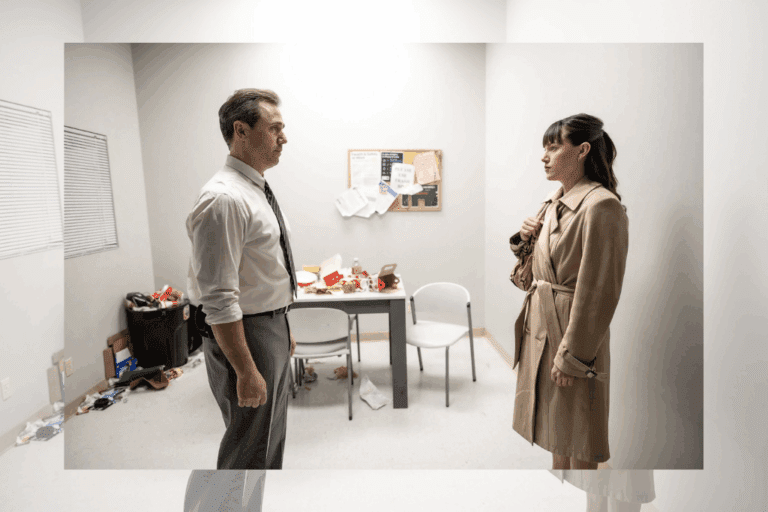 iPhoto caption: Cyrus Lane and Kirstyn Russelle in Barrie run of 'Blackbird.' Photo by Dahlia Katz.
REVIEW: Talk is Free Theatre’s Blackbird offers a close-up look at two detailed performances
Emerging director Dean Deffett has concocted a tight, straightforward production, primarily of interest as an intimate character study.
 iPhoto caption: Sleman Aldib and an audience member in 'The Opposite.' Still from a trailer by Spectrum Associates.
REVIEW: Kitchener’s biennial IMPACT Festival crackled with urgency
Most of the six works I viewed tackled urgent topics, from the convoluted Canadian immigration system to the Palestinian experience of displacement: explorations that line up with artistic director Pam Patel’s curatorial statement, which discusses how IMPACT ‘25 “unpacks what it means to survive, to resist, and to seek refuge” through a global, Indigenous-focused lens.
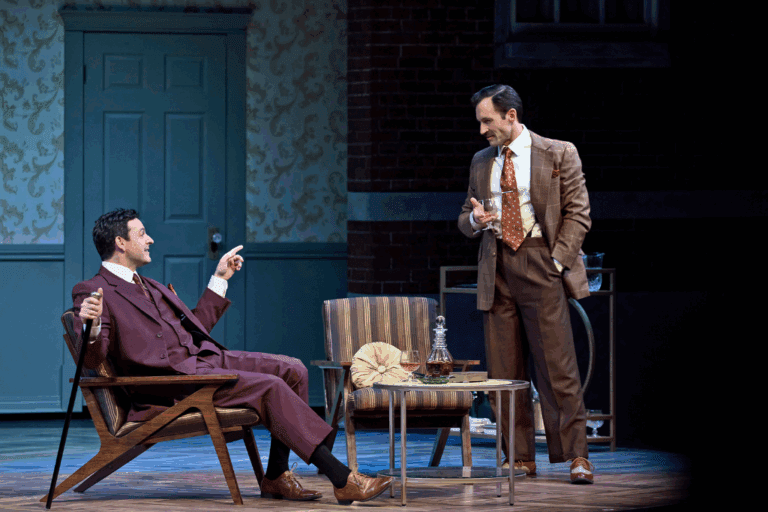 iPhoto caption: Tyrell Crews and Stafford Perry in 'Dial M For Murder.' Photo by Trudie Lee.
“There's a magic in theatre, and a spiritual part of theatre, that's really important," says Keiley. "It's the gathering, but it's also: ‘How did you make me believe that? How did you do that?’ That's the mystery I play with in all my shows. And it's a tightrope every time."
Comments