
REVIEW: The COC’s Orfeo ed Euridice plunges starkly into its mythical dilemma
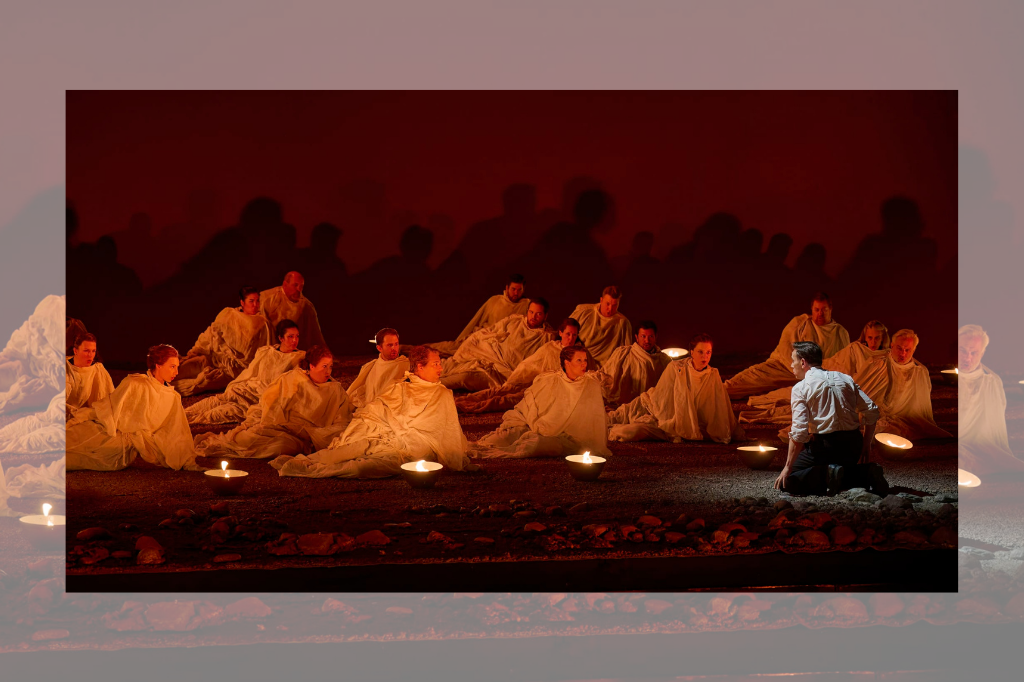 iPhoto caption: Iestyn Davies as Orfeo (right, facing away) in the Canadian Opera Company's production of Orfeo ed Euridice, 2025. Photo by Michael Cooper.
There is a scene in Céline Sciamma’s 2019 film Portrait of a Lady on Fire in which Héloïse reads the myth of Orpheus and Eurydice aloud to her lover Marianne. When it comes to Orpheus’ reason for turning around despite his promise to the Fates, a debate occurs between them.
“He’s madly in love, he can’t resist,” Héloïse says.
“Perhaps he makes a choice,” Marianne retorts: “He chooses the memory of her. He doesn’t make the lover’s choice, but the poet’s.”
That line lingered in the back of my mind as I watched the Canadian Opera Company’s (COC) revival of Gluck’s Orfeo ed Euridice, originally directed in an internationally acclaimed production by Robert Carsen in 2011 and now restaged by Christophe Gayral. This revival offers a stark take on the mythic dilemma, stripping away visual artifice to amplify the tale’s emotions.
When the curtain rises, Orfeo (Iestyn Davies) stands paralyzed before Euridice’s grave — a pit that also acts as a staircase to the underworld — with his back to the audience and, in my reading of this choice, casting us in the position of his late beloved.
Tobias Hoheisel designs the stage as a desolate hill strewn with concrete stones, behind which a single-file line of mourners in black funeral clothes ascend in silhouette against a grey backdrop. The lighting design by Carsen and Peter Van Praet reconfigures this simple staging throughout the opera’s three acts: tracking Orfeo’s journey through Hades (reddish-brown) to Elysium (purplish-grey). In addition, two consequential appearances of Amore (soprano Catherine St. Arnaud) invite a golden hue of hope as they present the possibility of resurrecting Euridice (soprano Anne-Sophie Neher) on the condition Orfeo does not turn around.
Amore, initially dressed in a suit like Orfeo and later in a dress like Euridice, acts as an androgynous voice of reason, steering the hero away from killing himself with a knife whenever he’s overcome with the isolating nature of grief. This gender-fluid depiction is well-suited to the story — which also blurs the boundaries of binaries such as life and death, heaven and hell, love and despair — but St. Arnaud’s animated, showmanlike manner, which mirrors the sanguine expressions in Gluck’s music, feels incongruous to the production’s bleak vision, shifting from the desolate tone Davies’s angelic countertenor sets up to one of assuaging levity.
In Pierre Louis Moline’s Italian-language libretto, Orfeo breaks his central promise not for the sake of poetry, but in response to Euridice’s intense insecurity. In their duet “Vieni, appaga il tuo consorte,” Neher plays Euridice as a vain, melodramatic shrew, lamenting her suffering as Orfeo refuses to meet her gaze. “I could die from anguish,” she sings, exaggeratedly averting her face, “But I’ll never say why.” I couldn’t help but laugh during this back-and-forth, out of identification: in the tussling pair I saw an everyday couple, each stubborn, unreasonable in their own way.
“This is not the time for tenderness,” Orfeo sings to her, before deciding to melt her anxieties and enter the pit to finally face her. But that pivotal encounter, which elicited audible gasps from audience members, left me oddly unperturbed, due to, I suspect, the tonal shift from dreary seriousness to romantic humor that, as with Amore’s appearances, stalls the story’s emotional momentum, contradicting the production’s sombre, striking re-inventions of the text.
The opera’s final twist further fortifies the disconnect between Gluck’s optimistic subject matter and the spectral appearance of the production informed by Carsen’s regietheatre — an approach to stage production in which a director significantly reinterprets the original material. Though I won’t spoil it here, I will note that the twist subverts narrative and thematic expectations and reveals the production’s true emphasis: its desire to underscore the fact that, despite mortal weakness, love triumphs all.
But, in 2025, I wonder whether this overplayed notion of the transformative power of love is enough to render a myth as a worthwhile meaning-making endeavour. Here, despair functions as a mere stressor on the plot, only to suddenly be undone, proving that Carsen’s vision — which alters the look of the opera without being able to effect its feel — is aligned with Gluck’s formal desire for this opera to achieve, as the program notes, “noble simplicity,” but is also, ultimately, misaligned to deliver its blithe message.
The COC’s Orfeo ed Euridice is a confident, contemporary resurrection of an ancient myth that, in the end, shifts what I thought I knew about it: that, depending on the iteration, Orpheus doesn’t always make the poet’s choice. Sometimes, he’s just a handsome lover boy.
Orfeo ed Euridice runs at the Four Seasons Centre for the Performing Arts until October 25. Tickets are available here.
Nirris Nagendrarajah wrote this review as part of Page Turn, a professional development network for emerging arts writers, funded by the Canada Council for the Arts and administered by Neworld Theatre.
Intermission reviews are independent and unrelated to Intermission’s partnered content. Learn more about Intermission’s partnership model here.

Nirris Nagendrarajah
Nirris Nagendrarajah (he/him) is a writer and culture critic from Toronto who writes about literary fiction, film, opera, theatre and himself. In addition to Metatron Press, his work has appeared in MUBI Notebook, Little White Lies, CBC Arts, Literary Review of Canada, The Film Stage, Ricepaper, Ludwigvan, In the Mood Magazine, and Cha: An Asian Literary Journal. He is currently part of Neworld Theatre's Page Turn program and received the 2026 Telefilm Canada Emerging Critic Award from the Toronto Film Critics Association.
LEARN MORE iPhoto caption: Grahpic designed by Shovemiya Packiyanathan, with photos by Michael Cooper and Emelia Hellman.
Pamela Mala Sinha passes the torch of Crash and looks toward a new era (part three)
“The play doesn’t need me,” says Pamela. “I knew it, as a playwright, but this just proves it. I felt validated in my belief that Crash has never been my play. It belongs to everyone or anyone who wants to step into The Girl."
 iPhoto caption: Griffin Hewitt in 'Cyclops.' Photo by Matthew Reid.
REVIEW: Kill Your Father and Cyclops: A Satyr Play ask audiences to revise Euripides
Rather than directly adapt their source texts or merely place them in a contemporary context, both plays sought to turn myths on their head by implicating the audience.
 iPhoto caption: Pamela Mala Sinha for Intermission Magazine. Photo and edit by Nirris Nagendrarajah.
Over the course of 90 minutes, Pamela and I spoke about her trajectory from actor to first-time playwright with Crash, the frustrations and anxieties of being a working artist, and the way her family has consistently inspired both her creative and personal lives.
 iPhoto caption: Pamela Mala Sinha, Ellora Patniak, and Zorana Sadiq record 'New.' Photo by Nirris Nagendrarajah.
A look inside the flourishing creative life of playwright-actor Pamela Mala Sinha (part one)
When I learned that the acclaimed artist would be having an action-packed start to 2026, I decided to document this busy period in a trilogy of articles.
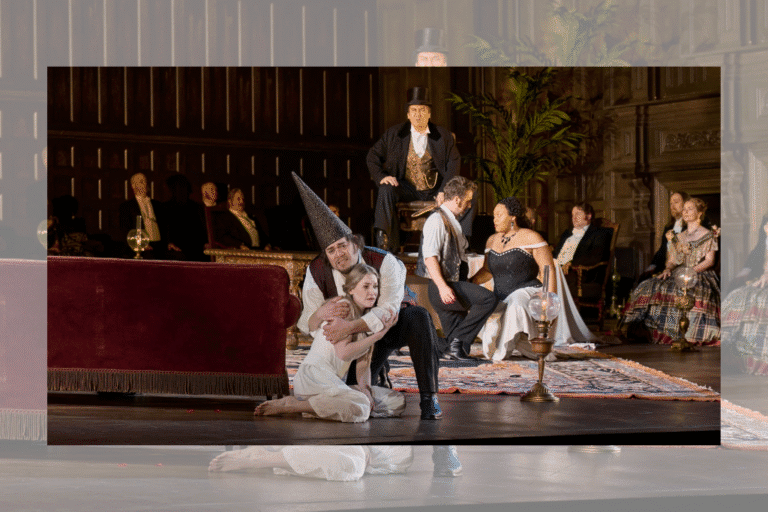 iPhoto caption: Members of the company of 'Rigoletto.' Photo by Michael Cooper.
REVIEW: COC’s elegantly bleak Rigoletto is no laughing matter
As Rigoletto wept, I became distracted by a lone petal belatedly descending from above. An accident, certainly, but one that offered a reminder of opera’s unpredictable magic: that, even among the grandest of designs, a performance’s final form depends upon these ephemeral moments one calls fate.
 iPhoto caption: Stephen Costello and Kseniia Proshina in 'Roméo et Juliette.' Photo by Michael Cooper.
REVIEW: Amy Lane’s campy Roméo et Juliette wears its heart on its sleeve at the COC
The opera is so grand, and Gounod’s music so august, that, at the start of Act Four, I was surprised to find an image as simple as the pair peacefully spooning in bed struck a sympathetic chord with me.
Comments