
REVIEW: COC’s elegantly bleak Rigoletto is no laughing matter
 iPhoto caption: Members of the company of 'Rigoletto.' Photo by Michael Cooper.
For much of the Canadian Opera Company’s revival of director Christopher Alden’s take on Verdi’s Rigoletto (which premiered in 2000 and was last performed in Toronto in 2018), a Victorian gentleman’s armchair remains on stage.
Throughout its three acts — all of which take place in set and costume designer Michael Levine’s stately, smoke-filled, meticulously sculpted gaming room — various characters seat themselves on that chair, including the titular hunchbacked jester (baritone Quinn Kelsey) and his love-struck virgin of a daughter Gilda (soprano Sarah Dufresne). In the prelude, as Rigoletto places a cone-shaped hat on his head, the opera positions itself as an ever-changing answer to who the fool really is.
Franceso Maria Piave’s Italian-language libretto, adapted from a play by Victor Hugo (and here presented with English and French surtitles), is set in motion when Count Monterone (baritone Gregory Dahl), avenging the defilement of his daughter (Emily Rocha), issues a curse on Rigoletto and his promiscuous boss the Duke of Mantua (tenor Ben Bliss). Mantua — who Bliss portrays with the perfect balance of cocky flamboyance and carnal verve — appears unaffected despite being the perpetrator, staring up at the high ceilings with fatigue. At the same time Rigoletto holds his head in melodramatic shock, more seriously registering the implications of the curse.
What complicates matters is when the fickle men of the court are inspired to seek revenge for Rigoletto’s history of mocking them. They scheme to kidnap the young woman they believe to be his mistress, who — in one of many twists of misidentification — is actually Gilda, whose existence has remained a secret from all and whose purity Rigoletto is insistent on preserving.
“It is a nightmare about an all-powerful and irresponsible ruler,” Alden writes in the director’s notes, pointing to the contemporary resonance of the 1851 opera’s themes.
Rigoletto suffers from his relation to and abuses of power, as well as his inability to reconcile his double life. “Here at home,” he sings, “I can be a different man.” At home — where Levine trades the luxurious rugs, parlour palms, and grandfather clocks of the gaming room for a dining table and portrait of Rigoletto’s late wife — restlessly lies Gilda, obeying her father’s demands while nursing the love that Mantua, impersonating a poor student, has ignited.
At the performance I attended, Dufresne took some time to warm up, at times singing so quietly as to be drowned out by Johannes Debus’ elegant command of the COC’s orchestra. Even though she found her stride in the second half, I was disappointed, at the end of Act One, after she confesses her love to Mantua, by her pitchy performance of the technically complex aria “Caro Nome.” By rushing into the high notes, she was unable to sustain them for long, and her coloratura became choppy where it needed to glide and erase the transitional seams.
At the aria’s climax, when the orchestra jarringly sped up to work around her limitations, I realized the production was also aware of her wrestling with the role’s demands. Rather than discover an inner resolve within the acrobatics of this aria — as great sopranos such as Maria Callas, Anna Moffo, and Sumi Jo have managed to achieve — Dufresne leans into the innocence factor, rendering the altruistic impulse Gilda later follows (in order to save Manuta’s life) as illogical rather than noble.
Elsewhere, as the vile Sparafucile, bass Peixin Chen brings out the darker colours of Verdi’s score. Simona Genga, as Giovanna, is a memorable supporting presence in her thoughtfully crafted asides, ratcheting up the flair of drama and flames of sensuality. But it is Kelsey, acclaimed for having played the role in various stagings around the world, who passionately imbues the fool with a palpable paranoia and crushing despair that pulls at the heart strings.
Prolonged scene transitions, in which Rigoletto, before a billowy silk curtain, pantomimes his distress as the sound of thunder attempts to obfuscate set changes, mostly make for awkward pacing and dead time. The final scene empties the room and rewarded my patience, leaving only a corpse beneath a white shroud: the stark simplicity of that image adds to the barren grandeur, which is furthered by the delightful surprise of red rose petals — previously used to evoke Mantua’s romantic life philosophy — strewn across the stage.
As at the end of Act One, Rigoletto attributes his destiny to the curse. But in my reading, the real tragedy is his inability to control himself and the others around him. “Language is my weapon,” he reflects early on, and over the opera’s two hours and 25 minutes we witness his futile struggle to grasp the words necessary to counteract the ire of his enemies.
As Rigoletto wept, I became distracted by a lone petal belatedly descending from above. An accident, certainly, but one that offered a reminder of opera’s unpredictable magic: that, even among the grandest of designs, a performance’s final form depends upon these ephemeral moments one calls fate.
Rigoletto runs at the Four Seasons Centre for the Performing Arts until February 14. More information is available here.
Nirris Nagendrarajah wrote this review as part of Page Turn, a professional development network for emerging arts writers, funded by the Canada Council for the Arts and administered by Neworld Theatre.
Intermission reviews are independent and unrelated to Intermission’s partnered content. Learn more about Intermission’s partnership model here.

Nirris Nagendrarajah
Nirris Nagendrarajah (he/him) is a writer and culture critic from Toronto who writes about literary fiction, film, opera, theatre and himself. In addition to Metatron Press, his work has appeared in MUBI Notebook, Little White Lies, CBC Arts, Literary Review of Canada, The Film Stage, Ricepaper, Ludwigvan, In the Mood Magazine, and Cha: An Asian Literary Journal. He is currently part of Neworld Theatre's Page Turn program and received the 2026 Telefilm Canada Emerging Critic Award from the Toronto Film Critics Association.
LEARN MORE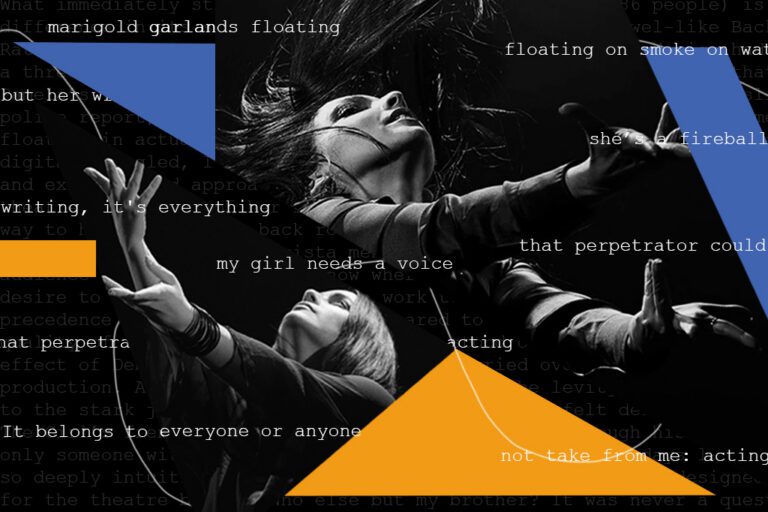 iPhoto caption: Grahpic designed by Shovemiya Packiyanathan, with photos by Michael Cooper and Emelia Hellman.
Pamela Mala Sinha passes the torch of Crash and looks toward a new era (part three)
“The play doesn’t need me,” says Pamela. “I knew it, as a playwright, but this just proves it. I felt validated in my belief that Crash has never been my play. It belongs to everyone or anyone who wants to step into The Girl."
 iPhoto caption: Griffin Hewitt in 'Cyclops.' Photo by Matthew Reid.
REVIEW: Kill Your Father and Cyclops: A Satyr Play ask audiences to revise Euripides
Rather than directly adapt their source texts or merely place them in a contemporary context, both plays sought to turn myths on their head by implicating the audience.
 iPhoto caption: Pamela Mala Sinha for Intermission Magazine. Photo and edit by Nirris Nagendrarajah.
Over the course of 90 minutes, Pamela and I spoke about her trajectory from actor to first-time playwright with Crash, the frustrations and anxieties of being a working artist, and the way her family has consistently inspired both her creative and personal lives.
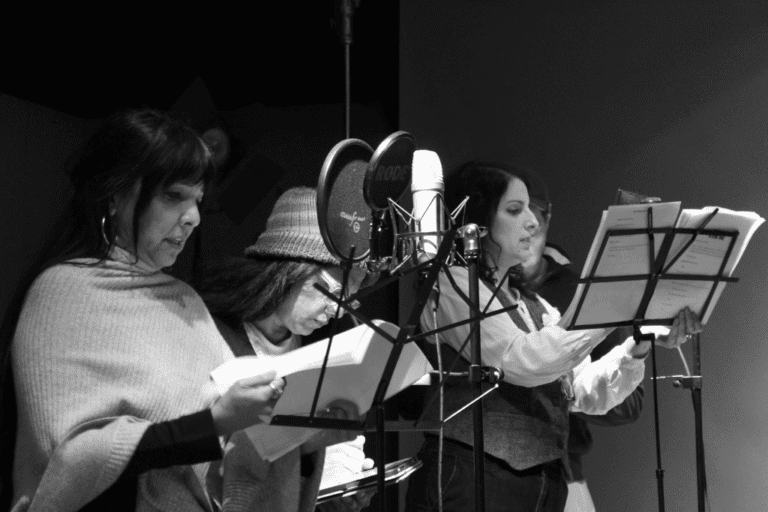 iPhoto caption: Pamela Mala Sinha, Ellora Patniak, and Zorana Sadiq record 'New.' Photo by Nirris Nagendrarajah.
A look inside the flourishing creative life of playwright-actor Pamela Mala Sinha (part one)
When I learned that the acclaimed artist would be having an action-packed start to 2026, I decided to document this busy period in a trilogy of articles.
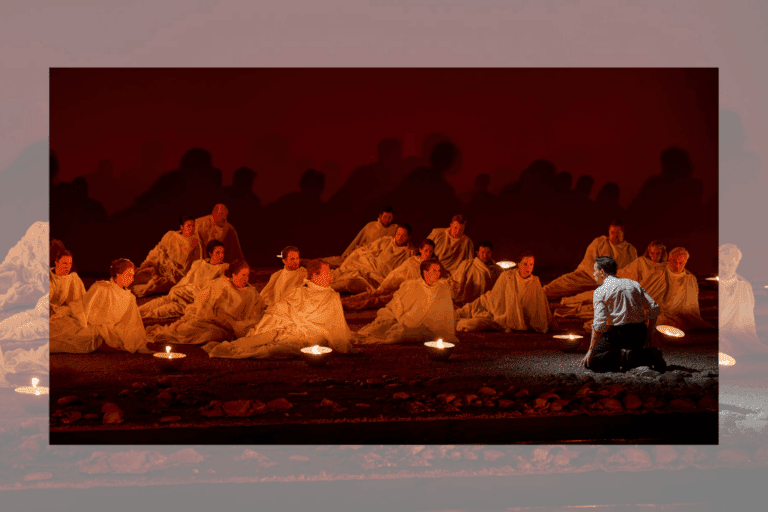 iPhoto caption: Iestyn Davies as Orfeo (right, facing away) in the Canadian Opera Company's production of Orfeo ed Euridice, 2025. Photo by Michael Cooper.
REVIEW: The COC’s Orfeo ed Euridice plunges starkly into its mythical dilemma
Though I won’t spoil it here, I will note that the twist subverts narrative and thematic expectations and reveals the production’s true emphasis: its desire to underscore the fact that, despite mortal weakness, love triumphs all.
 iPhoto caption: Stephen Costello and Kseniia Proshina in 'Roméo et Juliette.' Photo by Michael Cooper.
REVIEW: Amy Lane’s campy Roméo et Juliette wears its heart on its sleeve at the COC
The opera is so grand, and Gounod’s music so august, that, at the start of Act Four, I was surprised to find an image as simple as the pair peacefully spooning in bed struck a sympathetic chord with me.
Comments