
REVIEW: Amy Lane’s campy Roméo et Juliette wears its heart on its sleeve at the COC
 iPhoto caption: Stephen Costello and Kseniia Proshina in 'Roméo et Juliette.' Photo by Michael Cooper.
Resplendently they lived, passionately they loved, and yet tragically they must die.
The Canadian Opera Company has not mounted Gounod’s Roméo et Juliette since 1992 and the 2025/26 season’s iteration — borrowed from the Malmö Opera and directed by Amy Lane — is worth the wait. Most notably, it sets aside the expected Veronian staging and envisions its titular star-crossed lovers among the glamour and grit of 19th-century New York.
The French-language libretto by Jules Barber and Michel Carré excises characters such as the lovers’ mothers, includes an additional death, and dispenses of the play’s heightened language in favor of simple, poetic lines — whose romance is heightened by Yves Abel’s passionate conducting of the COC orchestra.
It begins with the Capulets’ masquerade ball that set and costume designer Emma Ryott’s campy imagination transforms into a carnivalesque playground called Theatre Bizarre, featuring gilded chairs, an outsized big mouth game, and the giant bust of a grinning clown.
Through a thicket of vaudevillian attendees, including dancers clad in glittery pancake tutus and untamed gossamer wigs, Roméo (tenor Stephen Costello) falls under the spell of Juliette (soprano Kseniia Proshina, returning to a role she originated in Malmö). She enchants him with “Je veux vivre,” an aria that Proshina — lilting her way to its final sustained note — executes in such a relaxed, graceful manner it warranted the first of many rounds of enthusiastic applause on opening night.
With the assistance of Mercutio (bass-baritone Gordon Binter) and Tybalt (tenor Owen McCausland), the pair soon realize they belong to opposing sides of a family rivalry, but they quickly resolve that the force of their love may possess the power to extinguish the divide.
Lane’s modernizing impulse and Ryott’s stylistic range represent the bifurcation between the houses’ heads: after the couple decides to get married — in the second of four key duets spread throughout — the set transforms into backroads of industry, complete with closed shutters and bare steel frames. Ryott trades in a sumptuous palette for gradations of brown and grey, starkly marking the descent from the opulence of the Capulets to the harsh-edged complexes where the Montagues, whom the director’s note frames as immigrants, reside.
Whether it be in the depiction of the gang brawls, which is inspired by Martin Scorsese’s Gangs of New York (as the program reveals), or in the treacly courtship that evokes the imagery of Jerome Robbins and Robert Wise’s West Side Story, Lane applies her cinematic references, in addition to theatrical traditions, such as burlesque, onto the opera’s scaffolding. This decision to suffuse the well-worn material with a variety of textures and tones breathes new life into it, but the elements never cohere, or complement each other, and are difficult to latch onto — similar though, I suppose, to the ever-changing contours of the erratic world entrapping the lovers.
That cinematic impulse is apparent in Charlie Morgan Jones’ lighting design as well, which subtly draws our attention towards a handful of moments by intensifying the brightness of a ray of light. When the pair first lay eyes on each other; when they consummate their love on their honeymoon; or when Juliette, in a wedding dress, finds herself surrounded by black-clad dancers, the ray glows, often accompanied by a musical cue, forming a series of close-ups into the characters’ emotional lives, manifesting the sparks occurring beneath the surface.
The opera — which runs at 195 minutes, over five acts and one intermission — is so grand, and Gounod’s music so august, that, at the start of Act Four, I was surprised to find an image as simple as the pair peacefully spooning in bed struck a sympathetic chord with me. Their fearless attitude toward death made me feel protective of them — those helpless dreamers.
Through the chemistry of Proshina, who stuns with her vocal athleticism in “Amour anime mon courage,” and Costello, whose warbled exaltations communicate Roméo’s feelings of injustice, I was convinced of the bond that, in aria after aria, inches its way to the inevitable conclusion, which doesn’t play itself as a straight tragedy. Instead, what Gounod and Lane grant their stubborn lovers is a concluding exchange: yet another tentative union of their pristine voices that eventually interlace, punctuated with a final kiss — an earnest note of amorousness.
“How sweet is this moment,” Juliette sings to Roméo as she bleeds to death.
Beyond the campy ball, the iconic balcony, the sword play, and the dubious potions, the COC’s Roméo et Juliette never loses sight of what makes this story endure: that moving capacity to see the beauty in the bloodshed, and to feel hope, even in the bizarrest of times.
Roméo et Juliette runs at the Four Seasons Centre for the Performing Arts until October 18. Tickets are available here.
Intermission reviews are independent and unrelated to Intermission’s partnered content. Learn more about Intermission’s partnership model here.

Nirris Nagendrarajah
Nirris Nagendrarajah (he/him) is a writer and culture critic from Toronto who writes about literary fiction, film, opera, theatre and himself. In addition to Metatron Press, his work has appeared in MUBI Notebook, Little White Lies, CBC Arts, Literary Review of Canada, The Film Stage, Ricepaper, Ludwigvan, In the Mood Magazine, and Cha: An Asian Literary Journal. He is currently part of Neworld Theatre's Page Turn program and received the 2026 Telefilm Canada Emerging Critic Award from the Toronto Film Critics Association.
LEARN MORE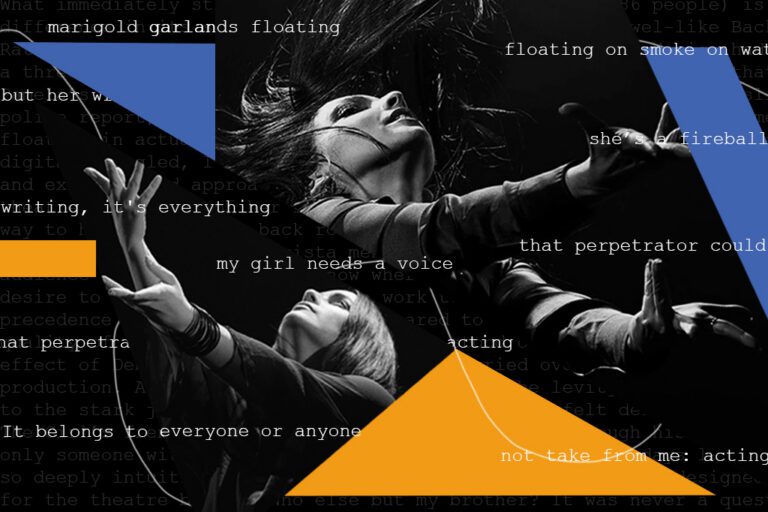 iPhoto caption: Grahpic designed by Shovemiya Packiyanathan, with photos by Michael Cooper and Emelia Hellman.
Pamela Mala Sinha passes the torch of Crash and looks toward a new era (part three)
“The play doesn’t need me,” says Pamela. “I knew it, as a playwright, but this just proves it. I felt validated in my belief that Crash has never been my play. It belongs to everyone or anyone who wants to step into The Girl."
 iPhoto caption: Griffin Hewitt in 'Cyclops.' Photo by Matthew Reid.
REVIEW: Kill Your Father and Cyclops: A Satyr Play ask audiences to revise Euripides
Rather than directly adapt their source texts or merely place them in a contemporary context, both plays sought to turn myths on their head by implicating the audience.
 iPhoto caption: Pamela Mala Sinha for Intermission Magazine. Photo and edit by Nirris Nagendrarajah.
Over the course of 90 minutes, Pamela and I spoke about her trajectory from actor to first-time playwright with Crash, the frustrations and anxieties of being a working artist, and the way her family has consistently inspired both her creative and personal lives.
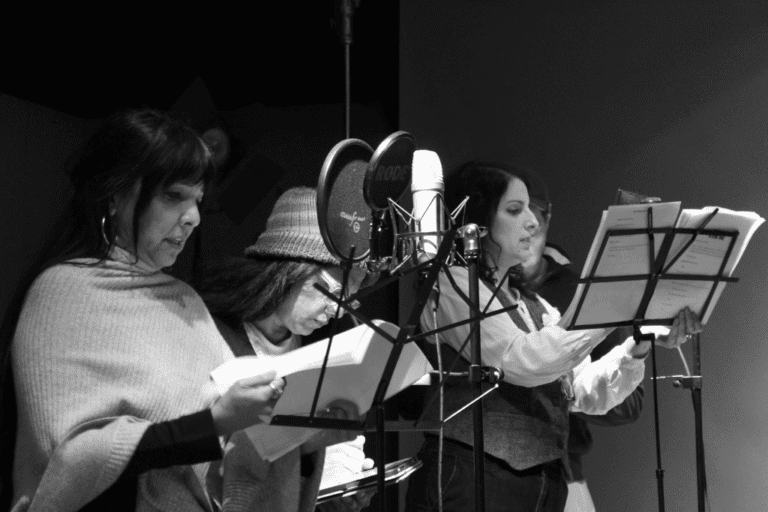 iPhoto caption: Pamela Mala Sinha, Ellora Patniak, and Zorana Sadiq record 'New.' Photo by Nirris Nagendrarajah.
A look inside the flourishing creative life of playwright-actor Pamela Mala Sinha (part one)
When I learned that the acclaimed artist would be having an action-packed start to 2026, I decided to document this busy period in a trilogy of articles.
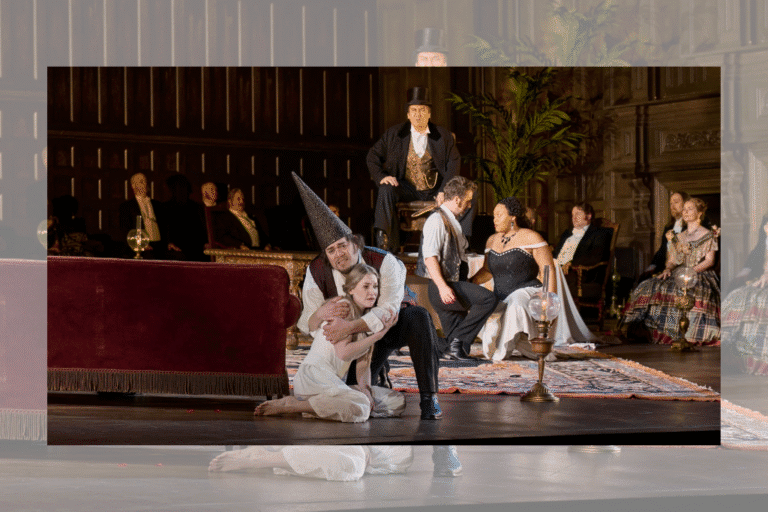 iPhoto caption: Members of the company of 'Rigoletto.' Photo by Michael Cooper.
REVIEW: COC’s elegantly bleak Rigoletto is no laughing matter
As Rigoletto wept, I became distracted by a lone petal belatedly descending from above. An accident, certainly, but one that offered a reminder of opera’s unpredictable magic: that, even among the grandest of designs, a performance’s final form depends upon these ephemeral moments one calls fate.
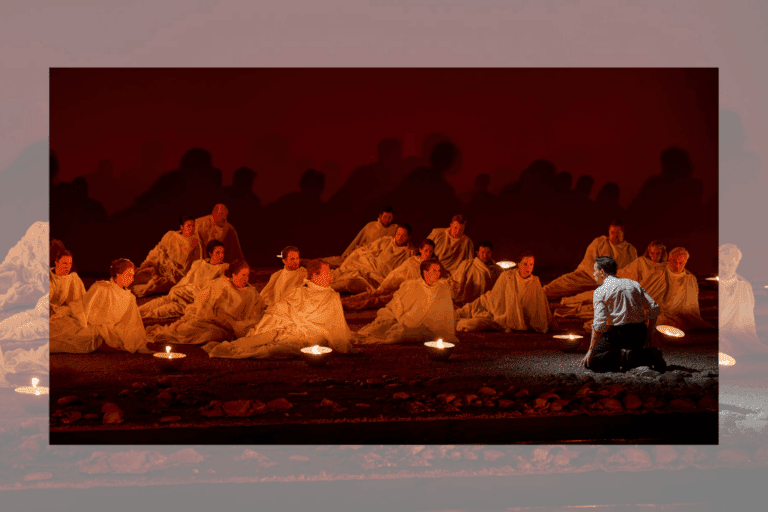 iPhoto caption: Iestyn Davies as Orfeo (right, facing away) in the Canadian Opera Company's production of Orfeo ed Euridice, 2025. Photo by Michael Cooper.
REVIEW: The COC’s Orfeo ed Euridice plunges starkly into its mythical dilemma
Though I won’t spoil it here, I will note that the twist subverts narrative and thematic expectations and reveals the production’s true emphasis: its desire to underscore the fact that, despite mortal weakness, love triumphs all.
Comments