
REVIEW: Tarragon’s Bremen Town gives the golden years a Grimm twist
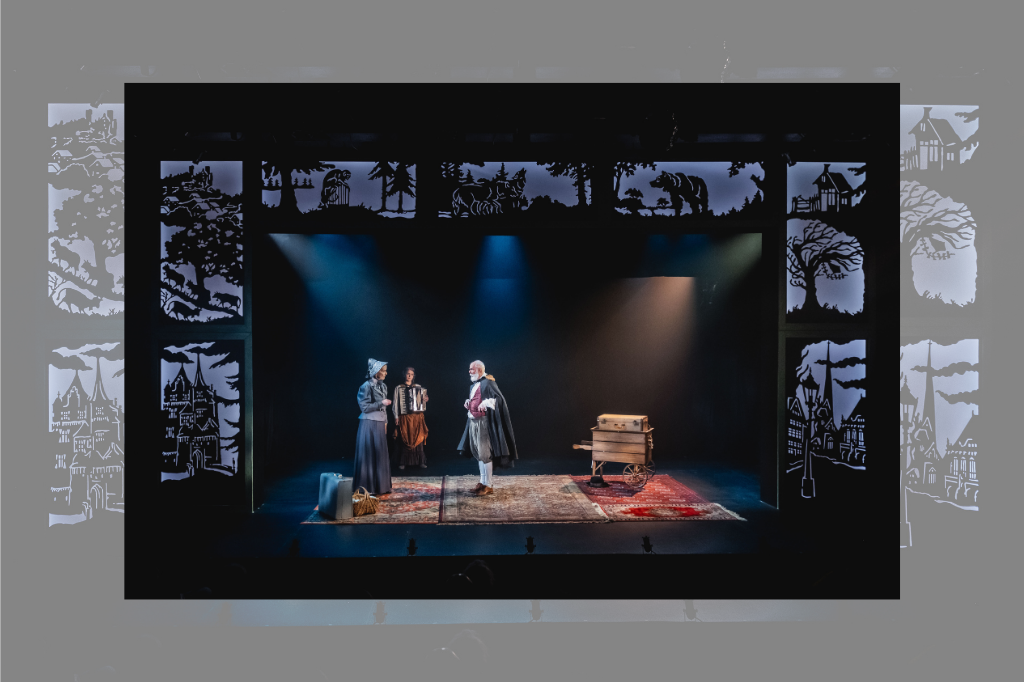 iPhoto caption: Nancy Palk, Tatjana Cornij, and Oliver Dennis in Bremen Town. Photo by Jae Yang.
Fairy tales pass down lessons that keep us connected and safe; we learn to not cry wolf and to never judge a book by its cover. Adapted from a classic Grimm Brothers tale, writer and director Gregory Prest’s Bremen Town has a takeaway that sticks: call your grandparents.
The show is a hilarious yet melancholic exploration of aging, self-determination, and connection to stories of our past, underscored by the accordion stylings of Vogel (Tatjana Cornij), the narrator. Her presence is a framing device that invites audiences into the world of the folktale by blending action and traditional storytelling.
When Frau Esel (Nancy Palk) is unceremoniously fired from her 45-year tenure as a housekeeper, she immediately decides to go live with her son in Bremen. In Hanover she meets Herr Hund (Oliver Dennis), a street magician in debt to most of the city, who tells her there are no trains running that day. Undeterred, Frau Esel hires him to guide her to Bremen on foot. Invigorated by the opportunity to feel needed — and to keep his kneecaps — he sets off with the Frau.
Their contrasting personalities and values become a recurring friction as they acquire new travel companions. Herr Katze (William Webster), searching for his childhood village, joins them after realizing it no longer exists.
They meet Frau Henne (Sheila McCarthy) tied to a stump in the woods, and her induction into the group is unsettling, to say the least. Her abusive children have decided that she is beyond useless, and plan to unburden themselves by selling her in town to the highest bidder.
Prest’s adaptation doesn’t shy away from the darker aspects of Grimm’s fairy tales nor of life, and instead explores life’s absurd humour with a sprinkling of schadenfreude. The show inspires guilt-tinged laughter as the characters cheerfully discuss the merits of turning their late mothers into candles. How else will the elderly contribute to society!?
Bremen Town nails the balancing act of levity and sincerity while dealing with significant real-world issues. We laugh at the societal structures and beliefs that alienate the older characters, never at their age, or abilities themselves.
Through wrong turns in the woods, the looming threat of bandits, and a surprisingly touching monkey funeral, the group takes comfort in each other; they reminisce and build hopes for their futures. Even stick-in-the-mud Frau Esel softens when she realizes that despite her sharp tongue, the rest of the group truly cares for her. Herr Hund encourages Esel to fly kites with them at a nearby festival, to take something weighing her down and send it up into the sky. Though Esel declines and continues to Bremen, she must decide whether she is ready to let herself fly off with the kite.
While the group’s pace through the woods is slow, the production is anything but. Under Prest’s direction the cast perfectly times the slapstick humour, energizes each line of dialogue, and ensemble members (Veronica Hortigüela, Dan Mousseau, and Farhang Ghajar) dynamically embody dozens of characters back-to-back. Coupled with the main cast’s attention to emotional precision and genuine connection, the show sustains this energy even through solemn moments.
Moreover, Bremen Town transforms the relatively intimate proscenium of Tarragon Theatre’s Mainspace into an expansive swath of countryside. Prest illustrates speed and distance by having faster characters pace quickly in place, engaging their whole body in the motion, while those slower move backwards, disappearing in the horizon. For a show that involves a lot of walking, this keeps the action visually engaging.
Set designer Nancy Perrin extends the playing space upward through cleverly designed kites attached at two points: a string leading towards the character flying the kite, and a long vertical pole the three ensemble members pilot. The subtle motion of the swaying kites evokes real wind as they soar high above the actors.
Perrin’s thoughtful set designs also reinforce Vogel’s character as a framing device; she both tells the story and watches it unfold from the sides of the stage. Vignettes of shadow cuttings that illustrate the play’s events line the outside of the proscenium, reminiscent of vintage storybook illustrations. Perrin also lines the playing space with various ornate rugs that make the space feel homey, as if Vogel is regaling us from her own living room.
The only query I was left with is about the underexplored relationship between Vogel and Frau Esel: in certain moments they can interact with each other, unlike the other characters. I wanted to see this take more shape over time, and perhaps speak to Esel’s agency as the star of her own story.
Bremen Town explores the difficulties of growing old and feeling left behind. It asserts that our elders continue to contribute to society through the stories and relationships they pass down. I left the theatre feeling lucky for time spent with my grandmothers, and a pre-emptive grief for my parents’ aging. Yet, I also felt a profound sense of hope — for the privilege of getting to age amongst loved ones.
Bremen Town runs at Tarragon Theatre until October 26. More information is available here.
Intermission reviews are independent and unrelated to Intermission’s partnered content. Learn more about Intermission’s partnership model here.

Columbia Roy
Columbia Roy is an interdisciplinary theatre artist and arts worker raised in Taiwan, now discovering life in Toronto. She’s passionate about arts philosophy, examining culture, and public transit. Columbia is drawn to work that confronts humanity with itself, warts and all, while still embracing the silliness of living. You can always find her knitting, talking to strangers, or waiting for the TTC.
LEARN MOREComments
Leave a Comment
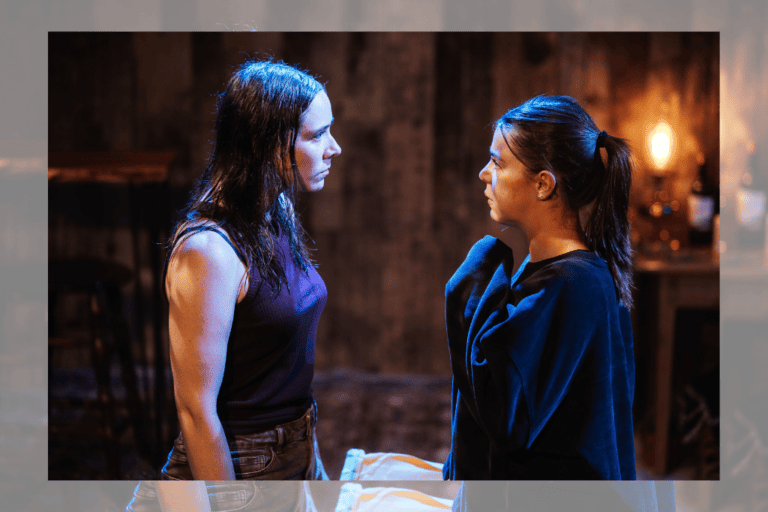 iPhoto caption: Members of the company of 'Walden.' Photo by Sandro Pehar.
Steeped in emotional and scenic intimacy, Icarus Theatre’s production probes the relationships we cultivate to duty, community, and progress in the face of climate crisis.
 iPhoto caption: Juliette Schroeder and the cast of 'The Drowsy Chaperone.' Photo by Taylor Long.
REVIEW: Shifting Ground Collective’s The Drowsy Chaperone is anything but a snore
Infused with infectious energy, the production is a harmony of well-crafted design elements and vivacious performances.
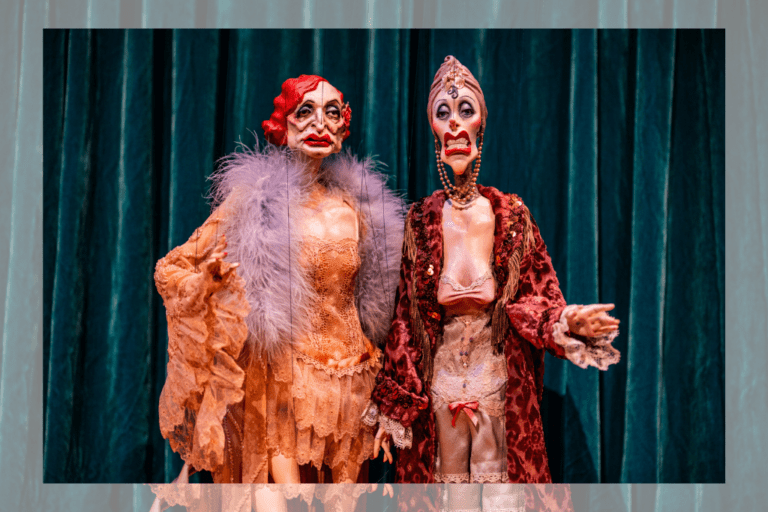 iPhoto caption: Marionette design by Ronnie Burkett. Photo by Dahlia Katz.
REVIEW: Ronnie Burkett’s Little Willy is a love letter to theatre
Ronnie Burkett and William Shakespeare agree on at least one fundamental truth: there’s no such thing as a bad dick joke.
 iPhoto caption: Members of the company of 'Pu Songling: Strange Tales.' Photo by Johnny Hockin.
REVIEW: Wet, weird, and woeful, Pu Songling: Strange Tales is a riotous trip into the mystical
One thing’s for sure — you’ve never seen a show with this much tongue.
 iPhoto caption: Photo by Bruce Zinger.
REVIEW: Outside the March’s Rainbow on Mars explores the future of embedded accessibility practices
Rainbow on Mars is a multisensory experience that goes beyond visual spectacle to create an all-encompassing narrative world from the moment your ticket is scanned.
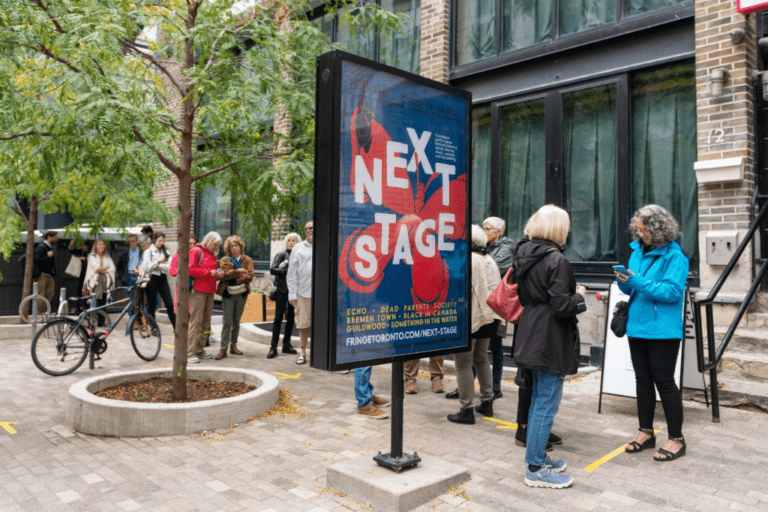 iPhoto caption: Photo by Colleen Yates.
Beyond the Fringes: Next Stage guides artists into creative control
As artists experimented with form and design, the festival compelled audiences to reconsider the boundaries of traditional performance.
About to go see the play. We enjoyed reading what seems a thorough and perceptive review.