
REVIEW: Icarus Theatre balances philosophical musings with richly shaded relationships in Walden at The Theatre Centre
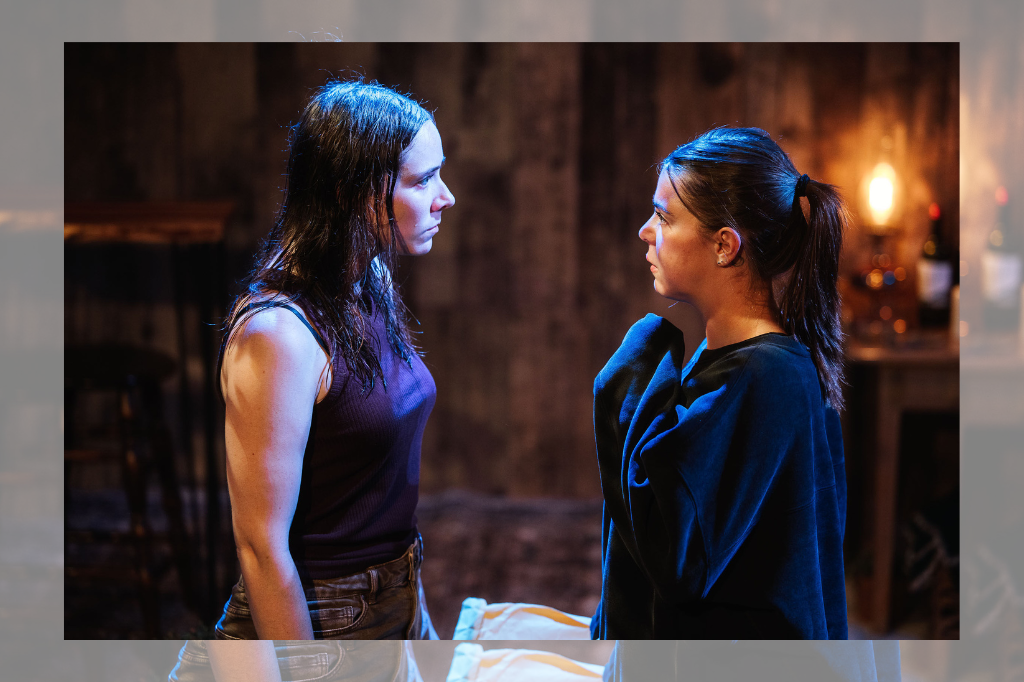 iPhoto caption: Members of the company of 'Walden.' Photo by Sandro Pehar.
The first thing that hits me is the smell.
Mulchy and woody, the air invites a deep inhale as I try to determine its source. Pine… or maybe cedar… I’m left feeling like I should be spending more time outdoors.
With only a few rows of seating inside The Theatre Centre’s intimate BMO Incubator, anywhere is a good vantage to admire director-designer Erik Richards’ detailed construction of a wooden cottage and its surrounding garden. Props designer Emily Anne Corcoran’s meticulously furnished, naturalistic set is a well-fitted container for the Canadian premiere of Amy Berryman’s Walden; steeped in emotional and scenic intimacy, Icarus Theatre’s production probes the relationships we cultivate to duty, community, and progress in the face of climate crisis.
It’s the year 20-something-something and estranged twin sisters Stella (Emily Anne Corcoran) and Cassie (Charlotte Dennis) reunite following Cassie’s year-long mission developing a lunar habitat. The temperatures, pollution, and natural disasters on Earth are crossing the rubicon toward total planetary extinction. Anything less than drastic collective action will mean humanity’s end. While Cassie looks to build sustainable colonies on other planets, Stella has set up refuge on Earth with her new fiancé Bryan (Oshen Aoun) at his homestead in an environmentalist enclave.
Walden ponders our obligations at a personal, societal, and existential level — what do you prioritize when those obligations are at odds?
The top of the show burns slowly with little context in an almost cookie-cutter sequence of a new partner preparing to meet family — conventional save for the mentions of bartering for a bottle of wine and a tsunami killing thousands on the East Coast. Despite its gradual start, however, I appreciate that the narrative resists the urge to spoon-feed audiences, and instead allows the characters to lead our understanding of the world. The trio of Corcoran, Dennis, and Aoun prove to be natural leaders; their clear portrayals of complex characters magnetized me to the story.
Bryan tries to lighten Stella’s mood, and in return she asks that he not mention he’s an “EA” in front of her sister. Though I was momentarily willing to accept a world that disapproves of educational assistants, they later reveal that it stands for “Earth Advocate,” a political alignment focused on funding on-planet solutions and reducing consumption. Bryan’s Earth-based beliefs directly clash with Cassie’s space-race style solutions, forcing Stella to contend between the ideals she was raised with and a future she’s only just begun to dream.
Although the play may not be exploring anything exceedingly new, it remains compelling because of well-developed philosophical analysis it delivers through dynamic characters in a timely discussion of humanity’s future.
Like Thoreau’s classic, Walden’s central question is how to lead a good life — one that balances enjoyment and moral duty — and adds on the tragedy of seeing someone else live how you’d want.
The twins envy each other’s situations deeply. Stella has wanted to be an astronaut since she was a kid, training hard only for her less devoted, albeit equally brilliant, sister to make the cut. And while Cassie presents herself as very strong, she’s rueful of the life and relationships she’s sacrificed to NASA. Corcoran and Dennis evoke such empathy that I was begging for a Parent Trap-inspired switcheroo just to see them happy.
It’s Corcoran’s, Dennis’, and Aoun’s performances that elevate Walden beyond the text’s confines. Bounding with chemistry, the trio skilfully handles 90 minutes of verbal sparring with very little downtime, and consistently embodies the nuanced realities of each character even when it’d be easier to ham it up.
Aoun and Dennis have a particularly strong scene emblematic of both the actors’ prowess and Richards’ take on the play’s themes, in which, around a midnight firepit, Cassie’s conventional (read: colonial) idealization of technology conflicts with Bryan’s reconnection to Earth. The actors distinctly convey their easy rapport through comedic timing and thoughtful tones that illustrate a desire to understand rather than battle.
The show inherently favours an Earth-centred narrative, which Richards and Corcoran further highlight through design choices that include the organic world (like real mulch and flowerbeds), but the intention is that both viewpoints are plausibly supportable.
One could argue the piece is steeped in climate doomerism, but I would venture it’s actually rooted in climate optimism. The characters (and the fictional world at large) disagree over approaches but not over the existence of a problem. They acknowledge the personal sacrifices they must make to make things better. As a production, Walden’s naturalistic design and standout performances animate the show’s earnestly introspective dissection of our relationships to personal activism.
Walden runs at The Theatre Centre until September 26. More information is available here.
Intermission reviews are independent and unrelated to Intermission’s partnered content. Learn more about Intermission’s partnership model here.
Columbia Roy
Columbia Roy is an interdisciplinary theatre artist and arts worker raised in Taiwan, now discovering life in Toronto. She’s passionate about arts philosophy, examining culture, and public transit. Columbia is drawn to work that confronts humanity with itself, warts and all, while still embracing the silliness of living. You can always find her knitting, talking to strangers, or waiting for the TTC.
LEARN MORE iPhoto caption: Juliette Schroeder and the cast of 'The Drowsy Chaperone.' Photo by Taylor Long.
REVIEW: Shifting Ground Collective’s The Drowsy Chaperone is anything but a snore
Infused with infectious energy, the production is a harmony of well-crafted design elements and vivacious performances.
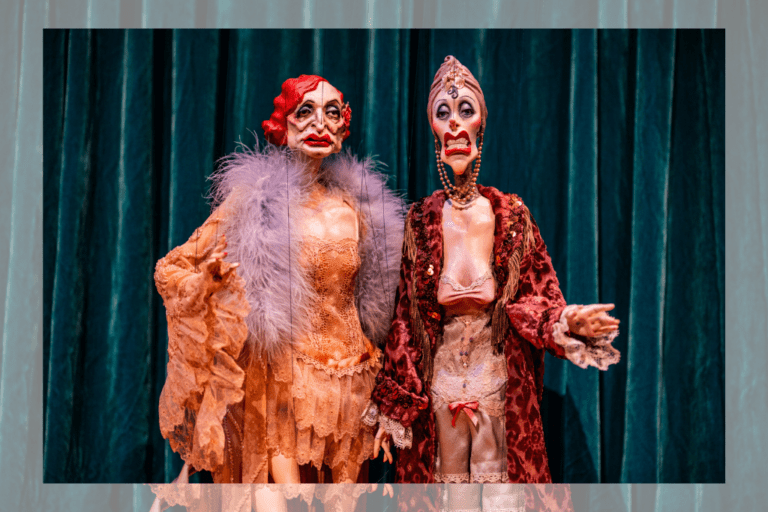 iPhoto caption: Marionette design by Ronnie Burkett. Photo by Dahlia Katz.
REVIEW: Ronnie Burkett’s Little Willy is a love letter to theatre
Ronnie Burkett and William Shakespeare agree on at least one fundamental truth: there’s no such thing as a bad dick joke.
 iPhoto caption: Members of the company of 'Pu Songling: Strange Tales.' Photo by Johnny Hockin.
REVIEW: Wet, weird, and woeful, Pu Songling: Strange Tales is a riotous trip into the mystical
One thing’s for sure — you’ve never seen a show with this much tongue.
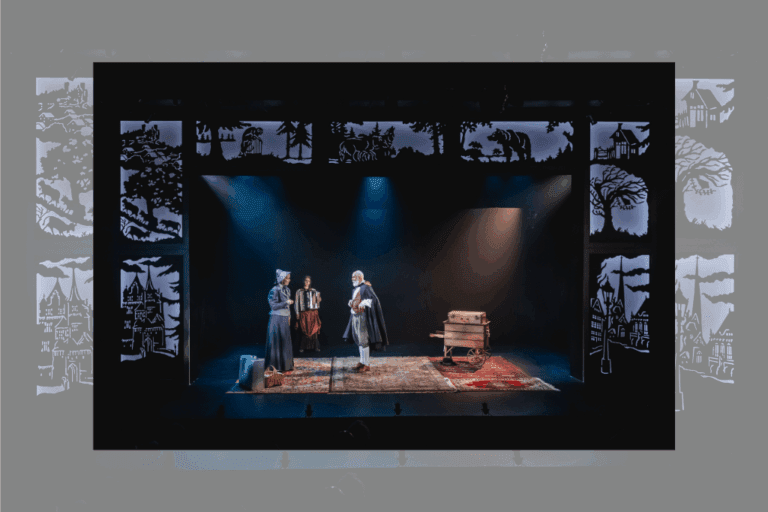 iPhoto caption: Nancy Palk, Tatjana Cornij, and Oliver Dennis in Bremen Town. Photo by Jae Yang.
REVIEW: Tarragon’s Bremen Town gives the golden years a Grimm twist
Prest’s adaptation doesn’t shy away from the darker aspects of Grimm’s fairy tales nor of life, and instead explores life's absurd humour with a sprinkling of schadenfreude. The show inspires guilt-tinged laughter as the characters cheerfully discuss the merits of turning their late mothers into candles.
 iPhoto caption: Photo by Bruce Zinger.
REVIEW: Outside the March’s Rainbow on Mars explores the future of embedded accessibility practices
Rainbow on Mars is a multisensory experience that goes beyond visual spectacle to create an all-encompassing narrative world from the moment your ticket is scanned.
 iPhoto caption: Photo by Colleen Yates.
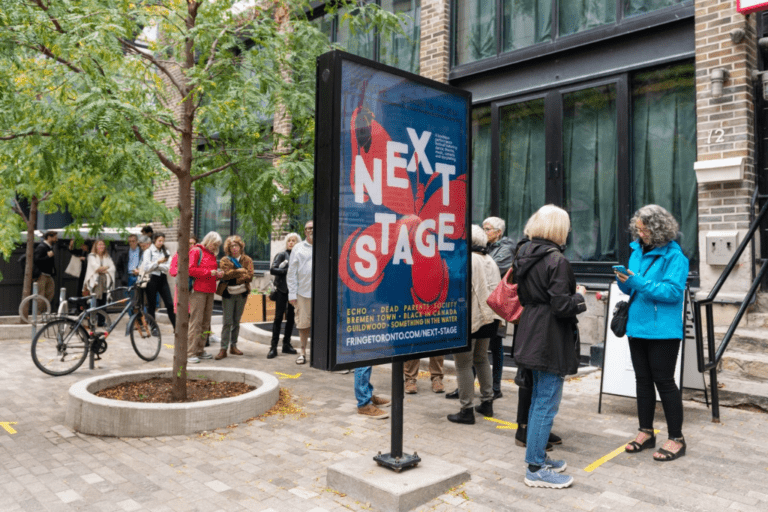
Beyond the Fringes: Next Stage guides artists into creative control
As artists experimented with form and design, the festival compelled audiences to reconsider the boundaries of traditional performance.
Comments