
Hofesh Shechter Company’s Theatre of Dreams uses contemporary dance to plunge its audience into a shared dream state
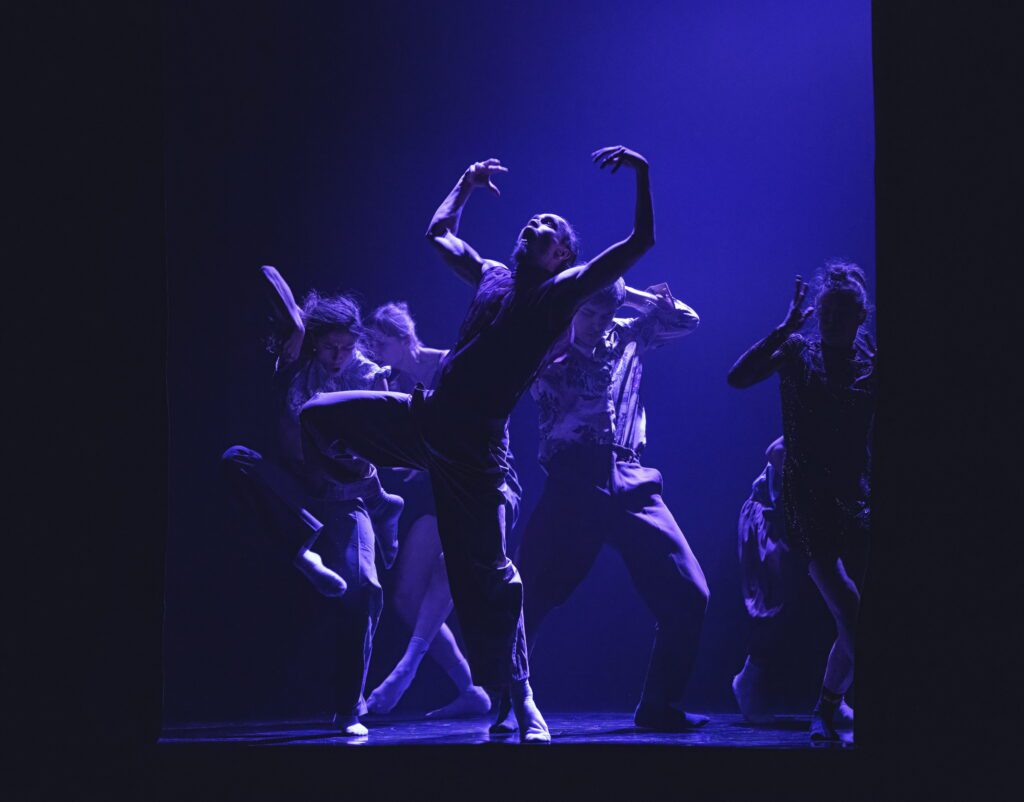
 iPhoto caption: Members of the company of 'Theatre of Dreams.' Photo by Tom Visser.
Hofesh Schechter tends to make dances that are laced with a raw, animalistic sensibility — but if there’s a more precise quality that unites his works it’s that they’re remarkably protean. For more than two decades, the Israel-born, England-based choreographer has been consistently shaking up the contemporary dance world. A former member of Batsheva Dance Company, Schechter founded his own U.K.-based troupe in 2008 and has become one of contemporary dance’s great atmosphere-makers.
Though usually non-narrative in style, Schechter’s casts often portray a tribe of losers — or ecstatic survivors if your glass is half full. Political Mother (2010) sets Old World travellers in a menacing rock opera, Grand Finale (2017) imagines a Titanic-era troupe in an oddly comic world headed for collapse, and barbarians (2015) takes a huge tonal swing with droll 18th-century Baroque music and dancers clad in skintight gold catsuits.
As observed by the Guardian, followers of Hofesh Shechter Company have begun to hang around post-show for a glimpse of the versatile dancemaker. And that was especially true after Shecter’s latest unique venture — the debut of Theatre of Dreams in Paris in 2024, which dance heads consider to be one his greatest works. Now, Theatre of Dreams is coming to the Bluma Appel Theatre for a three-night run presented by Luminato Festival and TO Live. With its air of otherworldly mystery and many nods to social dance, the show falls in line with “PLAY,” Luminato’s theme this year.

Over a video call, I spoke to Hofesh Shechter Company associate artistic director Bruno Guillore, asking him what viewers can expect, as well as if there are specific messages the audience should look out for, or if there’s a logic that informs the movement. But for a show about dreams, these turned out to be the wrong questions.
Dreams don’t have a universal, cut-and-dry explanation; they’re the abstract residue of memory. Freud called them the “royal road to a knowledge of unconscious activities.” In Theatre of Dreams, the royal road is the dance floor and there’s plenty of room for personal analysis. “Working with dreams as a theme gave us endless freedom. We guide the audience to a certain degree — it’s not just random movement — but we leave a lot of space for the audience to bring their culture, experience, and subconscious to fill in the meaning,” said Guillore.
Shechter and Guillore treat the specific theatre spaces Theatre of Dreams is performed in less as a static stage and more as a shared sleeping mind, dividing or opening the playing space with a series of textured and colourful curtains (designed by set collaborator Niall Black) that mimic the psyche. “In different parts of our brains we have compartments where we think, or put things in a corner, or even sow a private garden,” said Guillore. “The curtains allow the group of 12 dancers to appear and disappear, or embody different emotions based on the space.”
But the idea of dreaming isn’t only explored nocturnally. “A whole other part of the show is exploring the aspirational side of daydreaming — who we want to be and what we want to achieve. And that can be beautiful and light or dark and mysterious,” said Guillore.
It’s tough to tie Shechter’s style to any one dance lineage, but modern floorwork; commonplace gestures rendered sharp and frenzied; and loose, hip-circling movements often reserved for low-lit clubs — all seen in the show’s trailer — evoke the woozy surreality of half-revealed consciousness. Interwoven moments of improvisation also means that the show has a degree of unpredictability that feeds off the energy of the audience and the day.
Guillore said Theatre of Dreams owes more to cinema than any dance tradition. Stanley Kubrick came up as a master of atmosphere who also worked across genres, but the cues Theatre of Dreams takes from cinema are more about how cameras work with lighting to frame simple movements and gestures as rich with suggestion.
The show’s music has been its own journey. When Schechter — also a composer on top of it all — was first designing the music and the choreography, he lost all of his footage and early material when his laptop was stolen. Though an inconvenience, it forced him to realize he didn’t love what he’d made and gave him permission to restart the work.
In the final edition, dancers share the stage with three musicians who cycle through duduks, percussion instruments, vocals, guitar, and keys. “The presence of the musicians who created the music with Hofesh add another layer of storytelling to the show,” says Guillore. The score, which pivots from jazz to bossa nova to electronica and beyond, gives the ensemble numbers and solos distinct identities.
Near the end of our call, Guillore suggests that a big question for Theatre of Dreams might be how much an audience can become the protagonist themselves — how much the company can dissolve the line between stage and seat to create a layered experience where everyone in the theatre feels like they’re watching and acting within a dream.
I ask him how literal the incorporation of the audience gets. He pauses, smirking, with what looks, over the pixellated international connection, to be a twinkle in his eye. “I can’t give away all of the secrets. Some will find it funny; others will find it touching,” he says. “But instead of leaving them with a question, I hope the audience will leave feeling like we’ve taken them on a roller coaster.”
Theatre of Dreams runs at the Bluma Appel Theatre from June 4 to 6. More information is available here.
TO Live is an Intermission partner. Learn more about Intermission’s partnership model here.

Lindsey King
Lindsey King is a Toronto-based freelance writer and editor with bylines in Toronto Life, Maclean's, Canadian Business, Intermission, and The Creative Independent.
LEARN MORE iPhoto caption: Members of the company of 'Play Dead.' Photo by Alexander Galliez.
Play Dead trades death-defying circus tricks for bigger emotional risks
“The idea of consequences in [Play Dead] can make someone think the show is a little dreary, but we think of it more as a surreal celebration of all the little things that make up life,” says performer and People Watching co-artistic director Jérémi Lévesque.
 iPhoto caption: Melissa James and Patrick Heusinger in 'Paranormal Activity.' Photo by Johan Persson.
REVIEW: Mirvish’s Paranormal Activity summons real screams — but crashes into a cheap shock ending
It’s a spooky, cleverly staged hoot, but audiences might be distracted by one glaring narrative spectre that could use an exorcism.
 iPhoto caption: Amy Keating, Zorana Sadiq, Katherine Cullen, and Jean Yoon in 'Dance Nation.' Photo by Elana Emer.
REVIEW: Coal Mine Theatre’s Dance Nation vaults into the feral, ecstatic mess of girlhood
Played by a cast whose ages range widely, the characters exist in two tenses at once: present-day adolescence and retrospective memory, living these tender years shadowed by the adults they’ll become.
 iPhoto caption: Members of the company of 'Shucked.' Photo by Matthew Murphy and Evan Zimmerman.
REVIEW: Mirvish’s Shucked plants row after row of corny jokes
Shucked sits somewhere between a cartoon for adults and a wholesome farm musical.
 iPhoto caption: Siphesihle November in 'Flight Pattern.' Photo by Karolina Kuras.
Serge Lifar’s Suite en Blanc came out of the Second World War; Crystal Pite’s Flight Pattern emerges from the world of wars we live in today. The double bill might be asking: What role, if any, should dance play in times of crisis?
 iPhoto caption: Deborah Hay and Terra C. MacLeod in 'Piaf/Dietrich.' Photo by Dahlia Katz.
The Grand Theatre’s music-infused Piaf/Dietrich considers fame, friendship, and desire
“The extremes of both characters gives us a lot to consider and experience for how to live," says director Rachel Peake. "Should we lead with passion or precision? It’s sort of a no-brainer that happiness lies somewhere in the middle."
Comments