
REVIEW: Coal Mine Theatre’s Dance Nation vaults into the feral, ecstatic mess of girlhood
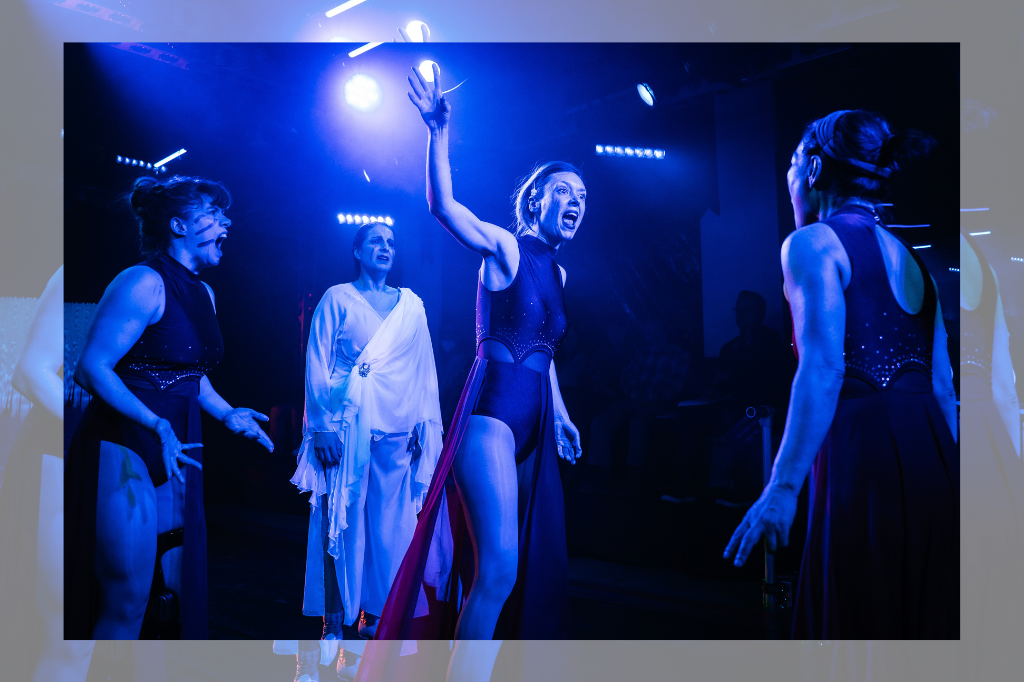 iPhoto caption: Amy Keating, Zorana Sadiq, Katherine Cullen, and Jean Yoon in 'Dance Nation.' Photo by Elana Emer.
I was once a preteen horse girl, but my stable was less prim pony club, more lawless female fiefdom — and adult knowledge was our capital. Swap the riding arena for a competitive dance stage to get a world not far from the one in playwright Clare Barron’s Pulitzer-nominated Dance Nation, running at Coal Mine Theatre in partnership with Outside the March and Rock Bottom Movement.
Directed by Diana Bentley with movement by Alyssa Martin — a partnership that won four Dora Awards in the independent theatre division with Coal Mine’s People, Places and Things last year — Dance Nation is an ensemble piece about the humiliations and ecstasies of seven preteen girls stumbling into sexual self-consciousness. Alongside a sole boy and their evil coach, they vie for the chance to dance the principal role at an upcoming national competition. Played by a cast whose ages range widely, the characters exist in two tenses at once: present-day adolescence and retrospective memory, living these tender years shadowed by the adults they’ll become.
The story sprawls across two stages, with set design by Nick Blais. Act One happens upstairs in Coal Mine’s workshop space, the Vault, while Act Two unfolds in its usual basement theatre. We start seated on either side of a wide runway-style stage where an Anything Goes-esque routine introduces Maeve (Katherine Cullen), Ashlee (Amy Keating), Amina (Beck Lloyd), Zuzu (Annie Luján), Connie (Zorana Sadiq), Vanessa (Amy Matysio), and Sofia (Jean Yoon) as sequined sailors and Luke (Oliver Dennis) as a glittery lobster, outfitted by costume designer Kathleen Black. At the end of their goofy number, Vanessa injures her knee and bleeds on stage to the sympathy of no one.
With a big regional competition coming, they spend ample time practicing. Barron and Martin’s shared interest in the uncanny body and Dionysian excess makes them a natural match. The show is loaded with purposefully bad preteen choreography that leads to slapstick comedy. But about 30 minutes in, the clumsy dance gag starts to tire and it slows the show’s emotional density.
Around rehearsals they speak daringly about their bodies with manic vulgarity. They share techniques for masturbation with Amina, the best dancer, whose success only brings her loneliness. Sofia, who has yet to menstruate, discusses the merits of circumcision. Ashlee, the confident firecracker, questions the powers in having “a frickin’ gorgeous ass.” And in a chilling confession, Connie asks if it’s okay that a man pressed his belly against her back — which the group dismisses. Like daughters trying on their mothers’ high heels, they experiment with the scripts of womanhood, but they’re ill-fitting.
There are no small roles in Barron’s play, but Zuzu and Amina are the engine of the story. Zuzu’s got a dance mom with cancer, she’s caught Luke’s eye, and she can’t stand falling behind Amina. Luján’s gift for both crude and fine-drawn comedy suits Zuzu’s sweet-natured clumsiness. Her delicate physicality — the acutely 13-year-old way of flicking her hair — draws just as many laughs from the audience as her bizarre screams. But when it comes to naturalistic drama, Luján’s performance falls flat: it’s hard to believe her drive to dance.
If a line in this production’s Dance Nation has the option to be screamed, it’s taken. I have a high tolerance for shrill works, but the first act rarely strays from a frenzied energy and I found myself craving more tonal variation. Dramatic credibility might be beside the point of Dance Nation though, and Barron’s ideas are brave, hilarious, and worth considering.
When the show moves downstairs after intermission, it feels like a descent into a dimly lit, otherworldly psyche, and the story turns more tender. We’re reseated around a low, round stage dressed in a red shag carpet beneath a canopy of crimson foliage. In between the competition plot, we encounter the play’s most arresting questions.
During a beautiful scene with Maeve, who’s initially a quiet character, she admits she wants to be in the sky, to do something more “cosmic” than dance. Cullen brings exquisite seriousness to the character’s longing for something bigger than applause and the approval of others.
The most wild moment, toward the end, sees the entire cast in an inward-facing circle chanting that their pussies are perfect. The audience grinned; I cackled. Why did we all love this strange self-consecration? Perhaps because it imagines, briefly, a girlhood released from scrutiny. They love themselves for themselves, loudly, against all ideas of politeness.
But the final message comes from Amina. Dressed in all black, to Robyn’s “With Every Heartbeat,” she whirls, tossing her limbs as if waving off cobwebs, and delivers a monologue that ends as she repeats, “I rode the wave like I always knew how to ride the wave. But I kept riding the wave, ‘til I was alone.” Lloyd’s words, energetic yet mournful, land as a victory and curse. Barron’s last question might be: What gets stranded in the bargain for female excellence?
And why, in this age of apparently enlightened feminism, is it still so isolating to just survive?
Dance Nation runs at Coal Mine Theatre until May 10. More information is available here.
Intermission reviews are independent and unrelated to Intermission’s partnered content. Learn more about Intermission’s partnership model here.

Lindsey King
Lindsey King is a Toronto-based freelance writer and editor with bylines in Toronto Life, Maclean's, Canadian Business, Intermission, and The Creative Independent.
LEARN MORE iPhoto caption: Members of the company of 'Play Dead.' Photo by Alexander Galliez.
Play Dead trades death-defying circus tricks for bigger emotional risks
“The idea of consequences in [Play Dead] can make someone think the show is a little dreary, but we think of it more as a surreal celebration of all the little things that make up life,” says performer and People Watching co-artistic director Jérémi Lévesque.
 iPhoto caption: Melissa James and Patrick Heusinger in 'Paranormal Activity.' Photo by Johan Persson.
REVIEW: Mirvish’s Paranormal Activity summons real screams — but crashes into a cheap shock ending
It’s a spooky, cleverly staged hoot, but audiences might be distracted by one glaring narrative spectre that could use an exorcism.
 iPhoto caption: Members of the company of 'Theatre of Dreams.' Photo by Tom Visser.
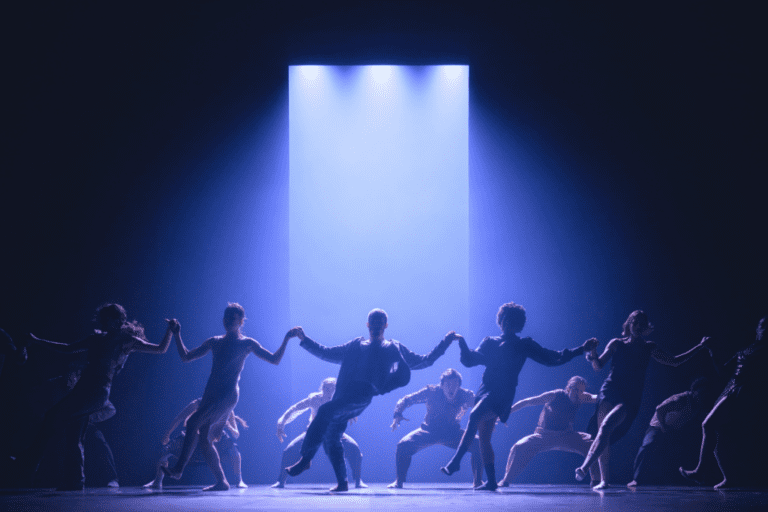
It’s tough to tie Shechter’s style to any one dance lineage, but modern floorwork; commonplace gestures rendered sharp and frenzied; and loose, hip-circling movements often reserved for low-lit clubs evoke the woozy surreality of half-revealed consciousness.
 iPhoto caption: Members of the company of 'Shucked.' Photo by Matthew Murphy and Evan Zimmerman.
REVIEW: Mirvish’s Shucked plants row after row of corny jokes
Shucked sits somewhere between a cartoon for adults and a wholesome farm musical.
 iPhoto caption: Siphesihle November in 'Flight Pattern.' Photo by Karolina Kuras.
Serge Lifar’s Suite en Blanc came out of the Second World War; Crystal Pite’s Flight Pattern emerges from the world of wars we live in today. The double bill might be asking: What role, if any, should dance play in times of crisis?
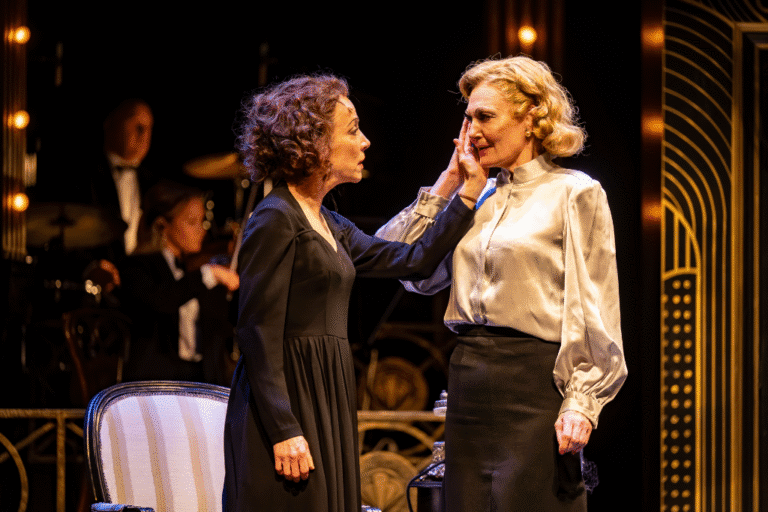 iPhoto caption: Deborah Hay and Terra C. MacLeod in 'Piaf/Dietrich.' Photo by Dahlia Katz.
The Grand Theatre’s music-infused Piaf/Dietrich considers fame, friendship, and desire
“The extremes of both characters gives us a lot to consider and experience for how to live," says director Rachel Peake. "Should we lead with passion or precision? It’s sort of a no-brainer that happiness lies somewhere in the middle."
Comments