
REVIEW: Heroes of the Fourth Turning is a breeding ground for hate, hellfire, and damn good theatre
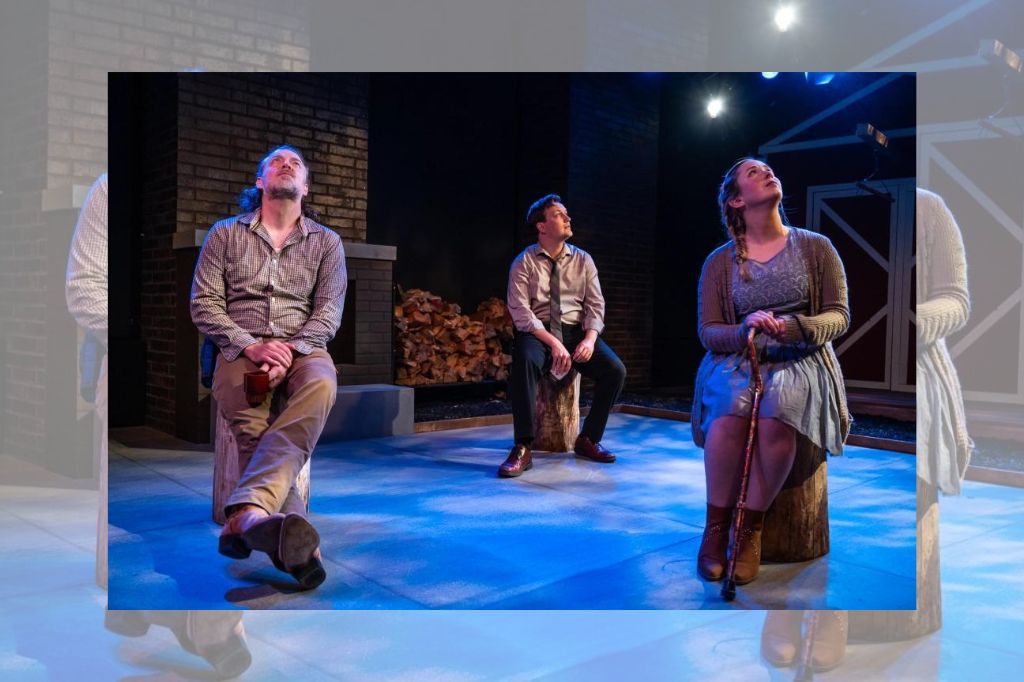 iPhoto caption: Photo by Dahlia Katz.
“What was that ungodly screech?”
Sure, that quote has roots in Come From Away, where the “screech” in question is bad Jamaican rum.
But in Heroes of the Fourth Turning, Will Arbery’s provocative diatribe on conservatism and the white American Christians holding it up, that ungodly screech is literal, a piercing, doomish squeal that quickly disappears into the vast Wyoming sky. Thirty-eight-year-old Justin, in cowboy boots and a well-worn flannel, tells his party guests that the sound comes from a failing generator behind his home. But in fact, it’s a much darker symptom of a world on the cusp of war – it’s not so much a screech as it is a battle cry.
Not much is comfortable about Philip Akin’s stirring production of Heroes of the Fourth Turning – the wail of Justin’s not-generator, too loud and yet perfect in the small studio space at Crow’s Theatre, is but one of the tools the play uses to disarm its audience. Real (or real-looking) vomit leaking from the mouths of actors just inches away from the first row of seats is another. The intermission-less, two-hour runtime is still another.
No, Heroes of the Fourth Turning is not a comfortable watch.
But Akin’s cast and Arbery’s Pulitzer-shortlisted words make magic of the end of the world, milking humour from some of the most dire politicking of modern-day America. Arbery writes from a sharp, specific vantage point – more on that in a moment – and while the protagonists of Heroes of the Fourth Turning blaze in shades of red, white, and blue, Akin has mined the play’s human drama for shreds of connection to a Toronto audience. People aren’t evil, Arbery posits and Akin affirms — they’re wrong, and they’re scared, and they’re angry, but they’re infrequently malevolent without reason.
The story: it’s 2017, and America is reeling from the recent, real-life white supremacist attack in Charlottesville. We’re in the prairies, where Dr. Gina, as her former students call her, has just been named president of the fictional Transfiguration College of Wyoming. It’s the after-party of Gina’s ceremony, and we’re catching up with four old friends at Justin’s house. There’s Teresa, the ultra-Trump blogger who makes a habit of ensnaring people in debates they won’t win, and Kevin, the depressed fuck-up (or “soyboy,” as Teresa calls him) who lives in Oklahoma and works for a Catholic textbook company. Then there’s Gina’s daughter, Emily, whose unnamed physical disability frequently propels her into the gentle arms of Justin, whose ranch’s generator just won’t stop screaming.
The college described in Heroes of the Fourth Turning is… a little extreme. Courses on outdoorsmanship are mandatory, as are Latin language classes and frequent philosophy seminars. As much time is spent on local mountains as on academics; it’s an improbably small, off-the-grid school that’s preparing its students for a life on the frontline of Catholicism, defending the world from abortions and trans people.
The kicker: that school, or one very much like it, exists. It’s a tiny outpost in Lander, Wyoming called Wyoming Catholic College. And until 2023 it was run by, drumroll please, Arbery’s parents. You don’t need to be aware of the metatheatrical intrigue of the play for it to pack a punch – the work’s tiptoeing around sociopolitical rabbit holes is masterful in its own right – but the connection between the playwright and the deeply troubling, conservative world he has penned is fascinating, and hard to ignore once you know about it. There’s a specificity to Heroes of the Fourth Turning that makes the frequently unsavoury opinions of these frequently unsavoury people feel intimate and dangerous, as if any minute Justin’s ranch might implode under the weight of an unforgiving God – or playwright.
Bringing this corps of Catholic soldiers to life is a knockout group of actors. Mac Fyfe’s Justin is a reserved, funny antidote to Ruth Goodwin’s conniving, snarling Teresa. Cameron Laurie is an unappealing yet sympathetic Kevin, with no career (or girlfriend) prospects to speak of. Maria Ricossa is terrifying as Gina, and superbly cast – the performance is (nearly) good enough to ignore that Ricossa called for a line mid-monologue on opening night.
But it’s Hallie Seline’s Emily who captures the bleeding, breaking hearts of our so-called “heroes,” or the generation of young people who will conquer the left and its identity politics (or so says Teresa). Emily’s capacity to love is unrelenting, and yet so is her tolerance for darkness and pain. It’s a wickedly good performance that veers into the sublime in the play’s final breaths.
Heroes of the Fourth Turning is no easy watch – I certainly wouldn’t recommend it for date night. Some audiences might yearn for the gentler, more amusing politics of Michael Healey’s Master Plan, playing in easier-to-swallow layers right next door.
But Akin has massaged Arbery’s semi-autobiographical time bomb of a play into something subtle and gorgeous inside the Crow’s Theatre studio. You’re unlikely to see anything else like it in Toronto — unflinchingly hateful, right-wing rhetoric is seldom treated with such curiosity and candour, as Akin has done here — and it would be a mistake to miss it.
Heroes of the Fourth Turning, produced by The Howland Company and Crow’s Theatre, runs at Crow’s Theatre until October 29. Tickets are available here.
Intermission reviews are independent and unrelated to Intermission’s partnered content. Learn more about Intermission’s partnership model here.
Aisling Murphy
Aisling is Intermission's former senior editor and the theatre reporter for the Globe and Mail. She likes British playwright Sarah Kane, most songs by Taylor Swift, and her cats, Fig and June. She was a 2024 fellow at the National Critics Institute in Waterford, CT.
LEARN MORE iPhoto caption: Photo by Aisling Murphy.
In the darkest months of Yukon winter, it’s all about the Sun Room
I’m here for a week in January as a guest of Nakai Theatre, a hub for theatrical experimentation and outside-the-box programming in Canada’s westernmost territory.

Armchairs, tattoos, and an online theatre magazine
When I started at Intermission, my world was limited to the confines of an armchair. Arts journalism was a high it felt dangerously fruitless to chase. The life stretched ahead of me was amorphous and frightening, a chasm filled with hand sanitizer and immigration concerns. It was worth crying over a spilled kombucha and scrubbing at the stain.
 iPhoto caption: Liz Appel headshot courtesy of Liz Appel.
Five questions with Wights playwright Liz Appel
Intermission spoke with Appel over email for a brief Q&A about Wights, now playing at Crow’s Theatre until February 9.

Call for applications: Publishing and editorial assistant
Intermission Magazine is seeking a dynamic and collaborative individual to join our team.
 iPhoto caption: What Writing Can Do: The 2025 Musical Theatre Critics Lab
Announcing What Writing Can Do: The 2025 Musical Theatre Critics Lab
What Writing Can Do is timed to coincide with the Grand and Theatre Aquarius’ co-production of Waitress, which will serve as a jumping-off point for discussions throughout the Lab.
 iPhoto caption: A Christmas Story production still by Dahlia Katz.
REVIEW: A Christmas Story feels fresh at Theatre Aquarius
If you want to catch A Christmas Story before it closes, good luck — the show is close to sold out, and with the talent on that stage, it’s not hard to see why.
Comments